
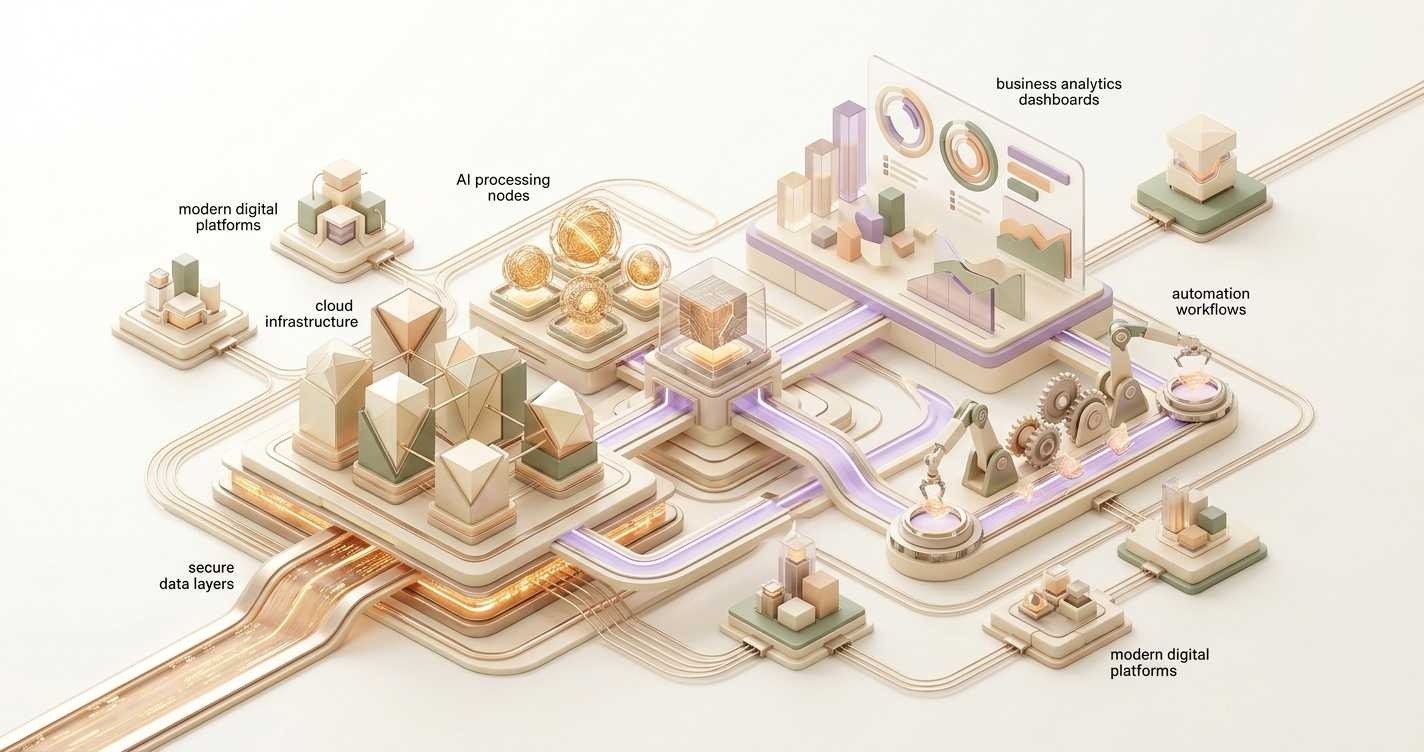
Businesses today use dozens of digital tools, yet disconnected systems can still slow down growth, waste data, and create poor customer experiences. A Digital Business Technology Platform solves this gap by bringing applications, data, cloud services, AI, IoT, and business processes into a connected digital ecosystem. But what exactly makes these platforms different from ordinary business software? This guide explores how they work, the technologies behind them, their real-world benefits, and how modern businesses can build a smarter, more scalable digital foundation in 2026.
What Is a Digital Business Technology Platform?
A Digital Business Technology Platform is an integrated technology environment that connects a company’s applications, data, devices, users, and external services so they can work together as one digital ecosystem. Instead of treating CRM, ERP, cloud services, analytics tools, IoT devices, and customer applications as isolated systems, a digital business platform creates an architecture that allows them to exchange information and support business processes more efficiently.
The idea is broader than simply buying one piece of software. Gartner-related research describes a digital business technology platform as a combination of technologies that enables an organization to deliver digital business capabilities. BMC’s explanation similarly emphasizes an intentional, service-oriented setup rather than a collection of disconnected legacy and SaaS applications.
At its core, the platform acts as a coordination layer between technology and business operations. It can connect information systems, customer-facing applications, data and analytics, Internet of Things (IoT) devices, and external partner ecosystems. These areas allow organizations to collect information, understand what is happening, and respond through digital workflows.
For example, imagine an online retailer receiving thousands of customer interactions every hour. Its enterprise digital platform could connect the website, payment system, inventory database, CRM, analytics engine, and warehouse technology. When inventory falls below a defined level, data can move between these systems automatically rather than requiring an employee to manually check each application.
This is where a digital transformation platform becomes valuable. The goal is not technology for its own sake. The objective is to make business processes more connected, responsive, scalable, and data-driven.
A strong digital business platform architecture can also support modern development approaches such as APIs, microservices, event-driven applications, cloud services, machine learning, and edge computing.
In simple terms: a Digital Business Technology Platform gives a business the connected technology foundation it needs to sense changes, process information, make better decisions, and deliver digital services faster.
How Does a Digital Business Technology Platform Work?
A Digital Business Technology Platform works by connecting different technology layers and allowing information to move between them. Rather than forcing every department to operate inside separate systems, the platform creates an integrated environment where applications, data sources, devices, users, and external partners can communicate.
The process usually begins with data collection. Information may come from an ERP system, CRM application, website, mobile app, database, employee system, connected device, or external business partner. IoT devices can also continuously generate real-time information from physical environments.
The next stage is integration. APIs, messaging systems, event-driven architecture, and other integration technologies allow different applications to exchange information. This is one of the most important characteristics of a modern digital technology platform because businesses rarely operate with a single application or vendor. O’Reilly’s enterprise architecture discussion specifically highlights pervasive integration across on-premises systems, cloud applications, mobile applications, partners, and IoT devices.
After integration comes processing and analysis. Data can be filtered, combined, enriched, or analyzed using analytics and AI/ML technologies. Instead of simply storing information, the platform can help identify patterns, unusual activity, customer behavior, operational problems, or opportunities.
The final stage is action.
For example:
Customer places order → Platform receives event → Inventory is checked → Payment is verified → Warehouse receives instruction → Customer receives update.
No single application has to perform the entire process. The digital business technology solutions work together through the platform.
This model can become even more powerful when event-driven architecture and edge computing are involved. Vantiq describes the platform as an orchestration layer capable of ingesting streaming data, analyzing it, and supporting real-time action.
A practical way to understand the workflow is:
| Stage | What Happens | Example |
| Connect | Systems and devices communicate | API connects CRM with ERP |
| Collect | Data enters the platform | Customer order received |
| Analyze | Data is processed | AI detects demand pattern |
| Decide | Rules or models determine action | Stock replenishment triggered |
| Act | Connected systems respond | Warehouse receives request |
| Learn | Results create new insights | Forecast improves over time |
This is why a modern digital business platform strategy focuses on more than integration alone. It creates an environment where connected systems can continuously support business decisions and workflows.
Key Components of a Digital Business Technology Platform
A successful Digital Business Technology Platform is not built around one technology. It combines multiple capabilities that work together to support digital operations. Gartner-related frameworks commonly identify five major areas: information systems, customer experience, data and analytics, IoT, and ecosystems.
1. Information Systems
These include core business applications such as ERP, CRM, HR systems, finance software, supply-chain platforms, and operational databases. They contain much of the information businesses already depend on.
A good enterprise digital platform does not necessarily require replacing these systems. Instead, it can connect them through APIs and integration services so their existing capabilities become part of a wider digital ecosystem.
2. Customer Experience
Customer-facing channels are another major component. Websites, mobile applications, portals, e-commerce systems, chatbots, and digital service platforms can connect with back-end systems to create more consistent experiences.
For example, when a customer updates information through an online portal, the change can automatically flow into relevant CRM and operational systems.
3. Data and Analytics
Data is the decision-making layer of a modern digital business technology platform. Data pipelines, analytics tools, dashboards, data warehouses, and machine learning models can transform raw information into useful business insights.
This allows companies to move from simply collecting data to using it for forecasting, optimization, personalization, and automation.
4. Internet of Things
IoT extends the digital platform technologies beyond software and into the physical world. Sensors and connected devices can report information about machines, products, vehicles, buildings, or environmental conditions.
BMC notes that IoT can connect physical assets with operational systems for monitoring, optimization, control, and integration.
5. Partner Ecosystems
Modern businesses rarely operate alone. Suppliers, marketplaces, payment providers, developers, distributors, and other partners may need controlled access to business capabilities.
APIs and ecosystem technologies allow organizations to exchange services and information without exposing the entire internal infrastructure.
6. Integration and APIs
Integration is the glue holding everything together. APIs, event brokers, messaging systems, microservices, and integration platforms help different components communicate.
This is particularly important for businesses dealing with legacy applications alongside cloud-native services.
7. Cloud and Infrastructure
Cloud computing provides scalable infrastructure for applications, storage, analytics, and AI workloads. However, a digital business technology platform does not have to be entirely cloud-based. Modern architectures can combine cloud, on-premises infrastructure, and edge environments depending on business requirements.
Together, these components create a flexible digital business ecosystem rather than another isolated software stack.

How AI, Cloud, and IoT Power Digital Platforms
The modern Digital Business Technology Platform is becoming significantly more capable as AI, cloud computing, and IoT converge. These technologies solve different problems, but their real value appears when they operate together.
AI Turns Business Data Into Decisions
Artificial intelligence can analyze large volumes of structured and unstructured data, identify patterns, generate predictions, and automate selected decisions. Machine learning can support demand forecasting, fraud detection, customer personalization, predictive maintenance, and operational optimization.
The important distinction is that AI becomes more useful when it has access to connected business data. An isolated AI model may produce an insight, but an integrated digital transformation platform can potentially connect that insight to an operational workflow.
For example, an AI model could predict that a machine is likely to fail. The platform can then connect that prediction with the maintenance system, create a task, notify the responsible team, and update the operational record.
Cloud Provides Scale and Flexibility
Cloud computing gives organizations flexible access to computing resources, storage, applications, and specialized services. Cloud-native architectures can also support APIs, containers, microservices, and distributed applications.
This makes cloud an important part of many digital platform technologies, particularly for businesses that need to scale applications or launch new digital services quickly.
Modern platforms can also use hybrid approaches, combining cloud services with on-premises systems and edge environments.
IoT Connects the Physical World
IoT supplies real-world data that traditional business applications may not capture. Sensors can monitor equipment, vehicles, buildings, inventory, energy consumption, or environmental conditions.
Consider a manufacturing company. Sensors detect abnormal machine vibration, IoT infrastructure sends the information to the platform, analytics identifies a potential failure, and AI estimates the risk. The platform can then trigger a maintenance workflow before the machine stops.
That creates a simple but powerful chain:
IoT senses → Cloud processes → AI analyzes → Platform decides → Business acts
Vantiq specifically highlights the importance of processing streaming IoT data and taking real-time action, while O’Reilly describes modern digital platforms as extending traditional integration into cloud, edge, IoT, microservices, event-driven architecture, and machine learning.
Why the Combination Matters
AI without connected data has limited context.
IoT without analytics produces enormous amounts of raw information.
Cloud without an effective architecture can simply become another infrastructure layer.
Together, they can create a more responsive digital business ecosystem capable of continuous data collection, analysis, automation, and action.
This is also where the 2026 perspective becomes important: Gartner’s current software-engineering material continues to position AI, cloud, security, and related capabilities as important considerations for organizations developing digital business technology platforms.
Key Benefits for Modern Digital Businesses
A well-designed Digital Business Technology Platform can change how a company operates, not simply how it uses software. The biggest advantage comes from connecting systems that previously worked in isolation. When business applications, data, employees, customers, devices, and partners can communicate through a shared architecture, organizations can respond faster and make better use of their existing technology.
Faster and More Connected Operations
Traditional businesses often rely on multiple applications that do not communicate smoothly. Employees may copy information between systems, wait for reports, or manually trigger routine processes. A digital business platform can reduce this friction through APIs, workflow automation, event-driven architecture, and integrated applications.
For example, when a customer submits an order, the platform can pass relevant information to payment processing, inventory, fulfillment, and customer-service systems without requiring someone to enter the same information repeatedly.
Better Data-Driven Decisions
A modern enterprise digital platform can bring information from CRM, ERP, websites, applications, IoT devices, and external sources into connected data workflows. Analytics tools can then transform this information into useful insights.
This matters because having more data does not automatically create better decisions. The real advantage comes from making relevant data available to the right system or person at the right time.
[Link to related article here: Data Analytics for Business]
Greater Scalability
Digital businesses need infrastructure that can grow with demand. Cloud services, microservices, APIs, and modular applications can allow individual capabilities to scale without rebuilding the entire technology stack.
This makes a digital transformation platform particularly useful for organizations expanding into new markets, launching digital products, or handling rapidly changing workloads.
Improved Customer Experience
Customer experience depends on what happens behind the interface as much as what customers see. A connected platform can synchronize customer information across websites, mobile applications, CRM systems, support channels, and transaction systems.
This can produce faster responses, more consistent interactions, and more personalized digital services.
More Innovation With Existing Systems
One of the strongest benefits is that companies do not always need to discard legacy technology. A carefully designed digital business platform architecture can expose useful capabilities from older systems through APIs and integration layers.
The result is a practical modernization path: preserve what still works while gradually introducing newer cloud, AI, automation, and analytics capabilities.
Stronger Business Agility
Markets change quickly. A modular digital technology platform allows organizations to introduce new capabilities without making every change dependent on a single large application.
In practical terms, this means the technology environment becomes easier to adapt as customer expectations, regulations, competitors, and business models change.
Digital Business Platform vs. Technology Platform
The terms digital business platform and digital technology platform are closely related, but they should not automatically be treated as identical. Understanding the difference helps explain why some organizations focus too heavily on technology while overlooking the business capabilities the technology is supposed to enable.
A digital business platform is generally broader. It focuses on enabling business activities through connected digital capabilities, including customers, employees, partners, data, applications, and business processes.
A digital technology platform, on the other hand, places greater emphasis on the underlying technical foundation. This can include cloud infrastructure, APIs, integration services, data platforms, microservices, security, AI infrastructure, and development tools.
The distinction becomes clearer when looking at the purpose behind each.
| Aspect | Digital Business Platform | Digital Technology Platform |
| Primary focus | Business capabilities | Technology capabilities |
| Main goal | Enable digital business models | Provide technical foundation |
| Key users | Business teams, customers, partners | Developers, IT teams, architects |
| Typical elements | Processes, services, ecosystems | APIs, cloud, data, infrastructure |
| Main outcome | Business value and agility | Scalability and technical enablement |
A Digital Business Technology Platform sits between these ideas. It provides the technology foundation while being designed around digital business requirements.
For instance, imagine a bank building a mobile lending service. The customer-facing application is part of the digital business experience. Behind it, APIs connect credit systems, customer databases, identity services, payment infrastructure, analytics, and AI models. That technical architecture supports the actual business capability: delivering faster digital lending.
This is why simply installing new technology does not automatically create digital transformation. The architecture must connect technology with measurable business outcomes.
Some industry analysis has even criticized the phrase “digital technology platform” when it is used to describe transformation too narrowly. The underlying point is important: technology is an enabler, not the final business objective
A strong digital business platform strategy therefore starts with questions such as:
- Which business capability needs improvement?
- What data is required?
- Which systems must communicate?
- What should be automated?
- Where can AI create measurable value?
- Which legacy systems should remain?
- How should security and governance be handled?
The technology comes after the business requirement is understood.
Also Read: Smart Digital Technologies Driving Future Business Innovation
Real-World Examples and Use Cases
The best way to understand a Digital Business Technology Platform is to see what happens when its capabilities are applied to real business problems. The architecture can look different across industries, but the basic principle remains the same: connect data, systems, people, devices, and applications so that useful actions can happen faster.
Manufacturing
Manufacturing is one of the clearest examples because physical equipment can generate continuous IoT data.
Sensors can monitor machine temperature, vibration, pressure, or energy consumption. That information can move through an enterprise digital platform, where analytics or AI identifies unusual patterns.
Suppose an AI model predicts that a machine may fail within the next few days. Instead of waiting for the equipment to stop, the platform can send information to the maintenance system, create a work order, notify technicians, and update operational records.
This turns raw IoT information into an actual business action.
Retail and E-Commerce
A retailer can connect its website, mobile application, CRM, inventory, payment systems, warehouse operations, and analytics tools through a digital business ecosystem.
When a customer purchases a product, the platform can update inventory, initiate fulfillment, record customer activity, and trigger personalized recommendations.
AI can take the process further by analyzing purchasing behavior and helping predict future demand.
Banking and Financial Services
Financial institutions handle huge volumes of transactions and customer information. A digital technology platform can connect customer applications with identity verification, transaction processing, fraud detection, risk systems, and analytics.
AI can identify suspicious transaction patterns, while automated workflows can route unusual activity for further review.
The important advantage is coordination. Instead of each system operating independently, relevant capabilities can work together.
Healthcare
Healthcare organizations can use connected platforms to bring together patient records, appointment systems, diagnostic equipment, monitoring devices, and analytics.
IoT-enabled devices can provide real-time patient or equipment information, while cloud and analytics infrastructure can help authorized professionals access and interpret data more efficiently.
Security, privacy, access control, and regulatory compliance are especially important in this environment.
Logistics and Transportation
Fleet-management systems, GPS devices, warehouse platforms, customer applications, and analytics can form a connected digital business platform.
For example, vehicle location data can be combined with traffic information and delivery schedules. Analytics can identify potential delays, while automated workflows can update customers and adjust operational plans.
A Common Pattern Across Industries
Although the use cases differ, the underlying model is surprisingly similar:
Data Source → Integration → Processing → AI/Analytics → Decision → Automated Action
That pattern is one reason digital platform technologies are becoming central to modern digital transformation strategies. Instead of using technology merely to digitize individual tasks, businesses can connect entire workflows.
How to Build a Digital Business Technology Platform
Building a Digital Business Technology Platform should not begin with randomly selecting cloud services, AI tools, or integration software. The strongest approach starts with business requirements and then builds the technical architecture around them.
Step 1: Identify the Business Problem
Start by identifying what needs to improve.
Is the company struggling with disconnected systems, slow decision-making, poor customer experience, manual processes, data silos, or limited scalability?
A clear business problem gives the platform a measurable purpose.
Step 2: Map Existing Systems
Create an inventory of current applications, databases, APIs, infrastructure, workflows, and data sources.
This step is particularly important for organizations with legacy systems. A good digital business platform architecture should identify which technologies should be retained, integrated, modernized, or eventually replaced.
Step 3: Design the Integration Layer
Next, determine how systems will communicate.
APIs, event brokers, messaging systems, integration platforms, and microservices can provide the communication layer between applications.
Avoid creating unnecessary point-to-point connections. A poorly designed integration network can become difficult to maintain as the company grows.

Step 4: Establish the Data Architecture
Decide where business data will come from, how it will move, where it will be stored, and who can access it.
Data governance should cover:
- Data quality
- Ownership
- Access controls
- Privacy
- Security
- Retention
- Compliance
A platform without reliable data can produce fast but unreliable decisions.
Step 5: Add Cloud, AI, and Automation Where They Create Value
Cloud computing can provide scalable infrastructure. AI can support prediction, classification, personalization, and intelligent automation. Workflow automation can reduce repetitive manual tasks.
However, not every process needs AI. A simple rule-based workflow can sometimes be more reliable and cheaper than a complex machine-learning model.
Step 6: Connect IoT and Edge Systems When Needed
For physical operations, IoT devices can provide real-time information. Edge computing can process selected data closer to where it is generated, which can be useful when latency, bandwidth, or operational continuity matters.
This creates a more responsive digital business ecosystem.
Step 7: Build Security Into the Architecture
Security should not be added at the end.
Identity management, encryption, API security, network controls, monitoring, vulnerability management, and appropriate access policies should be considered throughout the architecture.
Step 8: Start Small and Scale
A common mistake is attempting to transform every business system simultaneously.
A better approach is to select one high-value use case, build a measurable solution, evaluate its results, and then expand.
For example:
Customer problem → Pilot integration → Measure outcome → Improve architecture → Expand to additional workflows
This approach reduces unnecessary complexity while creating practical evidence that the digital business technology solutions are delivering value.
A Practical Architecture Model
A simplified modern architecture can look like this:
Users & Devices
↓
Digital Applications & Channels
↓
APIs & Integration Layer
↓
Business Applications & Microservices
↓
Data + Analytics + AI
↓
Cloud / On-Premises / Edge Infrastructure
Security and governance should operate across every layer.
The goal is not to build the most complicated platform possible. The goal is to create a scalable, secure, integrated, and business-focused technology foundation that can evolve as the organization grows.