

Technology is moving faster than ever, but having a great product is no longer enough to win customers. From AI startups and SaaS platforms to cybersecurity firms and software companies, every technology brand is competing for attention online. This is where digital marketing for technology companies becomes a powerful growth engine.
In 2026, buyers are smarter, search behavior is changing, and competition is tougher. People do not simply want to see a product advertisement—they want useful information, proof, trust, and a reason to choose one company over another. The right digital marketing strategy can help technology businesses attract qualified traffic, build authority, generate leads, and turn visitors into loyal customers.
Whether you are launching a new tech startup or growing an established technology brand, this guide will show you the key strategies, channels, trends, and practical tactics you need to compete and grow in today’s digital-first market.
What Is Digital Marketing for Technology Companies?
Digital Marketing for Technology Companies is the use of online channels, content, search, paid campaigns, social platforms, websites, and analytics to help technology businesses reach the right audience and guide them through the buying journey. It is especially important for SaaS, software, IT, AI, cybersecurity, cloud, and other B2B technology businesses with complex products.
Unlike consumer marketing, technology marketing often involves people who want to understand a product before they trust it. A developer may examine technical documentation, an IT manager may compare features, and a business leader may focus on cost, security, or return on investment. One marketing message rarely satisfies all of them.
That is why digital marketing for tech companies needs to connect education with decision-making. Helpful guides, comparison pages, product explainers, case studies, videos, webinars, and technical resources can answer questions before a prospect ever contacts a sales team.
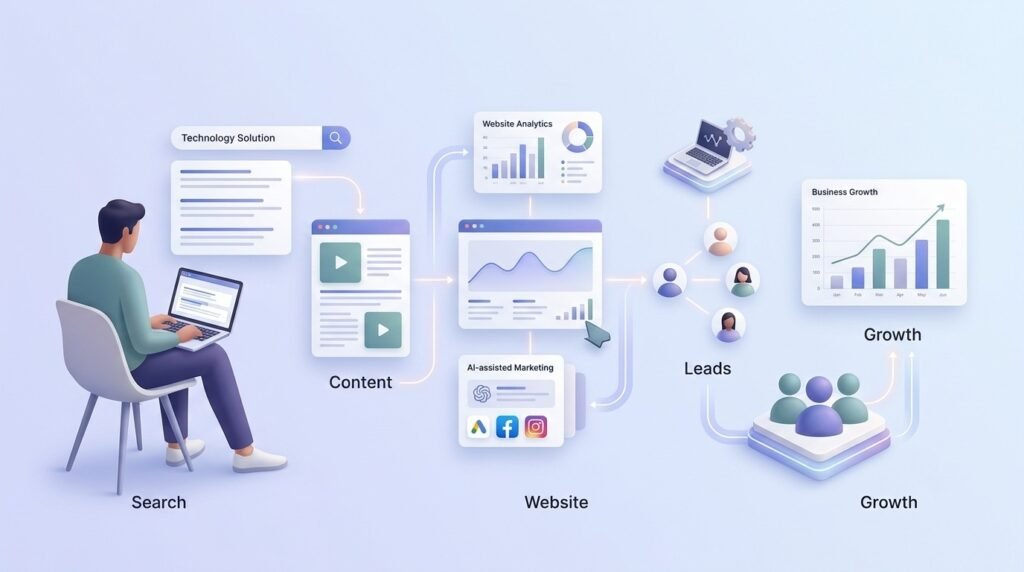
A strong technology company marketing strategy also considers the entire customer journey. Someone may first discover a company through Google, return through LinkedIn, read a technical article, compare alternatives, and finally request a demo. Each interaction can influence the final decision.
The most effective approach combines several channels rather than depending on one source of traffic.
| Marketing area | Main purpose |
| SEO | Capture relevant organic searches |
| Content marketing | Explain problems and solutions |
| Reach professional and B2B audiences | |
| Paid search | Capture high-intent demand |
| Nurture interested prospects | |
| Analytics | Understand performance and user behavior |
For technology companies, the goal is not simply to attract more visitors. It is to attract relevant visitors who have a genuine problem, fit the target market, and are likely to continue researching the solution.
This makes digital marketing a long-term visibility and education system rather than a collection of disconnected promotional activities.
Why Digital Marketing Matters for Tech Companies
Technology markets are crowded. A company can build an excellent product and still struggle to get discovered if potential customers cannot find useful information about it. This is where digital marketing for technology companies becomes strategically important.
One major advantage is visibility during the research stage. Technology buyers often investigate solutions before speaking with a salesperson. They search for problems, features, comparisons, integrations, alternatives, implementation advice, and industry-specific solutions. A company that provides useful answers can enter the conversation much earlier.
Another benefit is trust. Technical buyers are usually skeptical of exaggerated claims. Detailed guides, original research, transparent comparisons, documentation, customer examples, and expert commentary give people evidence instead of empty marketing language.
SEO is particularly valuable because it can connect a technology company with people already searching for relevant solutions. However, SEO for technology companies should not focus only on high-volume keywords. Lower-volume queries can be highly valuable when they represent a specific problem or buying need.
For example, a generic search such as “project management” may attract a huge audience. A more specific search such as “project management software for software development teams” may attract fewer people but provide much stronger relevance.
Content also plays a critical role. Content marketing for technology companies can cover:
- Educational guides
- Product use cases
- Comparison articles
- Integration guides
- Technical documentation
- Industry reports
- Case studies
- Frequently asked questions
A good B2B technology marketing strategy connects these resources to different stages of the buying journey.
The real value is relevance
Technology companies do not necessarily need massive traffic. They need the right traffic. Fifty visitors who closely match the ideal customer profile can be more valuable than thousands of visitors with no connection to the product.
This is why modern digital marketing strategy for tech companies should be measured through meaningful actions such as qualified leads, demo requests, trials, engagement, assisted conversions, and eventually revenue—not pageviews alone.
How to Build a Digital Marketing Strategy for Tech
A successful digital marketing strategy for tech companies starts with understanding the audience before choosing channels. Technology businesses often serve several decision-makers, so the strategy should identify who searches for the problem, who evaluates the product, who approves the purchase, and who eventually uses it.
1. Define the ideal customer
Start by identifying the industries, company sizes, locations, job roles, technical requirements, and problems that matter most. A cybersecurity company, for example, may need separate messaging for security engineers, IT leaders, and executives.
2. Map the buyer journey
Organize topics around awareness, evaluation, and decision-making.
At the awareness stage, people may search for solutions to a problem. During evaluation, they may compare products or investigate features. Near the decision stage, they may search for pricing, alternatives, integrations, implementation details, or reviews.
This creates a more useful technology company marketing strategy than publishing random blog topics.
3. Research search demand
Keyword research should include broad topics, long-tail questions, commercial-intent searches, comparison queries, and use cases.
For example:
Problem → Solution → Category → Comparison → Product
This structure helps a digital marketing for software companies strategy cover the entire research journey.
4. Build useful content
Create content that demonstrates genuine expertise. A software company can publish implementation guides, feature comparisons, integration tutorials, troubleshooting resources, and real-world use cases.
Current technology SEO guidance increasingly emphasizes product-aware content rather than generic articles created only to capture search traffic.
5. Optimize the website
Make important product, solution, documentation, and content pages easy to crawl and understand. Clear navigation, internal links, fast loading, mobile usability, structured data, and strong information architecture all support search visibility.
6. Distribute and measure
SEO can build long-term organic visibility, while LinkedIn, email, webinars, paid search, and other channels can support discovery and nurturing.
Finally, connect analytics with meaningful outcomes. Track which pages and channels contribute to qualified actions instead of judging success only by traffic.
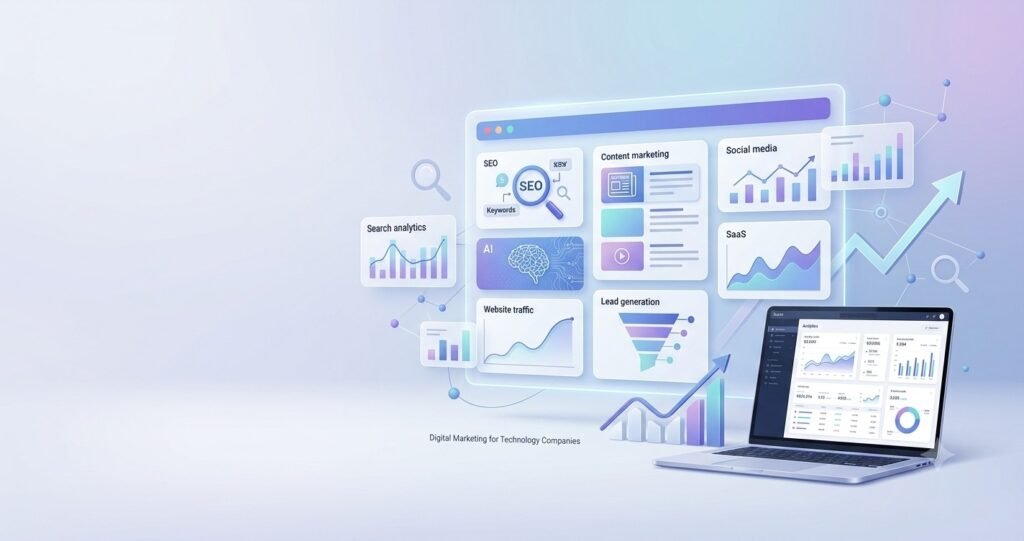
SEO Strategies for Technology Companies
SEO for technology companies requires more than inserting keywords into blog posts. Technology websites often contain complex products, documentation, integrations, multiple audiences, and highly technical terminology. The SEO strategy needs to make all of this understandable to both search engines and users.
Start with search intent
A strong technology company SEO strategy begins by understanding why someone searches for a particular phrase. Educational queries need educational content. Comparison searches need clear comparisons. Product or solution searches need focused landing pages.
Do not force every keyword into a blog article. Create the page format that best answers the query.
Build topic clusters
Instead of publishing unrelated posts, organize content around important technology topics.
For example, a cloud platform could create a central guide about cloud migration and support it with articles covering migration planning, security, cost optimization, infrastructure assessment, and common migration problems.
This creates stronger topical relationships and gives search engines clearer context.
Target high-intent long-tail queries
Large technology keywords can be extremely competitive. Specific queries often provide a better starting point.
Examples include:
- software for remote development teams
- cloud security for small businesses
- CRM integration with accounting software
- cybersecurity solutions for healthcare
- API monitoring tools for developers
These queries may have lower search volume, but their specificity can indicate stronger relevance.
Strengthen technical SEO
Technical foundations remain essential. Current technology SEO guidance highlights crawlability, Core Web Vitals, mobile performance, structured data, JavaScript handling, canonicalization, and clean site architecture as important areas for technology websites.
Create content experts would actually trust
Generic AI-style explanations are unlikely to differentiate a technology brand. Better content uses product knowledge, original examples, expert opinions, customer questions, technical explanations, and evidence.
Comparison pages, use-case pages, documentation, and problem-solving guides can be especially useful because technology buyers frequently research before making a decision.
Build authority beyond your website
Technical SEO alone does not guarantee strong rankings in competitive technology markets. Digital PR, industry publications, relevant partnerships, expert contributions, and genuinely useful research can help build external authority.
The strongest B2B tech marketing strategies therefore combine technical SEO, useful content, internal linking, search-intent targeting, and credible external signals.
Digital Marketing for IT Companies
Digital marketing for IT companies has to communicate technical value without making the message difficult for non-technical decision-makers. IT businesses often sell services such as managed IT, cloud infrastructure, cybersecurity, software development, consulting, and system integration. Each service can have a different audience and buying journey.
A strong strategy starts with identifying the problems potential customers are already searching for. Instead of creating content around broad terms such as “IT services,” an IT company can target specific needs such as cloud migration, network security, managed infrastructure, or software integration.
Search visibility is only one part of the process. The website should also make it easy for visitors to understand what the company does, which industries it serves, and what outcomes its solutions can provide. Service pages, technical guides, case studies, FAQs, and comparison content can work together to answer questions at different stages of research.
For example, an IT security company could publish a guide explaining common security risks, followed by a deeper article about endpoint protection and then a solution page explaining how its approach addresses those risks. This creates a logical path from education to evaluation.
The best digital marketing for technology companies programs follow the same principle: create useful information around real customer problems, then connect that information to relevant solutions.
Digital Marketing for Software Companies
Digital marketing for software companies requires a strong balance between product education and search visibility. Software can be difficult to explain through a short sales message, particularly when it includes advanced features, integrations, automation, APIs, or specialized workflows.
Content should therefore demonstrate how the product works in real situations. Feature pages can explain individual capabilities, while use-case pages can show how those capabilities solve specific business problems. Comparison articles can help users understand differences between approaches, while tutorials can demonstrate practical implementation.
Software companies can also benefit from targeting searches based on alternatives, integrations, industries, and workflows. For example, instead of focusing only on “CRM software,” a company might create useful resources around CRM integration, CRM for specific industries, or ways to automate a particular sales process.
Another important consideration is the difference between visitors and qualified prospects. A large amount of generic traffic may not contribute much business value. A smaller audience searching for a specific software solution can be far more relevant.
This is where digital marketing for technology companies becomes more strategic. SEO, product content, email nurturing, social distribution, and conversion-focused landing pages should support the same customer journey rather than operate independently.
For SaaS and software brands, the strongest content usually answers a question, demonstrates expertise, and gives the reader a clear understanding of what to do next.
SEO for Technology Companies
SEO for technology companies is the process of improving a technology brand’s visibility for searches that matter to its target audience. It combines technical optimization, keyword research, useful content, internal linking, site architecture, and authority-building activities.
Technology websites often face a unique SEO challenge: their products can be highly technical, but their buyers may not use technical language when describing their problems. Effective keyword research must therefore consider both industry terminology and the language customers actually use.
A useful keyword map can include four layers:
| Keyword type | Example purpose |
| Informational | Learn about a problem |
| Solution-based | Explore possible solutions |
| Comparison | Evaluate alternatives |
| Commercial | Investigate a product or provider |
This structure helps prevent a common mistake: creating dozens of informational articles while neglecting pages that support product discovery and evaluation.
Technical SEO is equally important. Search engines need to crawl important pages efficiently, understand their relationships, and identify the preferred versions of URLs. Clean navigation, logical categories, descriptive titles, canonical tags, structured data where appropriate, mobile usability, and strong page performance all contribute to a healthier website.
Also Read: SEO/SEM Strategies for Better Digital Marketing in 2026
Current technology SEO guidance also emphasizes technical foundations such as crawlability, JavaScript handling, Core Web Vitals, structured data, and site architecture.
The goal of digital marketing for technology companies is not to rank for every possible technology term. It is to build search visibility around topics that connect directly with the company’s audience, expertise, and solutions.
Technology Company SEO Strategy
A technology company SEO strategy should begin with business goals and customer problems rather than a list of keywords. Once the ideal audience is understood, SEO can be organized around the questions and decisions that audience makes throughout the buying process.
Start by building topic groups around the company’s core products or services. Each group can contain a primary guide supported by more specific articles. Internal links should connect related pages so users can move naturally from broad information to detailed resources.
Long-tail searches are especially useful for technology brands. They may attract fewer searches than broad terms, but they often reveal a clearer need. A query about a particular integration, security problem, software workflow, or implementation challenge can indicate a highly relevant visitor.
Content quality should also be treated as an SEO asset. Technical explanations become more valuable when they include practical examples, screenshots, expert insights, original observations, or real implementation considerations. This helps differentiate useful resources from generic summaries.
A strong strategy should also monitor pages that receive impressions but few clicks. Improving titles and descriptions can sometimes unlock additional organic traffic without creating a new article. Similarly, pages ranking on the second page may be candidates for deeper content, stronger internal links, or better search-intent alignment.
For digital marketing for technology companies, SEO works best as an ongoing system: research, publish, measure, improve, and update.
A strong digital marketing strategy should also follow search engine best practices. Google’s SEO Starter Guide explains the fundamentals businesses can use to help search engines understand and discover their content.
Content Marketing for Technology Companies
Content marketing for technology companies is most effective when it helps potential customers understand complicated subjects and make better decisions. Instead of producing articles simply to fill a publishing calendar, technology brands can build content around customer questions, product use cases, industry challenges, and emerging trends.
Different content formats can serve different purposes. Beginner guides can introduce a topic, technical tutorials can help users solve problems, comparison pages can support evaluation, and case studies can demonstrate how a solution works in practice.
For example, an AI software company could create a foundational guide about AI automation, followed by articles covering specific workflows, implementation challenges, data security, integrations, and measurable business outcomes. These resources create a connected topic ecosystem rather than isolated blog posts.
Originality matters as well. Technology audiences can quickly recognize shallow content. Adding expert commentary, original examples, product knowledge, diagrams, research findings, or lessons from real-world implementation can make a resource significantly more useful.
Content should also be updated when technologies, standards, software interfaces, or industry practices change. A technically accurate article that becomes outdated can lose both trust and search relevance.
The strongest digital marketing for technology companies strategies use content to support the entire journey—from the first question to product evaluation and continued customer education.
B2B Tech Marketing Strategies
B2B tech marketing strategies need to account for longer buying cycles, multiple stakeholders, and complex purchasing decisions. A developer, department manager, procurement team, and executive may all evaluate the same technology from different perspectives.
That makes audience segmentation essential. Content for technical users can focus on implementation, integrations, security, and performance. Content for executives can focus more on business outcomes, risk, efficiency, and return on investment.
Account-Based Marketing (ABM) can complement SEO and content by focusing marketing activity on specific high-value companies or customer segments. LinkedIn can help reach professional audiences, while webinars, newsletters, research reports, and industry content can support ongoing engagement.
Paid search also has a role, particularly when a company wants visibility for high-intent searches. However, paid traffic should lead to relevant landing pages rather than generic homepages. The message on the advertisement, landing page, and supporting content should align closely with the user’s intent.
Measurement is another major part of B2B technology marketing. Traffic can show whether visibility is growing, but metrics such as qualified leads, engagement with solution pages, demo requests, trials, pipeline contribution, and customer acquisition provide deeper insight.
A practical digital marketing for technology companies framework therefore combines:
- Search visibility for existing demand
- Content for education and authority
- LinkedIn and ABM for targeted reach
- Paid campaigns for high-intent opportunities
- Email for lead nurturing
- Analytics for continuous improvement
The strongest B2B tech marketing strategies do not treat these channels as separate campaigns. They connect them into one coherent buyer journey.