
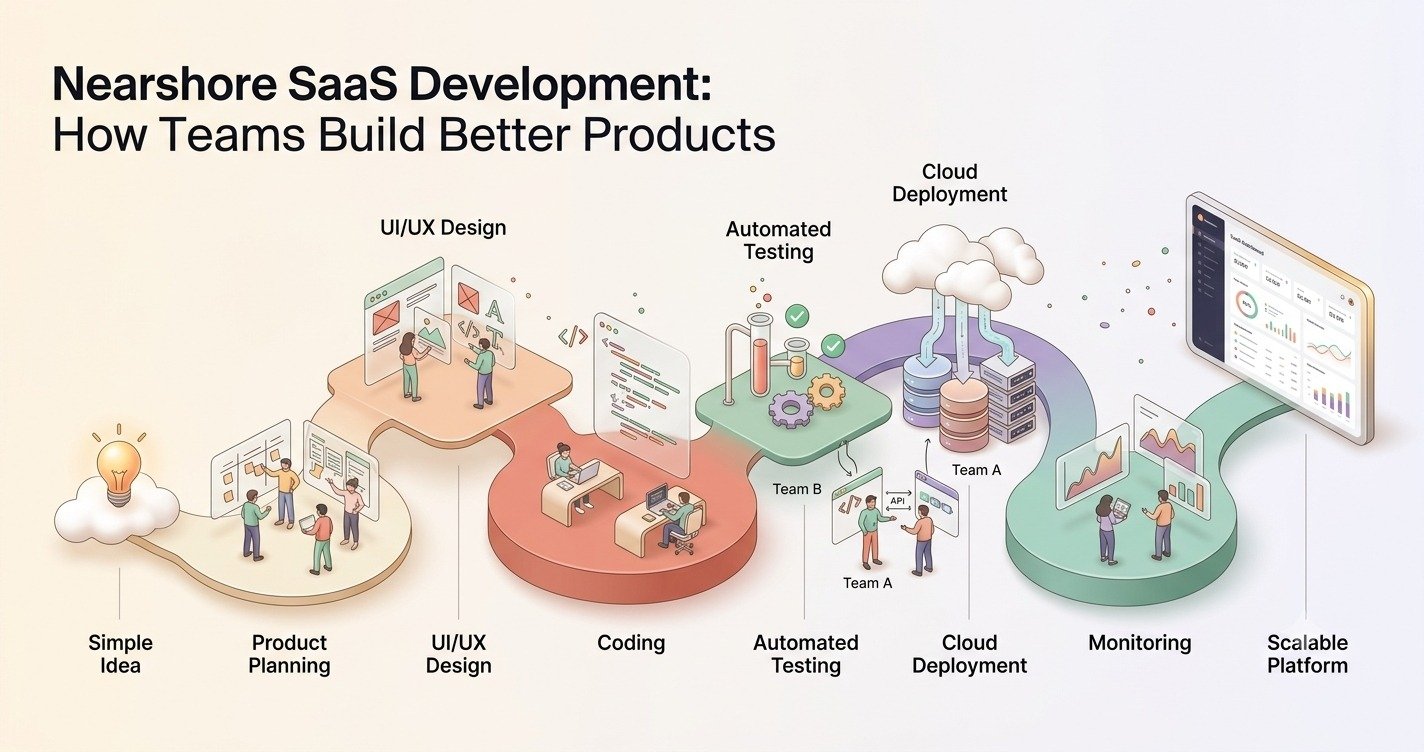
Building a SaaS product is no longer just about writing code and launching an application. Modern SaaS teams need to move quickly, respond to user feedback, maintain reliable infrastructure, and keep improving the product after launch. Nearshore SaaS development offers a practical way to extend engineering capacity while keeping teams closer in working hours and communication. Instead of managing a distant development process with long response gaps, businesses can work with nearby software teams that collaborate more closely with their product and engineering workflows.
The real advantage goes beyond geographic proximity. A well-structured nearshore team can contribute across product development, UI/UX, quality assurance, cloud infrastructure, DevOps, security, and ongoing maintenance. This makes the model relevant for startups building an MVP as well as established SaaS companies expanding an existing platform. Understanding how nearshore teams operate, what they cost, which development model fits different situations, and where potential challenges arise can help businesses make a more informed technology decision.
What Is Nearshore SaaS Development?
Nearshore SaaS development is a software delivery model in which a SaaS company works with developers or a development team located in a nearby country or region, usually with substantial working-hour overlap. The goal is to combine access to external engineering talent with easier communication, faster feedback, and lower operational friction than a distant outsourcing setup.
The word nearshore is primarily about geography and working hours, not a guarantee of quality. A US company, for example, may work with a team in Latin America, while a Western European business may use developers in Eastern Europe. The exact definition depends on the buyer’s location and the amount of practical time-zone overlap. Recent 2026 comparisons increasingly argue that the label itself matters less than how well the delivery model fits the product and team.
For SaaS products, that distinction matters because development rarely ends after the first release. Teams continuously work on feature requests, bug fixes, integrations, security patches, infrastructure, analytics, performance, and customer-driven improvements. A nearshore SaaS development team can therefore operate as an extension of an existing engineering organization rather than simply receiving a finished specification and returning code.
How Nearshore SaaS Development Differs From Basic Outsourcing
Traditional outsourcing can involve handing a defined project to an external provider and waiting for milestones. Nearshore SaaS development outsourcing can work differently when the external engineers participate directly in the product workflow.
A typical setup may include:
- Product managers defining priorities
- Developers building and reviewing features
- UI/UX specialists refining user flows
- QA engineers testing releases
- DevOps engineers managing deployment and infrastructure
- Technical leads maintaining architecture and engineering standards
This model is particularly useful when a SaaS product has an evolving roadmap. Instead of treating development as a one-time assignment, the team works through an ongoing software development lifecycle.
A Simple Example
Imagine a B2B SaaS company that has already launched its platform but needs to add a reporting dashboard, third-party integrations, automated testing, and new billing features.
Rather than hiring every specialist locally, the company could add a nearshore development team that works during overlapping business hours. Product managers can discuss requirements in real time, developers can clarify technical questions during the same workday, and QA can test completed features before the next release cycle.
That does not automatically make the project successful. Architecture, documentation, ownership, security, and engineering practices still determine the quality of the final product.
How Nearshore SaaS Teams Actually Work
A nearshore SaaS development team normally works inside a defined product and engineering process rather than operating as an isolated group. The practical difference comes from how responsibilities, communication, tools, and technical ownership are organized.
The first step is usually product discovery and scope definition. The company identifies what needs to be built, why the feature matters, which users it affects, and what technical constraints exist. This becomes a product backlog containing features, bugs, technical improvements, and infrastructure work.
Next comes technical planning. Developers and technical leads review architecture, APIs, databases, integrations, security requirements, and dependencies before implementation starts. For a SaaS application, this can also include decisions around multi-tenancy, authentication, authorization, cloud infrastructure, observability, and deployment.
The Typical Development Cycle
A practical nearshore SaaS workflow can look like this:
1. Product planning
Product owners prioritize requirements and define acceptance criteria.
2. Technical breakdown
Engineers divide features into manageable tasks and identify dependencies.
3. Development
Developers implement the feature through the team’s agreed coding and review process.
4. Code review and testing
Pull requests are reviewed, automated tests run, and QA checks the feature against requirements.
5. Deployment
The approved change moves through staging and production using the team’s CI/CD process.
6. Monitoring and feedback
Logs, performance metrics, error tracking, and user feedback reveal what needs improvement.
7. Iteration
The next sprint incorporates new requirements, fixes, and technical improvements.
This cycle is especially relevant to SaaS because releases are continuous. Current SaaS-focused sources emphasize frequent clarification, sprint planning, reviews, bug triage, and ongoing product work rather than treating the application as a project that simply ends at launch.
Common Nearshore Team Models
There is no single way to structure a nearshore team.
Staff augmentation adds individual engineers to an existing internal team. The company’s own product and engineering leaders usually retain day-to-day control.
Dedicated development team provides a stable group that works on the product over a longer period. This can include developers, QA, DevOps, and technical leadership.
Full-cycle development gives the external team broader responsibility across discovery, architecture, development, testing, deployment, and maintenance.
The right model depends on how much technical leadership already exists internally. Staff augmentation may make sense when a SaaS company has a mature engineering organization but lacks capacity. A dedicated team can be more appropriate when the company needs a stable product unit. Full-cycle development requires clearer governance because more technical decisions sit outside the internal organization.
Why Time-Zone Overlap Matters
Time-zone alignment is one of the most practical differences between nearshore and distant offshore development.
Suppose a product manager reports a production issue at 10 a.m. If the engineering team is working during roughly the same business hours, the issue can be discussed, investigated, fixed, tested, and potentially deployed within the same working day.
That does not mean every nearshore project automatically moves faster. Shared working hours reduce waiting time; they do not replace good engineering management.
Why SaaS Companies Choose Nearshore Teams
The strongest reason to consider a nearshore SaaS development team is not simply lower hourly rates. It is the combination of engineering capacity, collaboration, time-zone overlap, scalability, and access to specialized skills.
SaaS products create a particular development challenge: the roadmap keeps changing. Customer feedback may alter priorities, integrations can introduce unexpected technical work, and production issues can suddenly become urgent. A development model that creates long communication delays can therefore add friction to an already fast-moving product environment.
1. Faster Day-to-Day Collaboration
Nearshore teams can provide substantial working-hour overlap with the internal organization. That makes activities such as sprint planning, architecture discussions, pair programming, code reviews, and incident response easier to coordinate.
The benefit is not simply having meetings at convenient times. It is reducing the number of hours a developer or product manager spends waiting for clarification.
2. Access to Specialized Engineering Skills
A local hiring strategy limits the available talent pool to people willing and able to work in the company’s location.
Nearshore software development expands that pool geographically while maintaining relatively practical collaboration. Depending on the region, companies may find engineers experienced in:
- Cloud platforms
- DevOps
- Cybersecurity
- Data engineering
- AI integrations
- Mobile development
- Backend architecture
- Frontend frameworks
- QA automation
However, geography should never be treated as proof of technical quality. Recent industry comparisons emphasize that vendor capability, engineering controls, communication practices, and governance matter more than the geographic label itself.
3. Easier Scaling During Product Growth
A SaaS company may need two engineers during an MVP phase and a much larger engineering function after product-market fit.
Nearshore teams can provide a middle ground between repeatedly hiring locally and building a completely distant organization. The exact scaling mechanism depends on the engagement model.
For example:
| SaaS stage | Possible requirement | Suitable approach |
| MVP | Small engineering capacity | Small dedicated team |
| Early growth | More feature development | Dedicated team + specialists |
| Scaling | Multiple product streams | Several engineering squads |
| Mature SaaS | Capacity gaps | Staff augmentation or specialist teams |
4. Potentially Better Total Cost
Nearshore SaaS development cost should not be judged only by the developer’s hourly rate.
A cheaper team can become more expensive if it creates:
- Rework
- Communication delays
- Poor documentation
- Technical debt
- Slow releases
- Excessive management overhead
Recent 2026 comparisons specifically warn buyers to compare total delivery cost rather than headline hourly rates.
5. Better Fit for Continuous Product Development
This is where nearshore development can be particularly relevant to SaaS.
A SaaS product needs ongoing:
Build → Test → Release → Monitor → Improve
The development relationship therefore needs to support continuity, not just project completion.
That is why a stable team that understands the codebase, product architecture, customer requirements, and release process can become more valuable over time than repeatedly changing developers.
Nearshore vs Offshore vs Onshore Development
Choosing between nearshore, offshore, and onshore development is not simply a matter of picking the cheapest option. Each model creates a different combination of cost, communication, time-zone overlap, talent access, governance requirements, and management overhead.
The most useful comparison is therefore based on the work the team needs to perform, rather than the location alone. Current 2026 decision frameworks increasingly recommend evaluating collaboration requirements, compliance, project complexity, and total delivery risk before choosing a location model.
| Factor | Onshore | Nearshore | Offshore |
| Team location | Same country | Nearby region/country | Distant country/region |
| Time-zone overlap | Usually highest | Usually high | Can be limited |
| Communication | Very easy | Generally easy | Requires stronger processes |
| Talent pool | More geographically limited | Expanded | Broad/global |
| Cost | Usually highest | Moderate | Often lower |
| Real-time collaboration | Excellent | Strong | Depends on time difference |
| Management effort | Lower | Moderate | Can be higher |
| Scalability | Depends on local supply | Often flexible | Often highly scalable |
| Best fit | High proximity or regulatory needs | Collaborative product development | Structured, scalable or cost-sensitive work |
Onshore Development
Onshore software development means working with a team in the same country as the business.
Its biggest advantage is proximity. Communication, legal considerations, business culture, and working hours are usually straightforward.
It can be useful for highly regulated projects, sensitive systems, intensive face-to-face collaboration, or situations where local expertise is essential.
The main trade-off is cost. Senior engineering talent in high-cost markets can be expensive, and hiring may take longer when the local talent pool is constrained.
Nearshore Development
Nearshore software development sits between onshore and offshore in terms of geographic distance.
The key advantage is balance.
A company can access a broader engineering market while maintaining meaningful working-hour overlap. This can be especially useful for SaaS teams that need frequent communication around changing requirements, sprint planning, production issues, and releases.
However, nearshore is not automatically better. A weak nearshore team can perform worse than a strong offshore team. The selection should therefore focus on engineering maturity, technical evidence, communication practices, security, documentation, and ownership.
Offshore Development
Offshore software development generally involves teams located farther away, often with a larger time-zone difference.
The model can provide access to a very large talent pool and may offer lower direct development rates. It can work particularly well when requirements are stable, documentation is strong, and the organization already has mature project governance.
The main challenge appears when the product requires constant real-time interaction. A large time-zone gap can turn a five-minute clarification into a next-day feedback cycle.
Which Model Fits a SaaS Product?
A simple decision framework is:
Choose onshore when proximity, local regulation, or intensive collaboration justifies the additional cost.
Choose nearshore when your SaaS roadmap changes frequently and you need a combination of talent access, collaboration, and cost efficiency.
Choose offshore when the work is well-defined, processes are mature, asynchronous collaboration is acceptable, and global scalability or cost efficiency is a major priority.
There is also a hybrid model. For example, a SaaS company may keep product leadership and architecture in-house, use a nearshore development team for core product work, and bring in specialized offshore resources for selected tasks. Current 2026 comparisons identify hybrid delivery as an increasingly practical option for organizations that do not want to force every role into a single geographic model.
What a Strong Nearshore SaaS Team Looks Like
A strong nearshore SaaS development team is not simply a group of developers working from another country. It is a balanced engineering unit with clear ownership across product development, testing, infrastructure, and delivery. The exact structure depends on the product stage, but a typical SaaS team may include full-stack or backend developers, a frontend developer, QA automation, DevOps, and a technical lead. Recent team-structure guidance also emphasizes that headcount should follow the product rather than a fixed template.
For an MVP, a small team may be enough. A growing SaaS platform may need separate expertise for cloud infrastructure, security, data, and automated testing. The important point is to avoid building a team around job titles alone. Each person should have a clear responsibility within the product lifecycle.
Core Roles in a Nearshore SaaS Team
| Role | Main responsibility |
| Product Manager | Roadmap, priorities, user requirements |
| Tech Lead | Architecture, technical decisions, code quality |
| Frontend Developer | Interfaces and client-side functionality |
| Backend Developer | APIs, databases, business logic |
| QA Engineer | Functional, regression, and automated testing |
| DevOps Engineer | Cloud, CI/CD, monitoring, infrastructure |
| UX/UI Designer | User flows, usability, interface design |
A useful nearshore SaaS development team also needs a strong connection with the client’s internal product leadership. The external engineers should understand not only what they are building but also why the feature matters.
For example, if a SaaS company wants subscription upgrades, developers need more than a UI specification. They may need to understand billing states, failed payments, permissions, invoices, webhooks, database changes, and customer notifications.
That is where technical collaboration becomes more valuable than simply adding more developers.
How Much Does Nearshore SaaS Development Cost?
There is no single price for nearshore SaaS development cost because the final budget depends on team seniority, location, technology stack, product complexity, engagement model, and development timeline.
Current 2026 market comparisons commonly place nearshore engineering rates between offshore and onshore rates, but the ranges vary substantially by region and seniority. For example, recent comparisons show nearshore rates around $40–$75 per hour in some markets, while other guides report wider ranges depending on whether the team is in Latin America or Eastern Europe.
So an hourly rate should be treated as an indicative benchmark, not a universal price.
What Actually Changes the Budget?
The biggest cost factors include:
- Number and seniority of developers
- Product complexity
- SaaS architecture requirements
- Third-party integrations
- QA and automation requirements
- Cloud infrastructure
- Security and compliance
- UI/UX requirements
- Maintenance after launch
- Project management and technical leadership
For example, a basic SaaS MVP with authentication, dashboards, subscriptions, and a small admin panel is very different from a multi-tenant enterprise platform with complex permissions, analytics, APIs, integrations, and high availability.
Another important point is total cost of delivery.
A lower hourly rate can lose its advantage if the project suffers from poor requirements, excessive rework, slow communication, or weak testing. Recent 2026 cost analyses specifically recommend looking beyond the quoted developer rate and considering management, QA, rework, and coordination overhead.
In short: compare the cost of getting the product successfully built and maintained—not simply the cost of buying engineering hours.
Building, Launching, and Scaling SaaS Nearshore
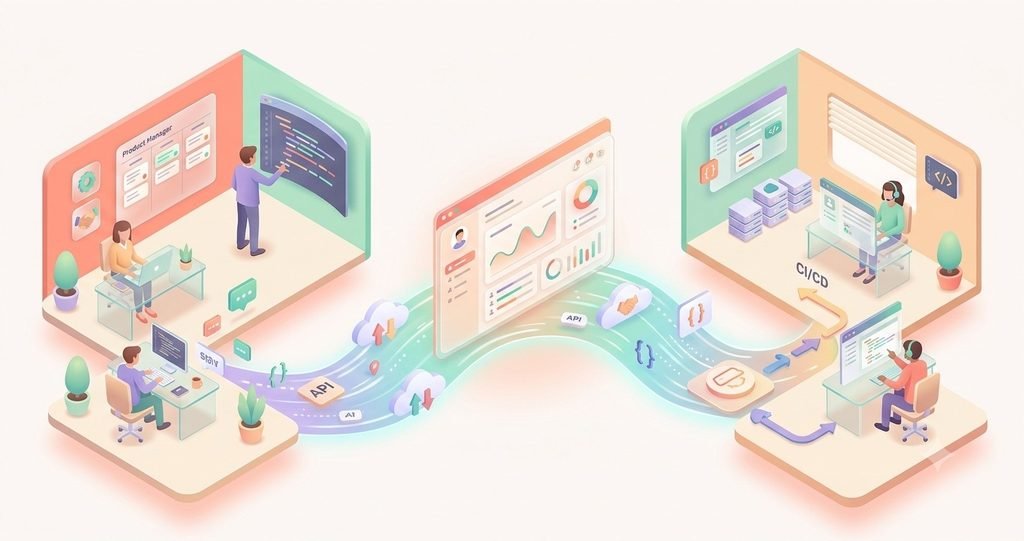
The real value of nearshore SaaS development becomes clearer when development is viewed as a continuous lifecycle rather than a single project.
A SaaS product normally moves through several stages:
Discovery → Architecture → Development → Testing → Launch → Monitoring → Optimization → Scaling
1. Build the Foundation
The first stage turns the product idea into a technically workable system. Teams define user flows, core features, architecture, database structures, APIs, authentication, and infrastructure.
For SaaS products, architecture decisions should also consider multi-tenancy, data isolation, permissions, billing, scalability, and observability from the beginning.
2. Launch in Controlled Stages
A production launch should not simply mean deploying the application and hoping everything works.
A stronger process uses:
- Staging environments
- Automated tests
- CI/CD pipelines
- Database backups
- Error monitoring
- Performance monitoring
- Rollback procedures
- Security checks
Some SaaS teams also use staged releases or feature flags so that new functionality can be introduced gradually. Full-cycle nearshore development models increasingly describe this progression from discovery and architecture through testing, deployment, monitoring, and iteration.
3. Scale Based on Evidence
Scaling does not always mean adding more developers.
A SaaS platform may first need database optimization, caching, better cloud configuration, queue processing, observability, or automated testing.
Likewise, a growing roadmap may require additional engineers, QA specialists, or DevOps capacity.
A practical nearshore SaaS development team should therefore scale according to measurable product needs rather than simply increasing headcount.
Common Nearshore SaaS Development Challenges
Nearshore development can reduce some collaboration problems, but it does not eliminate the risks associated with distributed software teams.
The biggest mistake is assuming that geographic proximity automatically creates good communication. It does not.
Unclear Requirements
If product requirements are vague, developers may build technically correct features that solve the wrong problem.
Better approach: use clear acceptance criteria, user stories, wireframes, technical documentation, and regular product reviews.
Architecture Misalignment
A team can produce working code while gradually creating an architecture that becomes difficult to maintain.
This is especially risky in SaaS because new features continuously interact with existing APIs, databases, authentication, billing, and tenant-specific logic.
Better approach: establish technical ownership and conduct architecture reviews before major changes.
Communication Gaps
Even a small time-zone difference can create delays if every decision requires a meeting.
Better approach: combine real-time meetings with written decisions, documentation, issue tracking, and asynchronous updates.
Security and Data Protection
SaaS applications often handle customer accounts, payment information, business data, and sensitive operational information.
A development relationship should therefore define:
- Access controls
- Repository permissions
- Secrets management
- Data handling
- IP ownership
- Security testing
- Incident procedures
- Compliance responsibilities
Team Turnover
Losing a developer who understands a critical part of the codebase can create knowledge gaps.
Better approach: maintain documentation, code reviews, automated tests, architecture records, and shared ownership of important systems.
Also Read: Outsourcing SaaS Development: Build Smarter, Scale Faster in 2026
How to Choose the Right Nearshore Development Model
Choosing the right nearshore SaaS development model starts with one question:
What does your existing team actually need?
There are three common approaches.
Staff Augmentation
Staff augmentation adds individual developers or specialists to an existing engineering organization.
It works well when internal product leadership, architecture, and project management are already strong but additional capacity is required.
Best for: feature development, temporary capacity gaps, cloud specialists, AI engineers, or infrastructure work.
Dedicated Development Team
A dedicated team provides a stable group of engineers working around the SaaS roadmap.
This model can include developers, QA, DevOps, and technical leadership. It is useful when the company needs sustained development capacity rather than one specialist.
Best for: growing SaaS products with an ongoing development roadmap.
Full-Cycle Development
With full-cycle development, the external team takes responsibility across several stages—from technical discovery and architecture to development, testing, deployment, and maintenance.
This provides broader external ownership but requires stronger governance, documentation, security controls, and clearly defined responsibilities.
Best for: companies that need substantial product development support without building every engineering function internally.
A Simple Decision Framework
| Your situation | More suitable model |
| Existing team needs extra developers | Staff augmentation |
| Product needs a stable engineering unit | Dedicated team |
| Limited internal engineering capacity | Full-cycle development |
| Temporary specialist requirement | Staff augmentation |
| Long-term SaaS roadmap | Dedicated team |
| New product requiring broad technical ownership | Full-cycle |
The right choice ultimately depends on product complexity, internal expertise, roadmap stability, budget, security requirements, and how much technical ownership the business wants to retain.
That is also why there is no universally “best” nearshore model. A startup with a technical founder may only need two additional engineers, while a company without an internal engineering function may need a complete product team.


One Response