
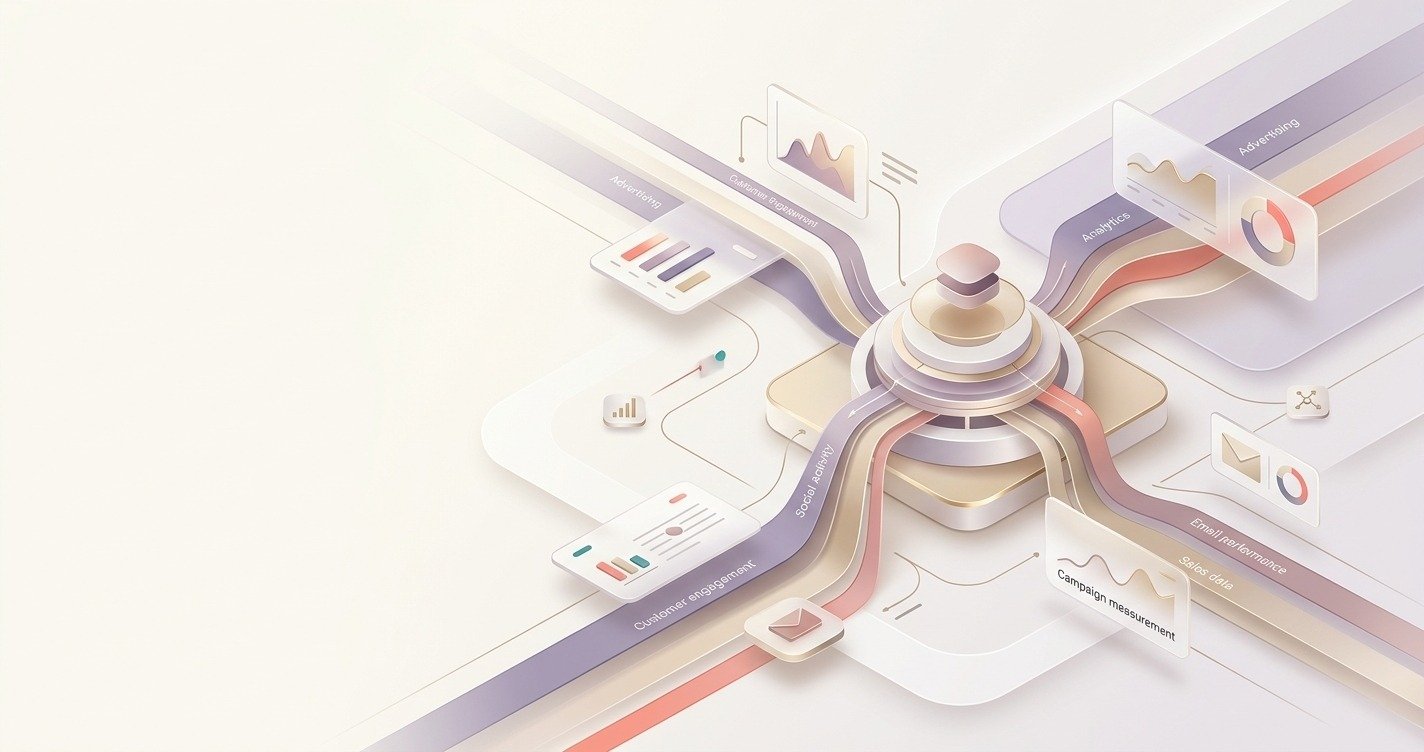
Marketing data rarely stays in one place. A business may run paid search, social advertising, email campaigns, ecommerce promotions, CRM activities, and website campaigns at the same time. Each platform can produce useful numbers, but comparing those numbers becomes difficult when they use different structures, naming conventions, and reporting systems.
Marketing Cloud Intelligence addresses this problem by bringing marketing data from multiple sources into a unified environment where it can be connected, harmonized, visualized, and analyzed. Salesforce documentation describes the platform as a way to integrate marketing and advertising data, web analytics, CRM, ecommerce, and other sources so marketers can develop a broader view of performance.
That makes it more than a collection of dashboards. The real value comes from creating relationships between otherwise disconnected datasets and turning them into information that marketing teams can actually use.
What Marketing Cloud Intelligence Really Does
At its core, Marketing Cloud Intelligence is a marketing analytics and data management platform associated with Salesforce. Its job is to help organizations bring marketing information together rather than forcing analysts to examine every advertising, CRM, web, or ecommerce system separately.
Consider a company running a product campaign across Google Ads, Facebook, email, and its website. Google may report impressions and clicks, the email platform may report opens and conversions, while the CRM contains lead and customer information. Looking at each report independently can show what happened inside each channel, but it does not necessarily explain how the channels performed together.
The platform is designed to create that broader view. Salesforce describes its main workflow as connecting data, harmonizing it, visualizing it, and then using the resulting information to optimize marketing performance.
This distinction matters because marketing analytics is not simply about collecting more numbers. A company can have millions of records and still struggle to answer a basic question such as, “Which campaign generated valuable customers relative to its cost?”
A unified marketing analytics platform can make those comparisons easier by placing relevant measurements and dimensions into a common structure.
It can therefore support activities such as campaign reporting, marketing performance analysis, KPI monitoring, media analysis, customer journey analysis, and cross-channel reporting.
The important point is that the platform does not magically make poor data useful. Its effectiveness depends heavily on how sources are connected, mapped, classified, and maintained. That data foundation is one of the less-discussed parts of the technology and is critical to getting reliable results.
How Marketing Data Gets Connected
One of the practical foundations of Marketing Cloud Intelligence is its ability to ingest information from different marketing and business sources.
Salesforce documentation explains that API connectors can connect sources such as Google Ads and Facebook and create data streams that map incoming fields to the platform’s data model. The available fields can vary depending on the connector.
This means marketers do not necessarily have to copy every report manually into spreadsheets. Connected sources can provide a more repeatable method for bringing information into the analytics environment.
The concept of a marketing data connector is especially useful for organizations operating across many platforms. Advertising systems, CRM applications, ecommerce platforms, web analytics tools, and messaging systems can all produce different types of information.
For example, one source may describe a campaign using a campaign ID, another may use a campaign name, and another may organize information around an ad group or placement. Simply importing all of these records does not automatically make them comparable.
Data streams help establish how incoming information should be interpreted.
Salesforce’s current documentation lists many data stream types, including Ads, CRM Leads, Ecommerce, Messaging, Search Keywords, Social Objects, Web Analytics, and Web Analytics Events.
There is also a Generic Data Stream Type for information that does not fit an existing model. This is important because real businesses rarely have perfectly standardized datasets.
The result is a more structured approach to marketing data integration. Instead of treating every source as an isolated spreadsheet, organizations can build a repeatable pipeline for bringing data into their broader reporting environment.
Making Disconnected Data Work Together
Connecting data is only the first step. The bigger challenge is making different datasets understand each other.
This is where Marketing Cloud Intelligence uses data harmonization. Salesforce explains that no single source normally contains every piece of information about a marketing campaign. Data may be distributed across multiple platforms, making it necessary to merge and standardize information before analyzing the complete picture.
Imagine that one advertising platform calls a campaign “Spring Sale,” while another calls it “Spring_Sale_2026.” If those records are treated as completely unrelated, the resulting report may underestimate the campaign’s total performance.
Harmonization helps solve these inconsistencies through mechanisms such as classifications, parent-child relationships, calculated dimensions, measurements, and data fusion. Salesforce describes the Harmonization Center as a place where data can be unified, enriched, and validated.
This is an important difference between simple marketing reporting and genuine cross-channel analytics.
A dashboard can display data. A harmonized data environment can establish relationships between data.
That relationship is what allows an analyst to move from isolated channel statistics toward questions such as:
- How did total campaign investment perform across channels?
- Which creative generated stronger engagement?
- Which campaigns generated leads rather than just clicks?
- Which product categories received the most attention?
- Where are costs increasing without a corresponding improvement in outcomes?
Good harmonization also improves consistency. When teams use common classifications and naming structures, reports become easier to compare over time.
Without this step, an impressive-looking dashboard can still be misleading because similar records may be counted separately or different records may be combined incorrectly.
Inside the Marketing Data Model
The data model is one of the most technical but important parts of Marketing Cloud Intelligence.
A data model determines how different pieces of information relate to one another. Salesforce explains that its platform receives data from sources with different combinations of dimensions and measurements and maintains relationships between entities to avoid incorrect aggregation.
A dimension describes a qualitative attribute. Examples can include campaign name, campaign ID, product, placement, or other descriptive characteristics.
A measurement, on the other hand, represents a numerical value that can be counted or analyzed. Clicks, impressions, email opens, and other performance metrics are examples.
This distinction sounds technical, but it has a direct effect on reporting accuracy.
Suppose an analyst wants to compare advertising cost by product and campaign. The system needs to understand which product belongs to which campaign and how the numerical cost should be aggregated. If those relationships are not modeled correctly, totals can become distorted.
Salesforce’s data model supports relationships such as one-to-many and many-to-many between entities. It also includes overarching entities that can help connect information across different data stream types.
That structure makes it possible to slice information from different sources using common business dimensions.
For marketers, the benefit is straightforward: instead of seeing a collection of unrelated platform reports, they can analyze performance through shared concepts such as campaign, product, channel, audience, or other business classifications.
This is also why data modeling should not be treated as an invisible technical task. A poorly designed model can affect every dashboard built on top of it.
Also Read: Market Intelligence Tools: Types, Uses, and Key Features
Turning Data Into Usable Dashboards
Once the data is connected and structured, Marketing Cloud Intelligence can turn it into visual reports and dashboards.
Salesforce describes visualization capabilities ranging from standard KPI reporting to more advanced visualizations used for audience segmentation, customer journey analysis, and predictive modeling.
The value of a dashboard is not simply that it looks attractive. A useful marketing dashboard should help someone notice an important change and understand what action may be needed.
For example, a marketing manager might monitor:
Spend: How much budget has been used?
Reach and engagement: Are campaigns generating meaningful interactions?
Conversions: Are users completing the desired actions?
Efficiency: Is the cost of generating those outcomes changing?
Channel contribution: Which channels are contributing to the broader campaign?
Pacing: Is spending progressing according to the campaign plan?
Salesforce Trailhead highlights cross-channel dashboards that can bring messaging, paid advertising, web analytics, and CRM KPIs into a common view.
This kind of marketing dashboard can reduce the need to manually assemble weekly reports from separate systems.
However, dashboard design still matters. Showing dozens of metrics on one screen can create another form of information overload.
A better approach is to connect dashboards to specific business questions. An executive dashboard might focus on investment, revenue, and overall performance, while an analyst dashboard may need campaign-level, creative-level, keyword-level, or audience-level detail.
The strongest reporting environment therefore combines high-level visibility with the ability to investigate what is happening underneath the headline numbers.
Finding Campaign Performance Gaps
The real test of Marketing Cloud Intelligence is what happens after the dashboard has been built.
A report can tell a marketer that one campaign has a higher click-through rate. Deeper analysis can help determine whether that campaign is actually producing better business results.
For example, imagine two campaigns:
Campaign A generates many inexpensive clicks but very few qualified leads.
Campaign B produces fewer clicks but substantially more qualified leads.
If the analysis stops at traffic or click volume, Campaign A may appear stronger. Once CRM outcomes and advertising costs are connected, the picture can change.
This is where campaign performance analysis becomes more useful than isolated channel reporting.
Salesforce positions the platform around discovering insights and acting on them, including optimizing campaign performance and identifying opportunities related to media spending.
A marketing team can investigate unusual patterns such as:
- Rising media costs
- Falling conversion rates
- Strong engagement with weak downstream results
- High-performing creative losing momentum
- Different channels reporting inconsistent campaign information
- Products receiving traffic without corresponding sales
- Budget being concentrated in inefficient areas
The goal is not to produce more reports. It is to shorten the distance between data → interpretation → decision.
This is also why connecting CRM information can be valuable. Advertising metrics alone may tell you what people clicked. CRM and conversion information can provide additional context about what happened after the click.
That distinction is especially important for businesses where the final outcome occurs well after the initial marketing interaction.
Practical Uses Across Marketing Teams
Marketing Cloud Intelligence can support different teams because marketing data problems are rarely limited to one department.
For a performance marketing team, it can provide a consolidated view of paid media performance across advertising channels.
For an ecommerce team, it can connect product, order, advertising, and marketing information to create a broader picture of commercial performance. Salesforce’s documented ecommerce data stream supports information such as product catalogs, orders, and purchased items from ecommerce sources.
For CRM and demand-generation teams, CRM lead data can be analyzed alongside marketing activity. Salesforce documents a CRM Leads data stream that can ingest lead-related information from platforms and CRM systems.
For social teams, social data can be compared with other marketing activity rather than being evaluated in isolation.
For marketing operations, the platform can reduce repetitive reporting work and establish more consistent data structures.
There is another practical use that receives less attention: cross-team alignment.
Different teams often use different definitions of success. A paid media manager may focus on impressions, clicks, and cost. A sales team may care about qualified leads and revenue. An ecommerce team may focus on orders and average order value.
A unified marketing data environment can give these teams a common analytical foundation.
That does not mean everyone needs to use the same dashboard. Instead, different teams can examine the same underlying data through metrics relevant to their responsibilities.
This makes marketing analytics more useful as an organizational system rather than simply another reporting tool.
See Also: Search Engine Marketing Intelligence: Data-Driven Search
Marketing Cloud Intelligence vs Newer Tools
There is an important naming issue that anyone researching Marketing Cloud Intelligence today should understand.
Salesforce still provides extensive documentation and product material for Marketing Cloud Intelligence, but its ecosystem also includes a newer Marketing Intelligence offering. Salesforce’s current documentation explicitly notes that there is a “new and improved Marketing Intelligence,” while describing it as natively built on the Salesforce Platform and connected with Data 360 and Agentforce.
That means the two names should not automatically be treated as interchangeable.
Marketing Cloud Intelligence is strongly associated with the Datorama technology and its established approach to marketing data integration, harmonization, visualization, and analysis. Salesforce Trailhead also identifies Marketing Cloud Intelligence as previously known as Datorama.
The newer Marketing Intelligence direction places greater emphasis on Salesforce’s broader platform architecture, unified data, and AI-powered capabilities.
This distinction matters for anyone evaluating Salesforce products because a search for “Marketing Intelligence” may return newer product information that does not describe the exact same environment as the established Marketing Cloud Intelligence platform.
It also matters for content readers. A useful guide should explain the terminology instead of quietly mixing the two products together.
For organizations already using an existing Marketing Cloud Intelligence setup, the relevant questions may include current architecture, data pipelines, connectors, reporting requirements, and migration or modernization considerations.
For a new buyer, the more relevant question may be which Salesforce marketing analytics solution fits its current technology stack and future data strategy.
In other words, understanding the name is only the beginning. The architecture behind the product matters just as much.
Conclusion
Modern marketing teams rarely have a single source of truth. Advertising platforms, websites, CRM systems, ecommerce stores, email tools, and social networks all generate different pieces of the customer and campaign story.
Marketing Cloud Intelligence was designed to bring those pieces closer together through data integration, harmonization, modeling, visualization, and analysis. Its value is therefore not limited to creating attractive dashboards. The deeper benefit comes from establishing relationships between datasets so marketers can analyze performance across channels and connect marketing activity with meaningful outcomes.
For organizations considering the platform, the most important questions are practical: Which sources need to be connected? How consistent is the underlying data? Which KPIs actually matter? How should campaigns and products be classified? And what decisions should the reporting system help the team make?
Those questions determine whether a marketing analytics platform becomes another reporting destination or a useful part of the organization’s decision-making process.
The Salesforce ecosystem is also evolving, so readers researching this technology should distinguish the established Marketing Cloud Intelligence environment from newer Marketing Intelligence capabilities. Understanding that difference can prevent confusion when comparing documentation, features, data architecture, and future platform options.


One Response