
Most small business owners in Florida know they need “better SEO” or “more marketing.” Fewer know what to actually do first. The result is a scattered budget spread across five tactics at once, none of them getting enough attention to move the needle.
Florida’s local search landscape is unusually competitive. Tourism-heavy cities, fast population growth, and a dense small business market mean the difference between page one and page three often comes down to sequencing, not spending more money.
Here’s a practical order of operations for businesses trying to figure out where their next marketing dollar should go.
Fix the Foundation Before You Build on It
Ranking campaigns and ad spend rarely work well on a site with underlying technical problems. Before investing in content or paid traffic, a business should confirm its website can actually be crawled, indexed, and loaded without friction.
Site Speed and Mobile Experience
Mobile devices now generate the majority of Google searches, and users abandon a slow, cluttered page on a phone far faster than they would on a desktop. A site that stutters while loading is losing visitors before they ever see an offer.
Compressing images, minimizing third-party scripts, and choosing reliable hosting solve most of this. It’s rarely glamorous work, but it’s the work that makes everything downstream more effective.
Crawlability and Indexing
A surprising number of small business sites have pages search engines can’t find or can’t properly read. Broken internal links, missing sitemaps, and duplicate content issues all quietly cap how much organic visibility a site can earn, no matter how good the content is.
Running a basic technical audit before any content push saves months of wasted effort later.
Local Visibility Comes Next
Once the technical basics are handled, local signals matter more than almost anything else for a Florida small business. Nearly half of all Google searches, roughly 46 percent, carry local intent, so this isn’t a niche tactic. It’s where most of the demand already is.
Google Business Profile Optimization
A complete, accurate, and regularly updated Google Business Profile often outperforms a brand-new blog post in terms of leads generated per hour invested. According to Google’s own research, 76 percent of people who run a “near me” search on their phone visit a related business within 24 hours. That’s not a warm lead, that’s someone already deciding.
Categories, service areas, photos, and review responses all factor into how a business shows up in the local map pack.
Local Citations and NAP Consistency
Name, address, and phone number consistency across directories still influences local rankings. When a business has moved locations, changed phone numbers, or rebranded, old listings can quietly work against new ones.
This is also where working with a specialist pays off. In a market this competitive, most businesses get faster, cleaner results by partnering with an established orlando seo team rather than handling citation cleanup alone, since they already have the directory relationships and process in place.
Content Should Answer Questions, Not Just Target Keywords
Search behavior has shifted, and the numbers back it up. Roughly two-thirds of Google searches now end without a single click to any website, the highest share on record, driven largely by AI Overviews answering questions directly on the results page. When an AI Overview appears on a query, that share climbs even further.
Pages that state a clear answer early, use descriptive subheadings, and structure information in scannable chunks tend to perform better in both traditional search results and AI-generated answers. Burying the useful information under three paragraphs of introduction no longer serves the reader or the algorithm.
A simple test: could a sentence be pulled directly from your page and used as a standalone answer to a question? If not, the content probably needs tightening.
Paid and Organic Should Support Each Other
Many businesses treat paid ads and organic SEO as competing budget lines instead of complementary channels. That’s a mistake. Paid campaigns can validate which keywords actually convert, while organic content builds long-term visibility that doesn’t disappear the moment ad spend stops.
A business that has already invested in Digital Marketing Service is often better positioned to run efficient paid campaigns, because the messaging, landing pages, and tracking are already aligned with what organic research shows people actually want.
The sequencing matters here too. Running ads to a landing page with weak content or slow load times wastes budget on traffic that won’t convert.
Measure What Actually Ties to Revenue
Rankings and traffic are easy to report on, but they aren’t the goal. Leads, calls, form submissions, and closed sales are. A page can rank on page one and still be a failure if it isn’t producing business.
Metrics That Actually Matter
Position matters more than most people realize. On a clean results page without AI features, the top organic result captures close to 40 percent of clicks, while position ten captures under 2 percent. A page stuck on the second page of results, or getting thousands of impressions with almost no clicks, usually has a messaging or ranking problem, not a lack of content.
Reviewing this data monthly, rather than quarterly, makes it possible to catch and fix small problems before they compound.
A Simple Prioritization Framework
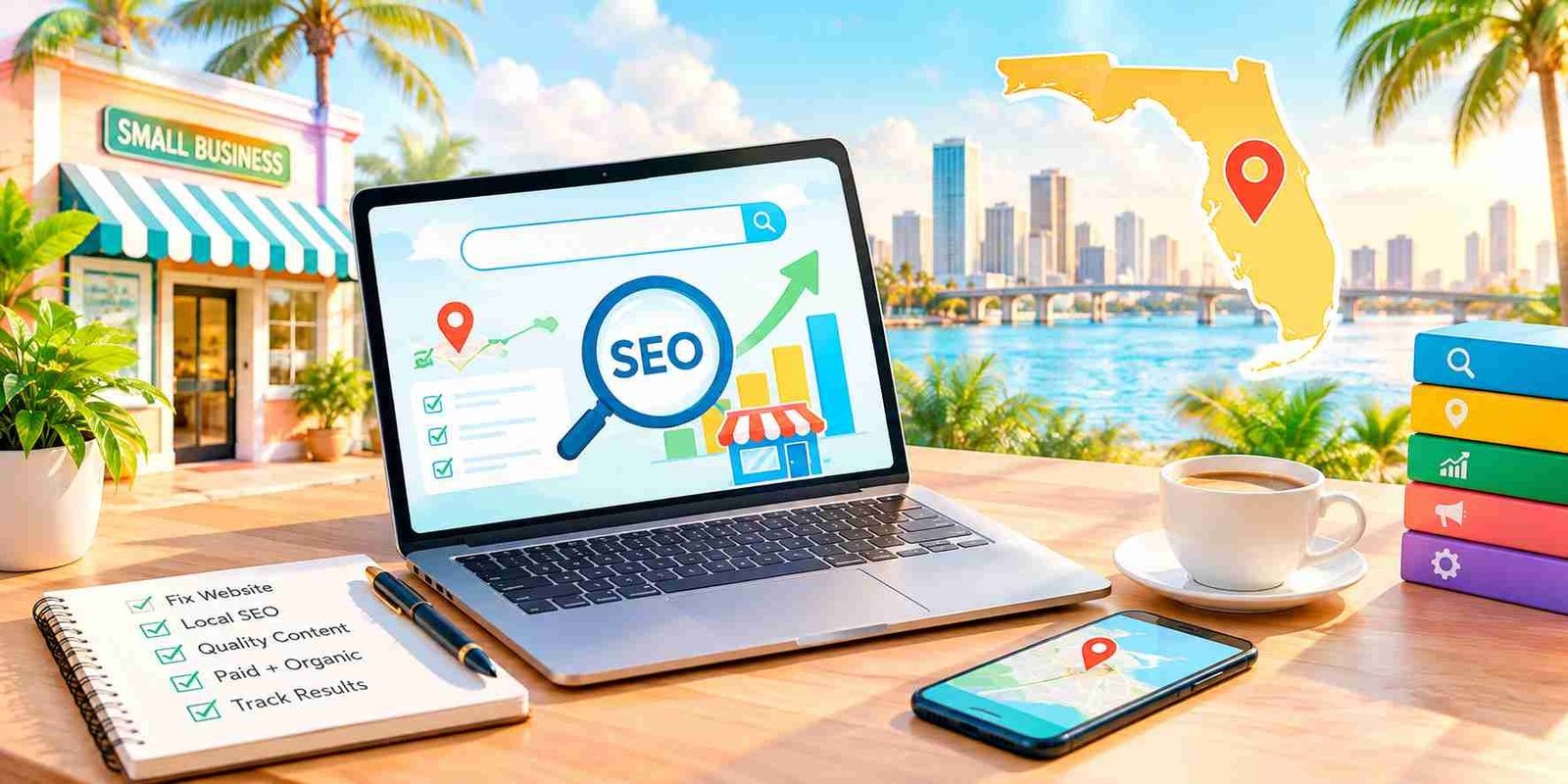
For a business trying to decide what to tackle first, this order generally produces the best return:
- Fix technical issues that block crawling, indexing, or mobile usability.
- Optimize local listings, especially Google Business Profile and citation consistency.
- Rebuild or refresh underperforming pages with clear, scannable, question-driven content.
- Layer in paid campaigns once organic messaging is validated.
- Track conversion data monthly and adjust based on what’s actually converting, not just what’s ranking.
Frequently Asked Questions
What should a Florida business fix first, SEO or paid ads?
Technical SEO and site usability should come first. Paid ads sent to a slow or poorly structured site waste money that could otherwise build long-term organic visibility.
How long does it take to see results from local SEO?
Most businesses start seeing measurable movement in local visibility within two to four months, though competitive markets can take longer depending on existing citation history and competitor strength.
Is content still worth investing in with AI search tools growing?
Yes, but the format matters more than ever. Content that gives clear, direct answers tends to get pulled into AI-generated results, while vague or overly promotional copy usually gets skipped.
Prioritization isn’t about doing less marketing. It’s about sequencing the work so each step makes the next one more effective, instead of spending on five things at once and hoping something sticks.