
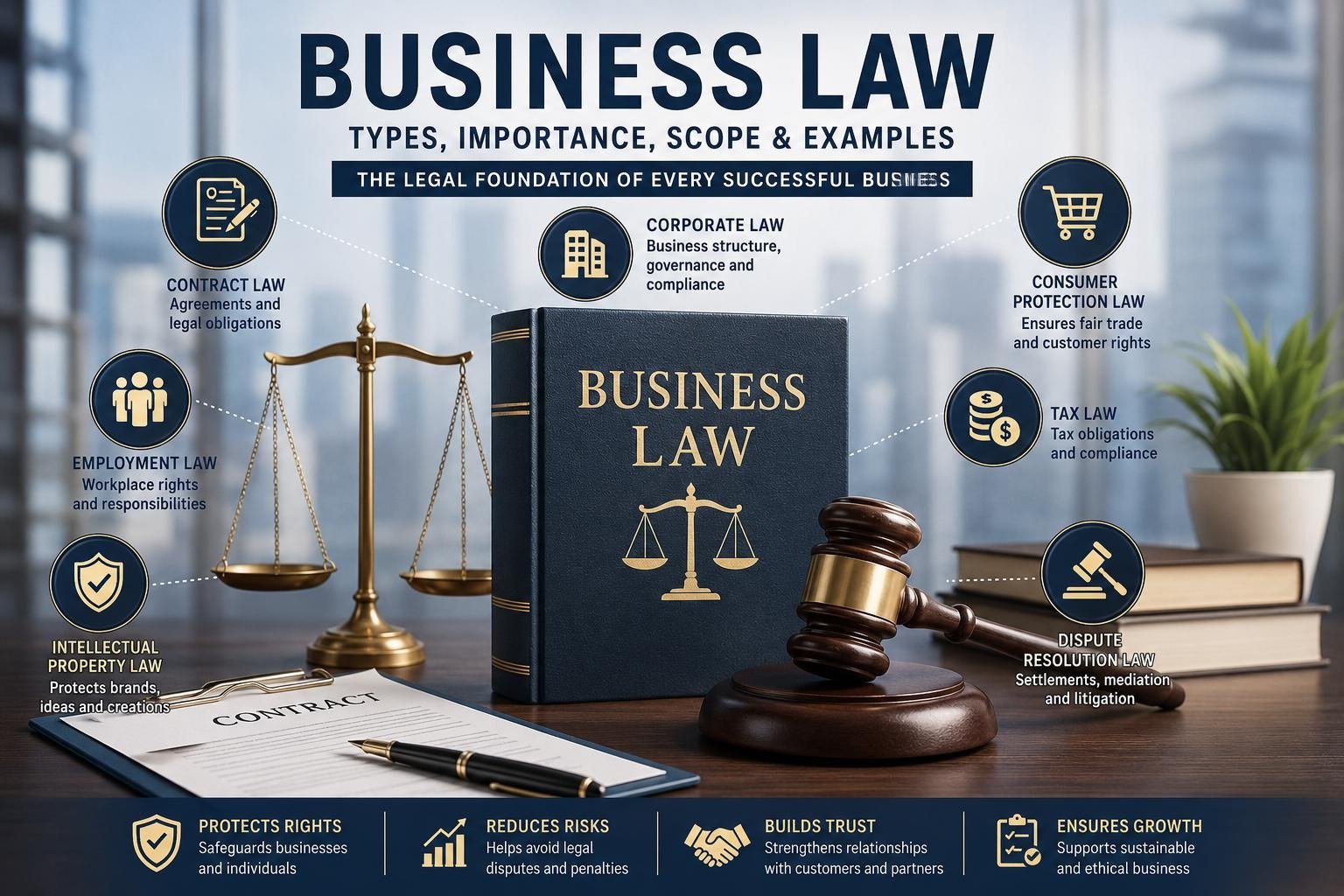
Running a business involves far more than selling products, making profits, and managing employees. Every agreement you sign, customer you serve, worker you hire, and brand you build can involve legal rules. That is where business law comes in. If you want to explain business law in simple terms, it is the legal framework that helps govern how businesses are formed, operated, protected, and held accountable. But what does business law actually include, and why does it matter to everyday businesses? From contracts and employment rules to intellectual property, consumer protection, taxation, and commercial disputes, its reach is surprisingly broad. This guide breaks the topic down without complicated legal language. You will learn the business law definition, its scope, major types, practical examples, and importance for modern businesses. We will also clarify how business law differs from business policy, corporate law, and commercial law so you can understand where each concept fits.
What Is Business Law? A Simple Explanation
If you want to explain business law in simple terms, think of it as the legal framework that tells businesses what they can do, what they must do, and what happens when legal obligations are ignored. Business law governs many parts of commercial activity, including business formation, contracts, employment relationships, sales, intellectual property, taxation, and interactions with customers, competitors, and regulators.
A useful business law definition is: business law is the body of legal rules that regulates how businesses are created, operated, financed, managed, and sometimes dissolved. It is broad rather than limited to one type of legal issue. A company signing a supplier agreement, hiring an employee, protecting a trademark, leasing an office, or selling products can encounter different areas of business law.
For example, imagine a small online clothing company. Before it makes its first sale, the owner may need to choose an appropriate business structure and comply with registration requirements. When the company purchases inventory, contract and commercial rules can become relevant. When it hires workers, employment law enters the picture. If it creates a unique brand name or logo, intellectual property law may help protect those assets.
This is why business law meaning is sometimes misunderstood. It does not mean one single law or one legal document. Instead, it is an umbrella concept covering several connected areas of law that affect commercial activity. OpenStax describes business law as an expansive field involving areas such as contracts, tax, corporate law, intellectual property, real estate, sales, employment, and bankruptcy.
Business law also differs from internal company policies. A business policy is generally an organization’s own guideline for how it wants employees or managers to act, while business law comes from legally recognized authorities and creates external legal obligations. A company might create a refund policy internally, for example, but that policy still has to operate within applicable consumer-protection and contract laws.
Because laws vary by country, state, province, or industry, the exact requirements depend on jurisdiction. The safest way to understand the subject is therefore to learn the general principles first and then check the laws that apply to the specific business.
What Does Business Law Actually Cover?
The scope of business law is much wider than contracts alone. It can follow a business through almost its entire life cycle—from choosing a legal structure and starting operations to employing people, making commercial deals, protecting assets, handling disputes, and eventually closing the business. Current educational resources similarly describe business law as a field spanning multiple legal disciplines rather than one isolated category.
One major area is business formation. Entrepreneurs must consider how their business will be legally organized, what responsibilities owners have, and what filings or registrations may be required. The legal consequences can differ significantly between structures such as sole proprietorships, partnerships, limited-liability entities, and corporations.
Another major area is contract law. Businesses enter agreements with suppliers, customers, employees, contractors, landlords, investors, and other companies. Contracts can establish payment terms, responsibilities, delivery conditions, warranties, confidentiality obligations, and remedies if one party fails to perform. OpenStax notes that contracts document promises that can be legally enforceable when the applicable requirements are satisfied.
Employment is another important part of the areas of business law. Businesses may have legal obligations concerning wages, workplace conditions, discrimination, employee classification, benefits, termination, and other employment matters. The exact requirements vary considerably by jurisdiction.
Then there is intellectual property law, which can protect valuable business assets such as trademarks, copyrights, patents, and trade secrets. For a software company, for example, intellectual property may be among its most important assets.
Business law can also involve taxation, consumer protection, advertising, commercial sales, real estate transactions, competition rules, securities, insolvency, and dispute resolution. Cornell’s Legal Information Institute similarly describes commercial law as encompassing numerous areas, including contracts, corporate law, consumer credit, intellectual property, sales, real estate transactions, and secured transactions.
A simple way to understand the scope of business law is to follow a business journey:
Start the business → hire people → sign contracts → sell products → protect assets → follow regulations → resolve disputes.
At almost every stage, a different legal issue may appear. That broad reach is what makes business law an essential subject for entrepreneurs, managers, students, and business professionals.
Why Is Business Law Important for Businesses?
Understanding why business law is important becomes easier when you consider what could happen without clear legal rules. Businesses constantly make agreements, employ people, exchange money, sell products, protect intellectual property, and interact with regulators. Business law provides a framework for these activities and helps define the rights and responsibilities of the parties involved.
One important benefit is legal compliance. Businesses must follow the laws and regulations that apply to their activities. Ignoring applicable requirements can lead to penalties, disputes, regulatory action, or other legal consequences. Compliance is therefore not simply a paperwork exercise; it is part of managing business risk.
Business law also helps create predictable commercial relationships. Consider a supplier agreement. Instead of relying entirely on a verbal promise, the parties can establish terms covering price, quantity, delivery, payment, warranties, and remedies. If a disagreement develops, the contract and applicable law can provide a framework for resolving it.
Another reason business law matters is protection of business assets and rights. A company’s brand, inventions, creative work, confidential information, and contractual rights can have significant economic value. Intellectual property and other legal protections can help businesses defend those interests.
The law also protects people who interact with businesses. Consumer protection rules, employment requirements, competition regulations, and other legal frameworks can establish boundaries around commercial conduct. Indeed highlights the role of business law in maintaining order and protecting the rights of people involved in business activity.
There is also a strategic side to understanding business law. A business owner who identifies a legal issue before signing an agreement or launching a product has more options than one who discovers the problem after a dispute begins. For example, reviewing a partnership agreement early may reveal unclear ownership rights, decision-making authority, or exit terms before those issues become expensive conflicts.
In practical terms, the importance of business law can be summarized through five functions:
| Function | What it helps address |
| Compliance | Following applicable laws and regulations |
| Risk management | Reducing avoidable legal exposure |
| Contracts | Defining commercial rights and obligations |
| Protection | Safeguarding people, property, and business assets |
| Dispute resolution | Providing legal mechanisms when conflicts occur |
This does not mean every business needs the same legal strategy. A local retailer, technology startup, manufacturer, and multinational corporation can face very different requirements. The key is understanding which rules apply to the business and when professional legal advice is appropriate.
What Are the Main Types of Business Law?
The types of business law can look confusing because business activity intersects with many different legal disciplines. There is no single universal list that applies identically in every jurisdiction, but several major categories appear repeatedly in business-law education and practice.
1. Contract Law
Contract law governs legally significant agreements between parties. Businesses use contracts with customers, suppliers, employees, contractors, landlords, partners, and other organizations.
A simple example is a manufacturer agreeing to supply 1,000 products to a retailer at a specified price and delivery date. The contract establishes what each side has promised and may specify what happens if one party fails to perform.
2. Corporate and Business Entity Law
Corporate law focuses heavily on corporations, including their formation, governance, ownership, directors, shareholders, and major structural transactions. More broadly, business-entity rules address how different business structures are created and operated.
Corporate law is therefore related to business law but is narrower. Current legal resources describe corporate law as a specialized area within the broader business-law field.
3. Employment and Labor Law
Employment law addresses the legal relationship between employers and workers. Depending on the jurisdiction, it can cover wages, working conditions, discrimination, employee classification, workplace rights, termination, and other employment obligations.
4. Intellectual Property Law
Intellectual property law protects certain forms of intangible business assets. Trademarks can protect brand identifiers, copyrights can protect qualifying creative works, patents can protect qualifying inventions, and trade-secret law can protect certain confidential commercial information.
5. Tax Law
Businesses can have tax obligations related to income, sales, payroll, transactions, property, or other activities. The applicable rules depend heavily on the business structure and jurisdiction.
6. Consumer Protection Law
Consumer-protection rules can regulate how businesses market, sell, advertise, and provide products or services. They are designed to address issues such as deceptive practices and unfair treatment.
7. Commercial and Sales Law
Commercial law covers many transactions involving the sale of goods and other business dealings. Cornell’s Legal Information Institute notes that commercial law encompasses areas such as sales, contracts, secured transactions, consumer credit, and corporate matters.
8. Bankruptcy and Insolvency Law
When a business cannot meet its financial obligations, bankruptcy or insolvency rules may determine how debts, assets, creditors, and restructuring or liquidation are handled.
Together, these business law principles and categories show why the subject is so broad. A single business transaction can involve several areas at once—for example, a company launching a product may encounter contract, intellectual property, consumer-protection, employment, tax, and regulatory issues simultaneously.
How Does Business Law Work in Practice?
To explain business law properly, it helps to see what happens when legal rules move from textbooks into everyday business decisions. Business law works as a framework around commercial activity. A company does not usually “use business law” as one single process. Instead, different legal rules become relevant at different stages of a transaction, employment relationship, business decision, or dispute.
Consider a small company preparing to launch a new product. First, it may need to choose a suitable business structure and complete required registrations. Before purchasing inventory, it may negotiate a supplier contract covering price, delivery, payment, warranties, and responsibility for defective goods. If employees are involved, employment rules may apply. If the product carries a unique brand, intellectual property protection can become important.
Contracts are particularly central to everyday commercial activity. A business agreement can establish what each party promises to do, when performance is due, how payment will work, and what happens if something goes wrong. If one party fails to meet its contractual obligations, the agreement and applicable law may determine available remedies. Contract law is therefore one of the practical foundations of commercial relationships.
Compliance is another practical layer. Businesses need to identify the laws and regulations relevant to their industry, location, employees, products, and transactions. A restaurant, software company, construction business, and financial firm will not face identical requirements. This is why business law principles should be applied according to the facts rather than treated as a universal checklist.
When a disagreement occurs, the legal process may involve negotiation, mediation, arbitration, or litigation. Alternative dispute resolution can sometimes resolve commercial conflicts without a full court proceeding, potentially reducing time and expense.
A practical business-law workflow looks like this:
Identify the business activity → determine applicable rules → review obligations → document the agreement → monitor compliance → resolve problems through the appropriate process.
This approach also helps distinguish law from internal management. A company may create a business policy explaining how employees should handle refunds, confidential information, or purchasing decisions. That policy is an internal rule; it does not replace applicable law.
What Are Real-World Examples of Business Law?
Real-world business law examples are everywhere because businesses constantly interact with customers, workers, suppliers, investors, competitors, and government authorities. Looking at practical situations is often a better way to understand the subject than memorizing legal terminology.
Example 1: A Supplier Contract
Imagine a retailer ordering products from a manufacturer. The agreement states the quantity, price, delivery date, payment schedule, and quality requirements. If the manufacturer delivers the wrong products or misses a contractual deadline, contract law may become relevant.
This example shows why businesses should not treat contracts as routine paperwork. A poorly defined agreement can create uncertainty about who carries responsibility when something goes wrong.
Example 2: Hiring an Employee
A growing company hires its first full-time employee. The employment relationship can raise questions involving wages, working conditions, classification, workplace rights, discrimination, benefits, and termination. The precise rules depend on the applicable jurisdiction.
Employment law is therefore a practical part of business law, not something that only matters when an employee files a complaint.
Example 3: Protecting a Brand
Suppose a startup develops a distinctive name and logo. Those assets can become commercially valuable as the company grows. Intellectual property law may provide legal mechanisms for protecting qualifying brand identifiers and creative or technical assets.
If another business begins using a confusingly similar protected mark, the company may need to evaluate its legal rights and available remedies.
Example 4: A Customer Dispute
A customer purchases a product that allegedly does not meet the advertised description. Depending on the jurisdiction and circumstances, consumer-protection, contract, warranty, or commercial-sales rules may become relevant.
This illustrates an important point: business law is not only about protecting companies. Many legal rules also establish protections and remedies for consumers.
Example 5: A Business Cannot Pay Its Debts
A company experiences severe financial difficulties and can no longer meet its obligations. Bankruptcy or insolvency law may determine how the business, creditors, assets, and outstanding debts are handled.
Example 6: Two Businesses Have a Commercial Dispute
A disagreement between two companies may concern payment, delivery, intellectual property, services, or a breached agreement. Depending on the contract and applicable law, the parties might negotiate a settlement, use mediation or arbitration, or pursue litigation.
These examples demonstrate the broad scope of business law. Legal issues can appear before a business launches, during ordinary operations, and when relationships break down.
Also Read: Digital Jersey Technology Sector Growth: Trends and Outlook
Business Law vs. Corporate and Commercial Law
Business law, corporate law, and commercial law are closely related terms, so it is easy to confuse them. They can also be used somewhat differently across countries, legal systems, law firms, and educational programs. The simplest distinction is that business law is generally the broader concept, while corporate law focuses more specifically on companies and their internal structure and governance.
Think of business law as the larger umbrella. It can involve contracts, employment, consumer protection, intellectual property, taxation, regulatory compliance, commercial transactions, and disputes. It can affect different types of businesses, including corporations, partnerships, LLCs, and sole proprietorships, depending on the jurisdiction.
Corporate law is more specialized. It commonly deals with the formation and governance of corporations, shareholder rights, directors and officers, corporate decision-making, mergers and acquisitions, and other structural transactions. Recent legal explanations similarly describe corporate law as a narrower area within the broader business-law landscape.
Commercial law generally focuses on legal issues arising from commerce and business transactions. Contracts, sales, supplier relationships, financing arrangements, and other commercial dealings can fall within this area. However, terminology varies in professional practice, and some law firms use “corporate” and “commercial” differently.
| Area | Main Focus | Simple Example |
| Business Law | Broad legal issues affecting businesses | Employment, contracts, compliance |
| Corporate Law | Corporate structure and governance | Shareholders, directors, mergers |
| Commercial Law | Business transactions and trade | Sales and supplier agreements |
There is substantial overlap between these areas. For example, a company acquisition can involve corporate law, commercial contracts, employment issues, intellectual property, tax, and regulatory requirements at the same time.
This is why the terms should not be treated as completely separate boxes. If someone asks you to explain business law, the most accurate approach is to describe it as a broad legal field and then show how specialized areas such as corporate and commercial law fit into the wider picture.
How Does Business Law Protect Businesses and Consumers?
One of the most important functions of business law is creating a predictable framework for commercial relationships. Businesses need to know what their obligations are, while customers, employees, suppliers, and other parties need mechanisms to protect their legal interests. This balance is a major reason why business law is important.
For businesses, legal rules can help protect contracts, property, intellectual property, financial interests, and organizational rights. A written commercial agreement, for example, can clearly establish the responsibilities of each party. If a dispute develops, the contract and applicable legal framework can provide a basis for determining rights and possible remedies.
Business law also supports risk management. Before entering a major transaction, a company can identify potential legal problems, review contractual obligations, assess regulatory requirements, and clarify responsibilities. Detecting a problem before signing an agreement is generally more useful than discovering the same problem after a dispute has already developed.
Consumers receive protections as well. Consumer-protection rules can address unfair or deceptive business practices, product-related obligations, advertising, sales practices, warranties, and other interactions between businesses and customers. The exact protections depend on the applicable jurisdiction and transaction.
Employment rules provide another layer of protection. They can establish legal standards for workplace relationships, including areas such as wages, discrimination, working conditions, and employee rights. At the same time, these rules give businesses a clearer framework for managing employment relationships.
Business law also provides mechanisms for resolving disputes. Not every disagreement needs to become a lawsuit. Depending on the circumstances, parties may negotiate, mediate, arbitrate, settle, or proceed to court. Alternative dispute resolution is specifically recognized as a way to address commercial disputes while potentially reducing the time and cost associated with traditional litigation.
The protection works in both directions:
Businesses → protection of contracts, assets, intellectual property, and legal rights
Consumers and other parties → protection from unlawful, unfair, or deceptive conduct
This balanced framework is why understanding business law matters even for a small company. Legal awareness is not simply about avoiding punishment. It helps businesses make clearer agreements, recognize risks earlier, protect valuable assets, and understand their responsibilities toward the people they serve.
For anyone trying to explain business policy, it is also important to remember the distinction: a company’s internal policy can guide employee behavior, but it should be designed and applied consistently with applicable business laws and regulations.