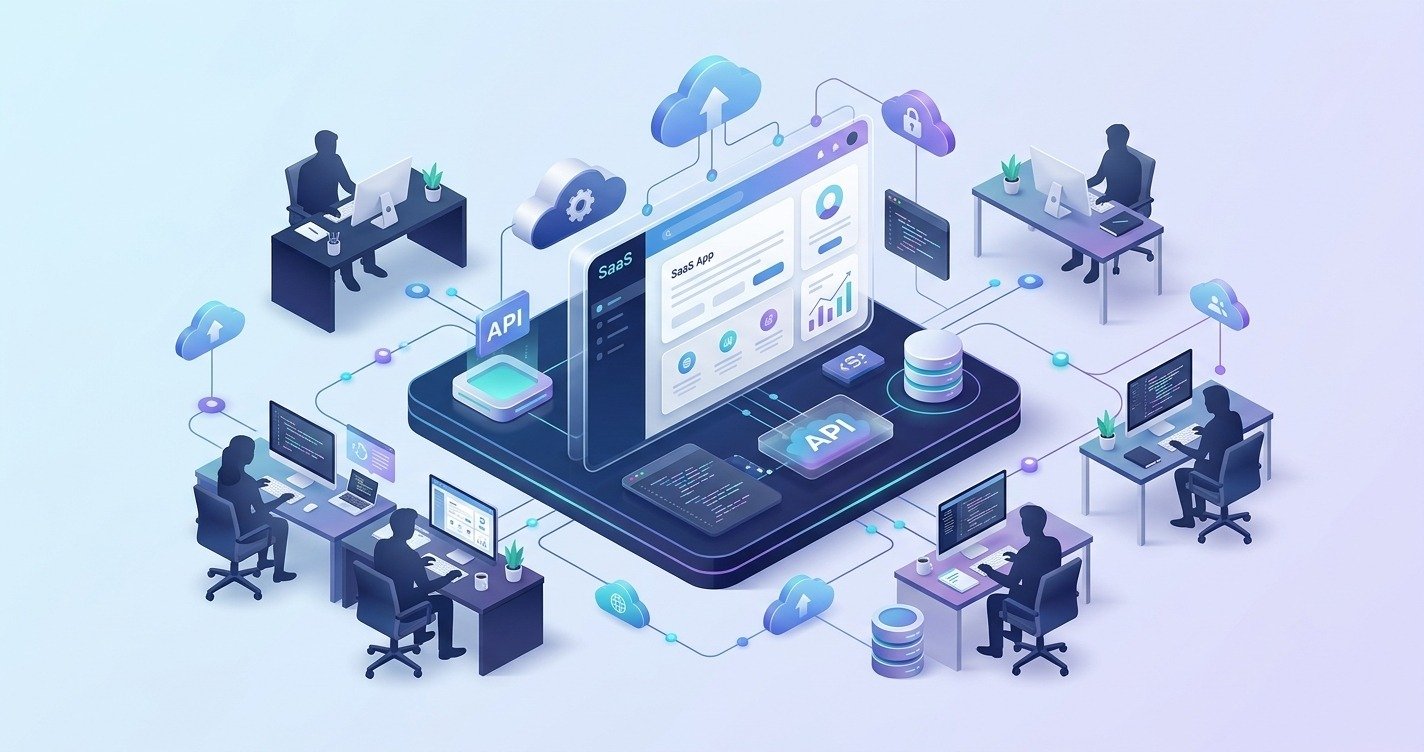
Building a SaaS product sounds exciting until the technical workload starts piling up. From product design and backend development to cloud infrastructure, security, testing, and ongoing maintenance, a successful SaaS platform needs more than a good idea. Outsourcing SaaS development gives startups and established businesses a way to access specialized developers without building a large in-house engineering team from scratch. But choosing the wrong outsourcing model or development partner can lead to unexpected costs, delays, security issues, and technical debt.
The good news is that SaaS outsourcing can be highly effective when it is planned around the right goals. In this guide, you’ll learn how SaaS development outsourcing works, why businesses use it, which tasks are worth outsourcing, how much it can cost, and how to choose a reliable development partner. We’ll also explore common outsourcing risks, different team models, and a practical process for taking an outsourced SaaS product from MVP development to launch and long-term growth.
What Is Outsourcing SaaS Development and How Does It Work?
Outsourcing SaaS development means hiring an external software development team to design, build, test, deploy, or maintain a cloud-based Software-as-a-Service product instead of handling every technical function with an internal team. The outside partner can manage the entire product lifecycle or take responsibility for selected areas such as UI/UX, backend development, cloud infrastructure, QA, or ongoing maintenance.
In simple terms, SaaS development outsourcing lets a business bring in specialized technical talent without building a large engineering department from scratch. This can be particularly useful when a startup needs an MVP quickly, an established company needs additional development capacity, or a business lacks expertise in areas such as cloud architecture, DevOps, cybersecurity, or AI integration. Current 2026 guidance increasingly frames outsourcing around delivery ownership and product governance, rather than treating it only as a way to reduce development costs.
How Does SaaS Development Outsourcing Work?
The process normally starts before a single line of production code is written. A business first defines the product idea, target users, core features, technical requirements, budget, and expected outcome. The outsourcing partner then helps translate those requirements into a development roadmap.
A practical SaaS outsourcing development process usually follows these stages:
- Define the product scope: Identify the problem, target users, core features, integrations, and MVP requirements.
- Choose an outsourcing partner: Evaluate relevant SaaS experience, technical skills, communication practices, security standards, and previous projects.
- Plan the architecture: Agree on the technology stack, cloud environment, database structure, APIs, authentication, scalability, and security requirements.
- Design and develop: The external team builds the interface, backend, APIs, integrations, and core SaaS functionality.
- Test and validate: QA specialists perform functional, performance, compatibility, and security testing before release.
- Deploy and monitor: The application moves into production with appropriate cloud, DevOps, monitoring, backup, and deployment procedures.
- Maintain and improve: After launch, the team fixes bugs, applies security patches, improves performance, and adds new features.
This approach is important because SaaS is not simply a one-time software project. Multi-tenant architecture, billing, permissions, customer data isolation, uptime, integrations, analytics, and continuous releases can all affect the product after launch.
Why Businesses Outsource SaaS Development in 2026
The biggest reason businesses outsource SaaS development is no longer simply finding cheaper developers. Companies increasingly use external engineering teams to access specialized expertise, accelerate product delivery, fill temporary skill gaps, and scale development capacity without committing to a large permanent workforce.
For a startup, outsourcing can make it possible to turn a validated idea into an MVP without immediately hiring frontend developers, backend engineers, QA specialists, DevOps professionals, designers, and technical leadership. For an established SaaS company, the same strategy can help accelerate a major release or add expertise that the internal team does not currently have.
Faster Access to Specialized SaaS Expertise
A SaaS product can require far more technical knowledge than basic web development. Depending on the product, the team may need experience with cloud infrastructure, API development, database optimization, authentication, payment systems, AI integrations, DevOps, cybersecurity, and multi-tenant architecture.
An experienced SaaS development outsourcing company can provide several of these skills through one external team. This is particularly valuable when the business needs expertise for a specific stage rather than a permanent in-house role.
Lower Hiring and Infrastructure Pressure
Building an internal engineering department involves recruitment, salaries, benefits, equipment, management, training, and the time required to find suitable specialists. Outsourcing changes that structure by allowing the company to purchase development capacity according to its current needs.
However, lower hourly rates do not automatically mean lower total project cost. Poor requirements, weak project management, excessive rework, technical debt, and communication problems can quickly eliminate any initial savings. A better approach is to evaluate total delivery cost, not just the developer’s hourly rate.
Faster Time to Market
Hiring a complete technical team can delay a product launch. An established external team may already have developers, QA engineers, designers, project managers, and DevOps specialists available.
That can shorten the path from product requirements to MVP, provided the scope is realistic and the team has genuine SaaS experience. Current 2026 guides consistently identify faster delivery and access to specialized expertise among the major reasons companies choose outsourcing.
Flexible Team Scaling
A SaaS roadmap rarely stays static. One quarter may require several backend engineers; the next may require QA automation, cloud engineering, or AI expertise.
With SaaS development outsourcing, companies can increase or reduce external capacity as priorities change. This makes outsourcing especially useful for startups and growing SaaS businesses whose technical requirements are still evolving.
Better Focus on Product and Growth
Outsourcing technical execution can also allow founders and internal teams to spend more time on customer research, product strategy, sales, marketing, partnerships, and business operations.
The important distinction is that outsourcing should remove unnecessary engineering workload—not remove product ownership. The business should still control its roadmap, priorities, acceptance criteria, data, intellectual property, and strategic decisions.
Which SaaS Development Tasks Should You Outsource?
Not every company needs to outsource its entire SaaS product. In many cases, the smarter approach is to identify the technical functions that require specialist expertise or additional capacity and outsource those areas first.
The right scope depends on your internal team, product maturity, technical leadership, and roadmap. A startup with no technical department may need full-cycle SaaS development outsourcing, while an established company may only need external QA engineers or cloud specialists.
SaaS Product Discovery and Technical Planning
An outsourcing partner can help convert an early product concept into technical requirements, user flows, architecture decisions, feature priorities, and an MVP roadmap.
This stage is especially useful when founders understand the business problem but do not have enough technical experience to estimate complexity or identify architectural risks.
UI/UX and Frontend Development
External teams can handle wireframes, prototypes, design systems, responsive interfaces, dashboards, onboarding flows, and frontend implementation.
This can be valuable when the internal team understands the product but lacks dedicated design or frontend capacity.
Backend and API Development
Backend development is one of the most common areas businesses outsource. It may include application logic, databases, authentication, authorization, APIs, payment integrations, third-party services, and data processing.
For SaaS products, the backend also needs to account for scalability, reliability, and appropriate customer-data separation.
Cloud, DevOps, and Infrastructure
A SaaS application needs more than application code. Cloud configuration, deployment pipelines, monitoring, backups, infrastructure automation, and performance management all affect reliability.
Outsourcing these functions can provide access to specialized SaaS DevOps development expertise without requiring a permanent internal infrastructure team.
QA and Security Testing
Quality assurance can be outsourced independently or as part of a complete development team. Typical responsibilities include functional testing, regression testing, API testing, performance testing, compatibility testing, and security checks.
For multi-tenant SaaS platforms, testing should also verify that users can access only the data and functions permitted by their roles and subscription level.
AI and Third-Party Integrations
Modern SaaS products increasingly connect with payment gateways, CRMs, analytics platforms, communication tools, AI APIs, and other business systems.
An external team can build and maintain these integrations when the required expertise is not available internally.
Maintenance and Post-Launch Support
SaaS development does not end when the application goes live. Bugs, security patches, dependency updates, infrastructure issues, performance improvements, and new customer requests continue throughout the product lifecycle.
For this reason, SaaS development outsourcing maintenance can be structured as an ongoing service rather than a separate emergency arrangement. Current guides also include monitoring, updates, security patches, performance optimization, and long-term support among common outsourced responsibilities.
What Should You Keep In-House?
The answer depends on your business, but product vision, strategic priorities, customer knowledge, and final product decisions are often better retained internally.
A useful rule is simple: outsource execution where external expertise adds value, but retain ownership of decisions that define the business.
SaaS Outsourcing Models: Which One Fits Your Business?
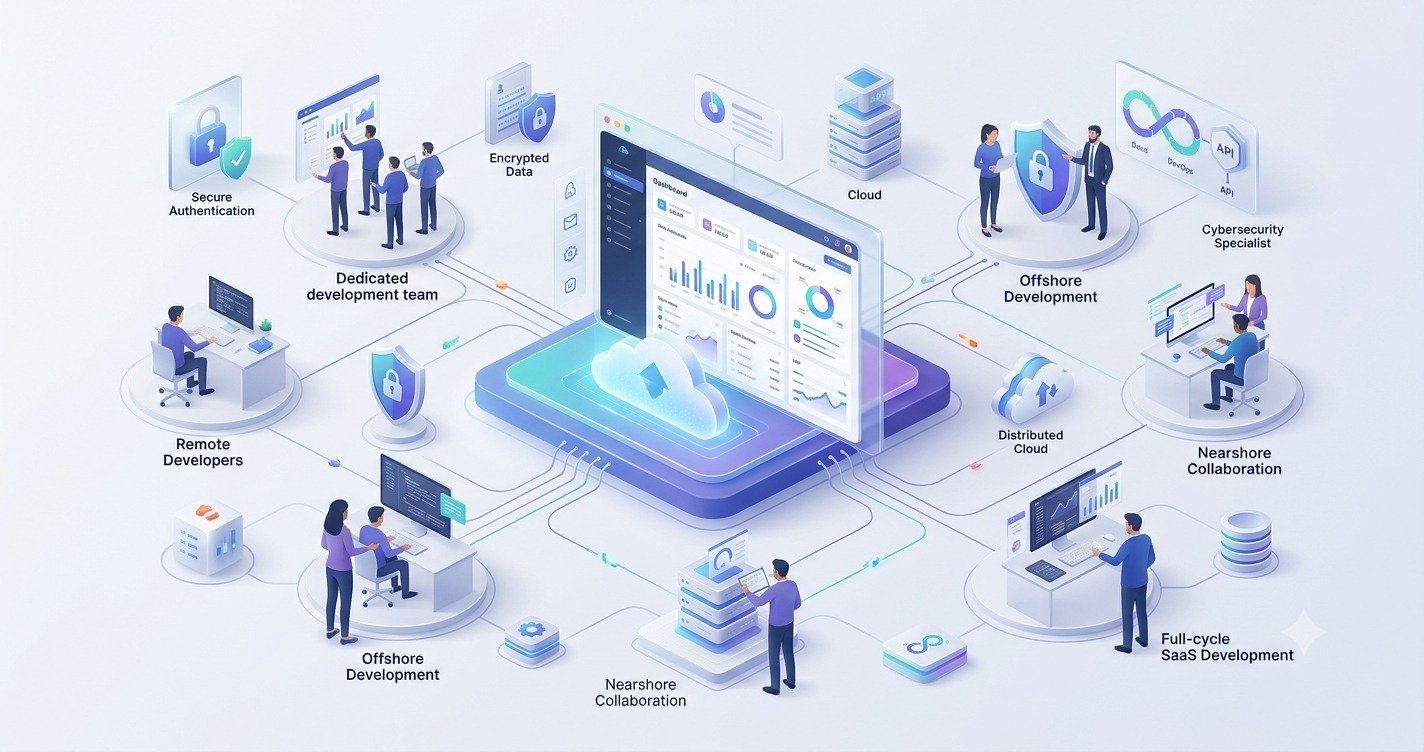
Choosing between SaaS outsourcing models is not simply a matter of selecting the cheapest option. The right model determines who manages developers, who owns delivery, how flexible the scope can be, and how closely the external team works with your company.
The three most common choices are staff augmentation, project-based outsourcing, and dedicated development teams. Full-cycle outsourcing is another useful model when a company wants an external partner to manage most or all of the product lifecycle. Recent 2026 comparisons emphasize that these models differ mainly in control, responsibility, flexibility, and delivery ownership.
| Outsourcing Model | Best For | Control | Flexibility |
| Staff Augmentation | Existing teams needing extra skills | High | High |
| Project-Based Outsourcing | Clearly defined projects | Medium | Lower |
| Dedicated Development Team | Long-term SaaS products | Shared | High |
| Full-Cycle Outsourcing | Businesses without technical teams | Lower day-to-day | Medium–High |
Staff Augmentation
With SaaS development staff augmentation, external developers join your existing engineering team. Your company normally controls priorities, architecture, workflow, code reviews, and day-to-day management.
This works well when you already have technical leadership but need additional backend developers, frontend specialists, QA engineers, or other expertise for a specific period.
Project-Based Outsourcing
In project-based outsourcing, the external provider takes responsibility for delivering an agreed scope. It is a practical choice when requirements are clear and the expected deliverables can be defined before development begins.
However, fixed-scope outsourcing can become difficult when an early-stage SaaS product is likely to change significantly during development. MVP requirements often evolve after user feedback, which makes flexibility important.
Dedicated Development Team
A dedicated SaaS development team is a stable external group that works continuously on your product. It can include developers, QA engineers, designers, DevOps specialists, and technical leadership.
This model is often suitable for growing SaaS products with a long roadmap because the same team can build product knowledge over time while the company retains control over priorities.
Also Read: Digital Information Technology: How It Works in 2026
Full-Cycle SaaS Outsourcing
Full-cycle outsourcing gives the external partner responsibility across multiple stages, such as discovery, design, development, testing, deployment, and maintenance.
It can be a strong fit for founders or businesses without an internal technical team. The trade-off is that the company must establish clear ownership, documentation, communication channels, acceptance criteria, security requirements, and intellectual-property terms before development starts.
Onshore, Nearshore, or Offshore?
Location is another decision within the outsourcing strategy.
Onshore outsourcing keeps the development team in the same country and usually offers easier communication and stronger time-zone alignment.
Nearshore outsourcing uses a nearby country or region, often balancing cost and collaboration.
Offshore SaaS development outsourcing uses a more distant development market and can provide access to larger talent pools and lower rates, but communication, time-zone overlap, and management processes require more attention. Current 2026 guides continue to compare these models primarily around cost, communication, talent access, and collaboration.
The best SaaS outsourcing model is therefore the one that matches your scope certainty, internal technical leadership, required control, roadmap volatility, and expected relationship length—not simply the one with the lowest quoted price.
How Much Does Outsourcing SaaS Development Cost?
The cost of outsourcing SaaS development does not have one fixed price. Your final budget depends on the product’s complexity, number of features, technology stack, development team, location, integrations, security requirements, and level of post-launch support. Current 2026 market guides commonly place a basic SaaS MVP somewhere around $20,000–$100,000, while larger production platforms can move into the $150,000–$500,000+ range. These are planning ranges rather than universal quotes.
A useful way to estimate the SaaS development outsourcing cost is to divide the project into stages instead of asking an agency for one large number. Discovery and product planning may require a smaller initial investment, while UX design, frontend and backend development, QA, cloud infrastructure, deployment, and security gradually increase the total.
What Determines SaaS Outsourcing Cost?
The first major factor is product complexity. A simple B2B dashboard with authentication and subscription billing is very different from an enterprise platform containing advanced workflows, AI functionality, third-party integrations, multiple user roles, analytics, and complex data processing.
Team composition also affects the cost to outsource SaaS development. A project may require a product manager, UI/UX designer, frontend developer, backend developer, QA engineer, and DevOps specialist. You may not need all of them full-time, but their involvement still affects the budget.
Location is another important factor. Offshore and nearshore teams can have lower hourly rates than teams in North America or Western Europe. However, hourly rate should never be treated as the final project price. Rework, poor communication, delays, and weak architecture can make a low-rate team more expensive overall.
Typical SaaS Outsourcing Cost by Project Stage
| Project Stage | Common Planning Range | Main Work |
| Discovery & prototype | $15K–$50K | Research, requirements, UX, architecture |
| SaaS MVP | $30K–$100K | Core features, testing, deployment |
| Mid-level SaaS | $100K–$250K | Advanced features, integrations, scaling |
| Enterprise SaaS | $250K+ | Complex architecture, security, compliance |
These ranges should be used for budget planning, not as guaranteed quotations. Scope is ultimately the strongest cost driver.
How to Control Outsourcing SaaS Development Costs
Start with a focused MVP rather than attempting to build every planned feature. Define acceptance criteria, document requirements, agree on change-control procedures, and decide whether the engagement will use fixed pricing, time and materials, or a dedicated team.
Also budget for expenses beyond initial development. Cloud hosting, monitoring, security updates, third-party services, maintenance, and future feature development continue after launch.
How to Choose the Right SaaS Development Partner
Choosing a SaaS development partner is more important than comparing three proposals and selecting the cheapest one. A capable partner should understand SaaS architecture, cloud infrastructure, multi-tenancy, security, testing, integrations, deployment, and the commercial model behind subscription software.
A successful SaaS product needs more than application code. Architecture, tenant isolation, identity management, observability, scalability, and cost management should be considered from the beginning. AWS SaaS Architecture and Development Best Practices provides practical guidance for designing and building modern SaaS applications.
Current 2026 partner-selection guides recommend looking beyond polished portfolios and evaluating live production products, technical capability, process maturity, communication, security, IP ownership, testing, and post-launch support.
Start With Real SaaS Experience
Ask potential partners to show live SaaS products they have actually deployed. A presentation full of screenshots is less useful than a functioning product that you can test yourself.
Look for experience with the architecture your product needs. A serious SaaS development company should be comfortable discussing multi-tenant data isolation, authentication, authorization, APIs, databases, cloud infrastructure, automated testing, CI/CD, monitoring, and scalability.
You should also ask whether they have worked with subscription billing, recurring payments, usage-based pricing, customer dashboards, role-based access, and third-party integrations if these are relevant to your product.
Evaluate Their Development Process
The right partner should have a clear process for discovery, requirements gathering, development, QA, deployment, and change management.
Ask what happens when requirements change. Early SaaS products often evolve after customer feedback, so a rigid process can create unnecessary conflict. A strong partner should explain how scope changes are documented, estimated, approved, and delivered.
Communication matters just as much. Establish who your main contact will be, how often progress is reported, which project-management tools are used, and how technical problems are escalated.
Check Security and IP Ownership
Security should be discussed before development starts—not after the first version is complete. Ask about authentication, authorization, encryption, backups, dependency management, vulnerability testing, and customer-data isolation.
Intellectual property ownership should also be explicit in the contract. Confirm who owns source code, designs, documentation, databases, and project-specific assets. Current partner-selection guidance specifically highlights IP ownership and handover as important due-diligence areas.
Compare Value, Not Just Price
The best SaaS development outsourcing partner is not necessarily the cheapest vendor. Compare technical expertise, delivery process, communication, security practices, documentation, team stability, and post-launch support alongside the quotation.
A useful final test is to start with a small discovery or technical engagement. It lets both sides evaluate communication and delivery quality before a large commitment.
Key Risks of SaaS Outsourcing and How to Avoid Them
SaaS outsourcing risks usually come from poor planning rather than outsourcing itself. Businesses can face security vulnerabilities, unclear ownership, communication gaps, technical debt, unexpected costs, vendor dependency, missed deadlines, and quality problems when the relationship is not properly structured.
The solution is not to avoid outsourcing. It is to identify these risks before development begins and create practical controls around them.
1. Poor Communication and Misaligned Expectations
A development team can technically follow a specification while still building the wrong product. This often happens when requirements are vague or business priorities are not communicated clearly.
Create written requirements, acceptance criteria, sprint goals, and regular demonstrations. A shared project-management system also gives both sides one source of truth.
2. Security and Data-Protection Problems
A SaaS platform may store customer profiles, payment information, business records, documents, or other sensitive data. Weak authentication, incorrect tenant isolation, insecure APIs, or outdated dependencies can create serious problems.
Security should therefore be part of the architecture from the beginning. Ask the partner how they handle access control, encryption, vulnerability management, backups, logging, and security testing.
3. Intellectual Property and Code Ownership
One of the most overlooked risks of outsourcing SaaS development is unclear ownership. If the contract does not clearly establish who owns the source code and project assets, switching vendors can become difficult.
Keep repositories, documentation, credentials, and important infrastructure under your organization’s control whenever practical. Define IP assignment and handover requirements in writing before development starts.
4. Technical Debt and Poor Scalability
A product may work perfectly during early testing but struggle when customer numbers increase. This can happen when the architecture was designed only for the MVP without considering future growth.
Ask your partner how the system will handle increased traffic, database growth, background jobs, API load, monitoring, and tenant isolation. A good team should explain scalability using concrete architecture decisions rather than simply promising that the product “will scale.”
5. Vendor Dependency
If only the external team understands your codebase, moving to another provider becomes expensive.
Reduce this risk through documentation, automated tests, coding standards, repository access, architecture records, and regular knowledge-transfer sessions.
6. Hidden Costs and Scope Creep
A low initial quote can become expensive when integrations, testing, revisions, infrastructure, or new requirements are excluded.
Before signing, ask exactly what is included and how additional work is priced.
The strongest SaaS outsourcing risk management strategy is simple: maintain ownership, document decisions, test continuously, define responsibilities clearly, and never let one vendor become the only source of technical knowledge.
How to Manage an Outsourced SaaS Project From MVP to Launch
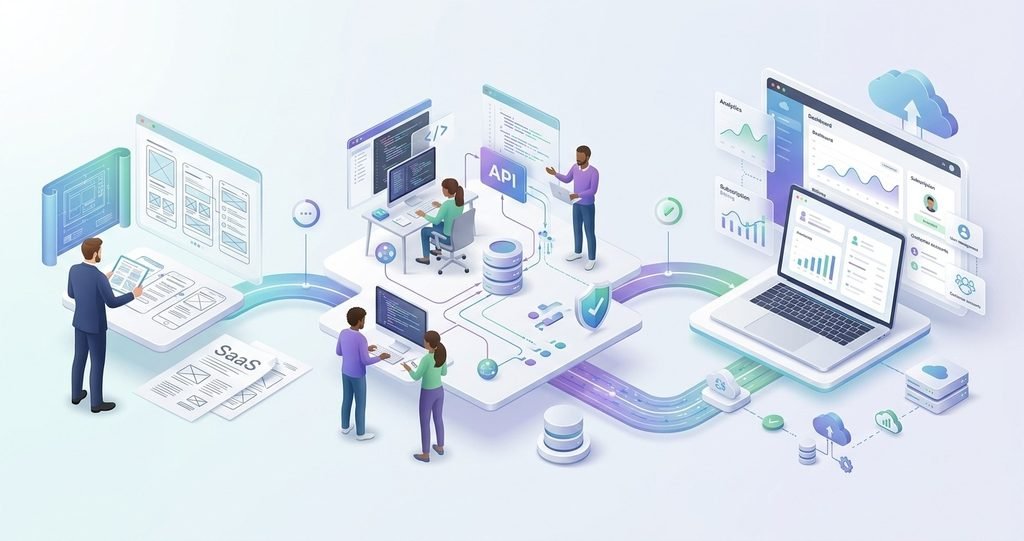
Successful outsourced SaaS project management starts with one principle: the development partner should own its delivery responsibilities, but the business should retain control over product priorities and outcomes.
This becomes especially important when building an MVP. Early SaaS products often change after customer interviews, usability testing, and beta feedback. A good management process needs enough structure to control the project without making useful changes unnecessarily difficult.
Step 1: Define the MVP Before Development
Start by identifying the problem the product solves and the smallest feature set required to validate that solution.
Separate features into three groups: essential for launch, useful after launch, and future ideas. This prevents the MVP from turning into an oversized first release.
For example, a subscription analytics SaaS might initially need user accounts, data connection, core analytics, dashboard reporting, and billing. Advanced AI recommendations and extensive integrations can wait until there is evidence that customers need them.
Step 2: Create a Clear Product Roadmap
Turn the MVP scope into milestones. Each milestone should have specific deliverables and measurable acceptance criteria.
A practical roadmap might include:
Discovery → UX/UI → Architecture → Development → QA → Beta → Production Launch → Maintenance
This gives both the client and external team a shared view of progress.
Step 3: Use Short Development Cycles
Agile sprints work well for SaaS because they create frequent opportunities to review actual product progress.
Instead of waiting until the end of a four-month project, review completed functionality every one or two weeks. Demonstrations can reveal misunderstandings early, when they are cheaper to correct.
Step 4: Build QA Into Every Sprint
Testing should not be postponed until the final week. Functional testing, API testing, regression testing, security checks, and performance validation should happen throughout development.
Automated tests are particularly useful when the SaaS product will receive frequent updates after launch.
Step 5: Prepare Deployment Before Launch Week
Your team should establish the production environment, deployment pipeline, backups, monitoring, logging, error tracking, and rollback procedures before the final release.
A launch plan should answer a simple question: What happens if something breaks immediately after release?
Step 6: Measure the MVP After Launch
Launching the product is the beginning of validation, not the end of development.
Track activation, user engagement, feature adoption, conversion, support issues, retention, and performance. Customer feedback should then influence the next development cycle.
Step 7: Plan Post-Launch Support
A SaaS product requires continuous maintenance. Define who handles bugs, security updates, infrastructure problems, performance issues, and feature requests after launch.
Current SaaS guidance increasingly treats development as an ongoing relationship because subscription products require continuous updates, optimization, monitoring, and support.
The most effective SaaS development outsourcing process therefore combines a tightly scoped MVP with flexible iteration. Keep the first release focused, review progress frequently, protect code and data ownership, and use real customer behavior to decide what gets built next.


One Response