
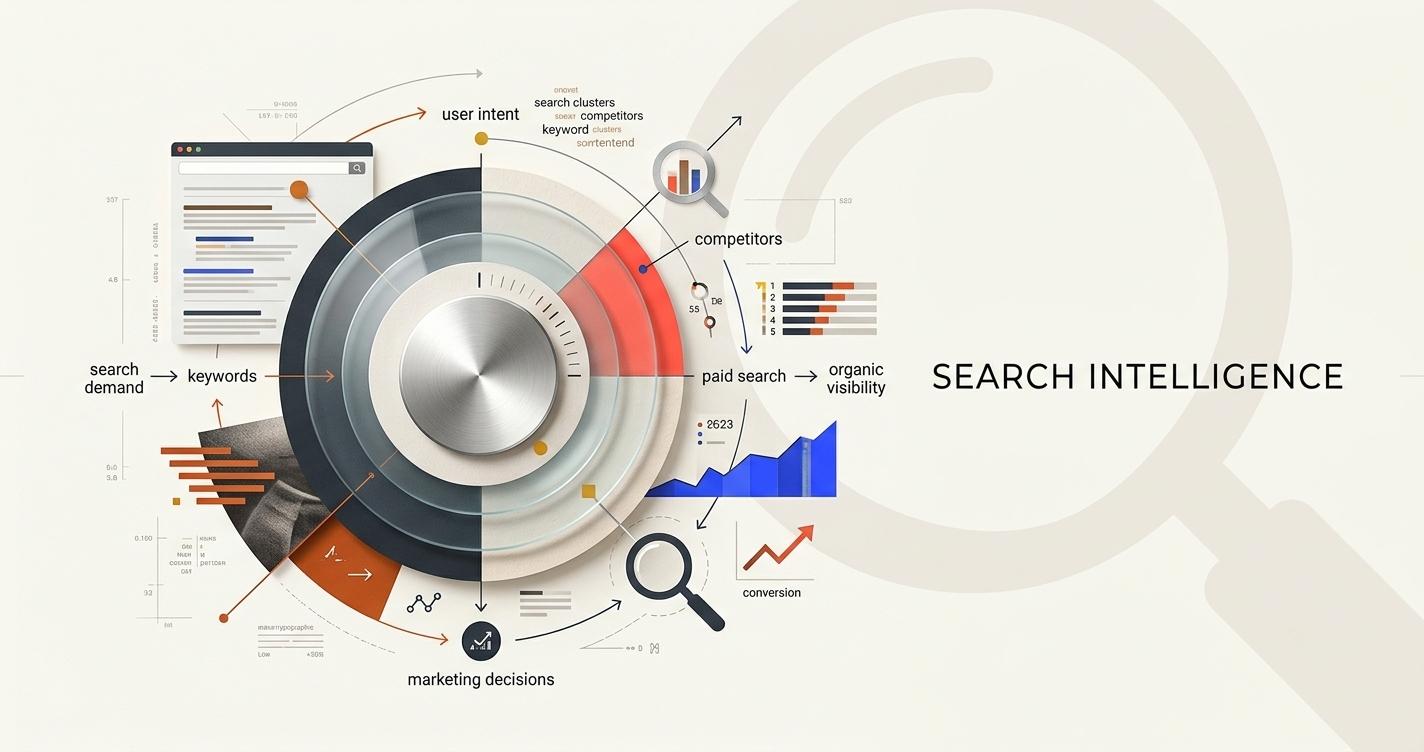
Search marketing has become much more complicated than simply choosing keywords and launching ads. A business can rank well organically, appear in paid results, receive thousands of impressions, and still struggle to understand where its search performance is coming from. The problem is often not a lack of data. It is the lack of a clear system for interpreting that data.
Search engine marketing intelligence brings those scattered signals together. It looks at search behavior, keyword demand, competitor activity, paid advertising, organic visibility, SERP changes, conversion data, and market trends to help marketers make more informed decisions. Recent industry guides describe the discipline as a process of collecting, analyzing, and acting on search data rather than simply producing reports.
This distinction is important because a report can tell a marketer that CPC increased, traffic declined, or a competitor gained rankings. Intelligence goes further by asking why the change happened, whether it matters commercially, and what should happen next.
For example, a sudden increase in CPC may look like a bidding problem. Further investigation could reveal that several competitors have entered the same auction, a seasonal demand shift has occurred, or the keyword is attracting a different type of searcher. Each explanation requires a different response.
The same principle applies to organic search. A competitor ranking above your page is not automatically a reason to create another article. Their page may be winning because it satisfies a different search intent, covers a missing subtopic, has stronger authority, or simply matches the SERP format more closely.
That is why modern search intelligence is increasingly treated as a decision-making discipline rather than another analytics dashboard. It connects search data with business context.
Search Marketing Intelligence Explained
At its simplest, search engine marketing intelligence is the process of turning search-related data into useful marketing insight. The data can come from paid campaigns, organic rankings, competitor activity, keyword research, SERP features, website analytics, conversion systems, and customer behavior.
The important word is intelligence. Collecting numbers alone does not create intelligence.
Suppose a company discovers that the keyword “enterprise accounting software” receives substantial search volume. That information is useful, but incomplete. A marketer still needs to know whether the query has commercial intent, how competitive the SERP is, which companies dominate it, what type of pages Google displays, whether competitors are bidding on it, and whether visitors from the keyword actually become qualified leads.
Search intelligence connects those pieces.
This also explains why search engine marketing intelligence should not be confused with ordinary keyword research. Keyword research helps identify search terms and estimate demand. Intelligence uses those terms as one input among many. Competitor behavior, advertising patterns, search intent, rankings, conversion performance, and market movement can change the meaning of a keyword.
The scope can also vary. Some platforms use the term primarily for paid-search competitive intelligence, including competitor keywords, advertising data, traffic analysis, and PPC performance. TrustRadius, for example, describes search marketing intelligence tools as a specialized area of SEM tools with a strong focus on paid-search data and competitive analysis.
Other current guides use a broader definition that combines SEO and PPC. Marketing Lad describes the discipline as combining SEO, PPC, competitor analysis, keyword trends, and user behavior.
For businesses, the broader interpretation is often more useful because customers do not experience SEO and PPC as completely separate worlds. A person might first discover a brand through an advertisement, later search its name, read an organic comparison article, and finally return through a branded search.
A useful intelligence system therefore asks not only, “Which keyword is performing?” but also:
What is happening in the search market, why is it happening, and what should the business do about it?
That shift—from reporting activity to explaining opportunity—is the foundation of modern search intelligence.
How Search Intelligence Works
A practical intelligence process begins by collecting information from several sources instead of relying on one dashboard. The first layer is usually first-party performance data: impressions, clicks, conversions, revenue, cost, landing-page behavior, organic traffic, rankings, and engagement.
The second layer is external search data. This can include keyword demand, SERP composition, competitor rankings, paid advertisements, estimated traffic, backlinks, content gaps, and changes in search visibility.
The third layer is contextual information. Seasonality, product launches, pricing changes, new competitors, industry developments, and changes in customer behavior can all explain why search performance changes.
This is where search engine marketing intelligence becomes more valuable than isolated metrics. Imagine that organic traffic falls by 15%. A simple analytics report identifies the decline. An intelligence workflow investigates whether rankings fell, search demand changed, SERP features expanded, branded traffic decreased, or competitors captured previously shared queries.
The workflow can be thought of as five connected stages:
Collect → clean → compare → interpret → act.
Data first needs to be cleaned because different tools may use different date ranges, keyword databases, attribution models, or traffic estimates. Comparing inconsistent datasets can create false conclusions.
Next comes comparison. A keyword may look weak in isolation but become interesting when several competitors are investing in it. Likewise, a competitor may appear dominant overall but have weak visibility for an important subtopic.
Interpretation is the most human part of the process. A data point does not automatically explain its cause. Marketers need to connect it with search intent, business goals, customer behavior, and the actual SERP.
Finally, the insight needs to produce an action. That could mean changing an ad, excluding a keyword, improving a landing page, creating a comparison page, adjusting content, defending a branded query, or investigating a competitor.
A useful weekly workflow might therefore include checking major ranking changes, paid-search movement, new competitor ads, conversion trends, search-query patterns, and SERP changes. The purpose is not to stare at dashboards every day. It is to detect meaningful changes early enough to respond.
This approach also prevents a common problem: optimizing what is easiest to measure rather than what actually matters. A keyword with high traffic may have little commercial value, while a smaller long-tail query may consistently generate qualified leads.
Good intelligence prioritizes business impact over impressive-looking numbers.
Signals That Shape Search Insights
The quality of a search strategy depends heavily on the signals being analyzed. Search volume is useful, but it is only one signal. A stronger system considers several dimensions before deciding whether an opportunity deserves attention.
Keyword demand shows how frequently people search for a topic. It helps estimate potential reach, but it does not reveal the complete value of that traffic.
Search intent explains what the searcher wants. A query may be informational, commercial, transactional, navigational, comparison-focused, or local. Intent determines what kind of content or offer is appropriate.
SERP composition provides another important clue. If Google consistently shows product pages, advertisements, comparison pages, videos, local listings, or featured results, that tells marketers something about the expected search experience.
Competitive visibility shows which brands already occupy valuable positions. Instead of simply counting competitors, marketers can study where those competitors appear and what topics they prioritize.
Paid-search signals reveal another layer of commercial behavior. Repeated competitor advertising, recurring offers, landing-page themes, and keyword coverage can indicate which search areas companies consider commercially meaningful. Current industry material emphasizes competitor advertising and paid-search analysis as major uses of search marketing intelligence.
Conversion signals connect search activity to business results. Clicks and impressions matter, but they become much more useful when connected with leads, sales, customer value, or revenue.
SERP change signals are becoming increasingly important. Search pages are not static. New features, AI-generated answers, shopping modules, local results, videos, and other elements can change how much attention traditional organic listings receive.
This means search engine marketing intelligence should also monitor the shape of the results page, not just rankings.
One underused signal is competitor persistence. If a competitor appears to have maintained similar advertising themes for a long period, that can provide more meaningful evidence than a short-lived ad. It does not prove that the campaign is profitable, but it can justify further investigation.
Another useful signal is keyword overlap. Compare the terms where your site and competitors are visible. Then separate them into shared terms, competitor-only terms, and terms where competitors appear weak. This can uncover gaps that ordinary keyword lists miss. Current research-oriented articles increasingly recommend combining organic keyword overlap with paid keyword analysis.
The final step is prioritization.
Not every signal deserves an immediate response. A practical opportunity can be evaluated through a combination of relevance, intent, competition, potential business value, and execution difficulty.
That prevents search teams from chasing every fluctuation and helps them concentrate on changes that can actually influence growth.
Keyword and Intent Intelligence
Keyword research becomes considerably more useful when it is connected with intent. Searchers do not type words into Google randomly. Their queries often reveal what they are trying to accomplish.
Consider three searches:
“what is inventory forecasting”
“best inventory forecasting software”
“inventory forecasting software pricing”
All three concern the same general subject, but the expected user journey is different. The first searcher needs education. The second is evaluating solutions. The third is closer to a commercial decision.
This distinction is central to search engine marketing intelligence because the same keyword metrics can represent very different business opportunities depending on intent.
A common mistake is to choose keywords primarily by search volume. A term receiving 20,000 searches may generate less useful traffic than a specific query receiving 500 searches if the smaller query has stronger commercial relevance.
Intent analysis should therefore consider the language of the query, the SERP itself, the pages ranking for it, and the action a visitor is likely to take afterward.
The SERP is particularly valuable because it provides real-world evidence. If most results for a keyword are detailed educational guides, creating a product page may not satisfy the dominant intent. If the results are mostly software vendors, comparison pages, and pricing pages, the query may have stronger commercial characteristics.
This creates an important relationship between keyword intelligence and content strategy.
For informational queries, businesses may create guides, explainers, definitions, research articles, or educational resources. For commercial investigation, comparison pages, alternatives, case studies, and feature explanations can be more appropriate. Transactional queries may require product, service, pricing, or conversion-focused landing pages.
PPC teams can use the same framework. High-intent queries may deserve closer attention to conversion rate, cost per acquisition, impression share, and landing-page performance. Informational queries may have a different role, particularly when they support later branded or commercial searches.
Intent can also change over time. A keyword that historically behaved as informational may become more commercial as a product category matures. Seasonal events can create temporary changes as well.
This is why keyword classification should not be treated as a one-time spreadsheet exercise.
A stronger process periodically checks whether the actual SERP and user behavior still match the original classification.
There is another overlooked opportunity: query language can reveal customer problems.
Suppose customers repeatedly search for “how to reduce SaaS billing errors.” That query is not just a keyword opportunity. It may reveal a recurring pain point that could influence content, product messaging, sales conversations, and even product development.
In that sense, search behavior can function as lightweight market research.
The best use of keyword intelligence is therefore not simply finding terms to rank for. It is understanding what people need, how urgently they need it, and what evidence they expect before taking the next step.
Also Read: Business Intelligence in Higher Education: Complete Guide
Competitor Search Intelligence
Competitor analysis is one of the strongest applications of search intelligence because competitors leave many observable signals in search results.
A useful competitor analysis begins with visibility rather than assumptions. Identify the queries where competitors appear, the pages receiving that visibility, the advertisements they run, and the themes repeated across their messaging.
The goal is not to copy competitors. It is to understand the market they are competing in and identify gaps.
For example, imagine three competing software companies repeatedly advertise around “automated reporting,” while their organic content focuses heavily on general analytics. A fourth company could investigate whether customers also search for specific problems such as reporting delays, manual spreadsheet work, or data reconciliation. Those related queries may reveal a content or product-positioning opportunity.
Search engine marketing intelligence becomes especially powerful when paid and organic competitor data are compared together.
A competitor ranking organically for a keyword tells you they have search visibility there. A competitor consistently paying for the same keyword provides a different signal: they are willing to allocate advertising budget to that audience. Neither signal proves profitability, but together they can justify deeper investigation.
Competitor ad copy can also reveal positioning.
Repeated phrases such as “free migration,” “same-day setup,” “enterprise support,” or “no contracts” may indicate the objections competitors are trying to overcome. Those messages can be treated as market clues rather than instructions to duplicate their copy.
Landing pages provide another layer. Study where competitors send paid traffic. Is it a product page, industry-specific page, pricing page, comparison page, or lead form? The destination can reveal how the competitor expects the searcher to move toward conversion.
One particularly valuable analysis is the keyword gap.
Separate competitor keywords into three groups:
- Keywords where both sides compete
- Keywords where competitors appear but your site does not
- Keywords where competitors appear but their pages appear weak or poorly aligned with intent
The second group identifies visibility gaps. The third can identify potential openings.
However, competitor data must be interpreted carefully. A competitor may target a keyword because of a different customer lifetime value, geographic market, pricing structure, or business model. Copying its bids or targeting decisions without understanding those differences can waste budget.
Competitor intelligence is therefore evidence, not a blueprint.
Another underused concept is message-gap analysis. Instead of asking only which keywords competitors target, examine what they fail to explain. Are their pages missing pricing context? Do they avoid implementation details? Are FAQs shallow? Do they discuss features but not limitations? Do they ignore a particular audience?
These gaps can produce better content opportunities than simply finding another high-volume keyword.
Search results can also reveal competitive movement. A new brand suddenly appearing across multiple commercial queries may deserve monitoring. A previously dominant competitor losing visibility may indicate an algorithmic change, content weakness, market shift, or technical problem.
The important point is to investigate before assuming the cause.
Effective competitor intelligence does not answer “How can I become like them?”
It answers:
“What is the market rewarding, where are competitors strong, where are they weak, and where can our business create a differentiated response?”
That question leads to strategy rather than imitation.
Paid vs. Organic Search Data
SEO and PPC are often managed as separate disciplines, but search intelligence becomes more useful when their data is viewed together.
Organic search provides signals about long-term visibility, content relevance, authority, rankings, and unpaid demand capture. Paid search provides signals about bidding pressure, advertising messages, landing pages, budget allocation, and immediate conversion opportunities.
Neither channel tells the entire story.
Suppose a company receives strong organic traffic for “CRM software for small business” but has a weak conversion rate. Its PPC team might already be bidding on related commercial queries and discovering which messages produce leads. Those paid insights can potentially inform organic titles, landing pages, comparison content, and calls to action.
The opposite can happen too.
An SEO team may discover that a detailed informational article consistently attracts highly relevant visitors. The PPC team could test whether related commercial terms or remarketing audiences generate additional value from that topic.
This is one reason search engine marketing intelligence should connect paid and organic data instead of treating them as isolated reporting channels.
There are several useful comparison points.
Keyword overlap: Which terms generate organic visibility and paid activity? Where do the two channels compete or complement each other?
Intent overlap: Are PPC campaigns targeting the same commercial intent that organic pages are trying to capture?
SERP ownership: Does the brand appear in both paid and organic results for important searches?
Conversion differences: Do paid visitors and organic visitors behave differently after landing?
Messaging transfer: Are successful PPC messages reflected in organic content where appropriate?
Content opportunities: Are expensive paid keywords also suitable for long-term organic investment?
One particularly useful scenario is identifying keywords where competitors invest heavily in PPC but have weak organic content. These queries may represent a long-term SEO opportunity.
Another is finding terms where a company already ranks strongly. Paying aggressively for those terms may or may not be necessary, depending on the business objective, competition, incremental conversions, and brand strategy. Search intelligence should inform that decision with actual performance data rather than a simplistic “SEO means stop PPC” rule.
Current research also emphasizes the value of combining SEO and PPC signals to identify market opportunities. Digitalways, for example, highlights competitor keyword overlap and the combination of organic rankings with paid-search behavior as a way to identify demand and competitive gaps.
Search engine marketing intelligence works best when search data is combined with reliable guidance on how search engines understand and display content. For official information about crawling, indexing, search visibility, and SEO best practices, marketers can refer to Google Search Central, which provides guidance directly from Google on improving a website’s presence in search results.
Modern search also introduces another layer: AI-generated search experiences.
Traditional rank tracking does not necessarily tell the entire visibility story when users receive AI-generated answers, summaries, or other SERP features before reaching conventional organic listings. Recent 2026 discussions of search intelligence increasingly include AI visibility and changing SERP behavior as part of the broader measurement landscape.
That does not mean every business needs an expensive AI-search platform. It means search teams should understand that “ranking position” is only one representation of visibility.
A more complete measurement model considers whether the brand is discoverable, trusted, clicked, mentioned, and ultimately connected with meaningful business outcomes.
SEM Intelligence Tools
Tools provide the data layer for intelligence, but no single platform can explain every part of a search market.
Google Ads is useful for first-party paid-search performance, including campaign results, search terms, conversions, bidding information, and other account-level signals. Google Keyword Planner can support keyword discovery, demand estimates, and bid-related research.
Platforms such as Semrush and Ahrefs can provide broader keyword, competitor, ranking, backlink, and content research. SpyFu is particularly associated with SEO and PPC competitor research, while Similarweb can contribute market-level traffic and audience information. Current industry guides commonly mention these tools as parts of an intelligence stack rather than treating one platform as sufficient for every purpose.
The important question is not:
“Which tool is the best?”
A better question is:
“Which evidence do I need to make this decision?”
For example, if the question is “Which search terms are generating conversions for my business?”, first-party analytics and advertising data are more important than an external traffic estimate.
If the question is “Which keywords are my competitors visible for?”, a competitor research platform becomes more useful.
If the question is “What does the current SERP look like?”, direct SERP inspection may provide information that a third-party database does not fully capture.
A practical stack can therefore combine:
- First-party analytics
- Search advertising platforms
- Keyword research databases
- Rank tracking
- Competitor intelligence
- Website analytics
- CRM or revenue data
- SERP monitoring
- Search Console data
- Optional AI-visibility monitoring
The last two layers are becoming more important because search behavior is changing. AI Overviews and other generated search experiences can alter how users interact with traditional listings, while search engines continue to add different SERP formats.
But tools also have limitations.
Third-party keyword databases use estimates rather than your actual account data. Competitor traffic numbers are generally modeled. Estimated ad spend should not be treated as a competitor’s confirmed financial record. Ranking tools can vary because of location, device, personalization, database coverage, and update frequency.
That means good search engine marketing intelligence requires judgment about data quality.
A useful habit is to label evidence according to its source.
First-party data: what your own systems directly recorded.
Observed search data: what can be seen in search results or advertising transparency systems.
Third-party estimates: modeled information from external platforms.
Interpretation: the conclusion drawn from those signals.
Keeping these categories separate prevents estimated numbers from becoming “facts” inside a marketing strategy.
The strongest tool stack is therefore not necessarily the largest one. It is the one that provides reliable evidence for the decisions a business actually needs to make.
Also Read: Market Intelligence Tools: Types, Uses, and Key Features
From Search Data to Strategy
The final purpose of intelligence is action. A spreadsheet full of competitor keywords, CPC values, ranking changes, and traffic estimates does not improve marketing by itself.
The value appears when those signals change a decision.
Imagine a B2B software company discovers that several competitors are aggressively bidding on a particular commercial query. Its organic page for that topic ranks on page two, while the SERP is dominated by product pages and comparison content.
The intelligence does not automatically mean “increase the ad budget.”
Instead, the company could investigate:
- Is the query aligned with its ideal customer?
- Are competitors converting that traffic?
- What objections appear in their landing pages?
- Does the existing organic page satisfy the current intent?
- Is the CPC economically sustainable?
- Is there a narrower long-tail variation with stronger relevance?
- Could a comparison or industry-specific page address the intent better?
Now the data has become a decision framework.
This is the central value of search engine marketing intelligence: it helps marketers decide where to look next instead of simply documenting where they have already been.
A useful prioritization model can score opportunities against five practical factors:
Relevance: Does the query match the product, service, or audience?
Intent: Does the search indicate a meaningful problem or buying stage?
Competitive pressure: How difficult is it to gain visibility?
Business value: Could the traffic reasonably influence leads, revenue, retention, or another important outcome?
Execution cost: How much time, content, advertising budget, technical work, or authority would the opportunity require?
This prevents teams from automatically chasing high-volume keywords.
The same framework can be used for competitor movements. If a new competitor appears in several valuable searches, the response should depend on the strategic importance of those searches—not simply on the fact that a competitor appeared.
Measurement should also close the loop.
After an action is taken, monitor the result. Did conversion quality improve? Did the page gain relevant visibility? Did paid acquisition become more efficient? Did a content update attract the intended search audience?
If the result was different from the expectation, that becomes new intelligence.
This creates a continuous cycle:
Search signal → interpretation → action → measurement → learning.
That cycle is more sustainable than one-time audits.
It also makes search strategy less reactive. Instead of changing campaigns whenever a metric moves, marketers can establish thresholds for meaningful changes and investigate only when evidence suggests that action is justified.
The broader lesson is that search data should not exist in isolation from the rest of the business.
A keyword matters because people search for it. A search matters because it reflects a need. A need matters because the business may be able to solve it. And the opportunity matters commercially only when the business can reach the right person with a useful response.
That is where search intelligence becomes more than an SEO or PPC technique.
It becomes a way to understand demand.
Frequently Asked Questions
Is search engine marketing intelligence the same as SEM?
No. SEM generally refers to search engine marketing activities, particularly paid search in many industry contexts. Search intelligence is the analytical layer that examines search, competitor, performance, and market signals to guide those activities. Some sources use the broader term to include both SEO and PPC data, while others focus primarily on paid-search intelligence.
How is it different from keyword research?
Keyword research identifies search terms, demand, and related opportunities. Intelligence adds context by connecting keywords with intent, competitors, SERP behavior, performance, and business outcomes.
Can small businesses use search intelligence?
Yes. A small business does not need an enterprise platform to begin. Search Console, Google Ads data, analytics, manual SERP research, and carefully selected third-party tools can provide a useful foundation. The important part is building a repeatable process rather than collecting every available metric.
Does it only apply to paid advertising?
Not necessarily. Some industry definitions focus strongly on paid-search and competitor advertising data, while broader definitions combine SEO, PPC, competitor research, search trends, and user behavior.
What is the most important outcome?
The main outcome is better decision-making. The goal is not to collect more dashboards. It is to understand search demand, competitive movement, user intent, and performance well enough to choose the next action with stronger evidence.

2 Responses