
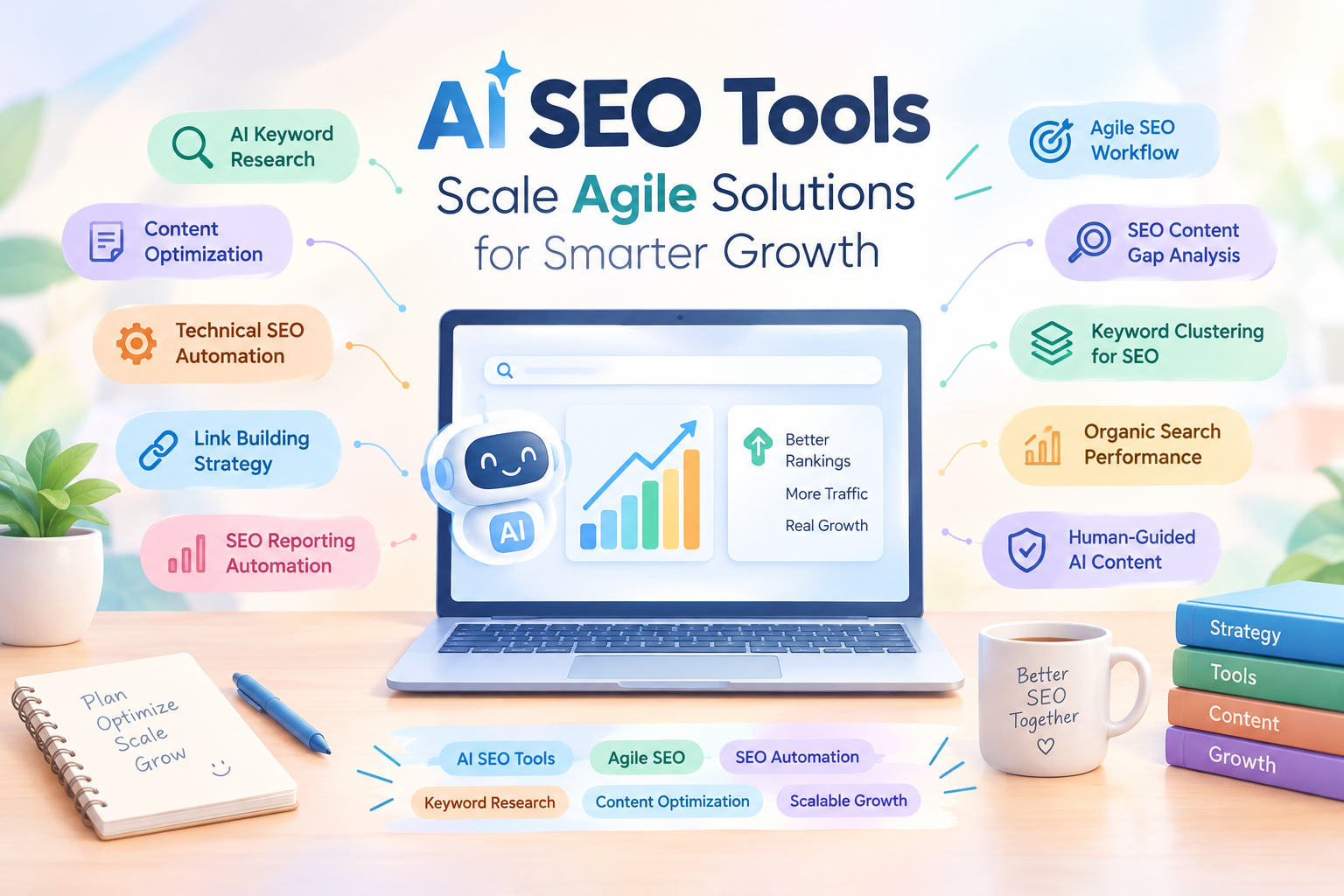
Search engine optimization becomes more complicated as a business grows. A website may begin with a few articles and a small keyword list, but managing hundreds of pages, multiple campaigns, and changing customer needs requires a more organized approa
ch. Teams must research keywords, optimize content, monitor technical issues, and evaluate performance without wasting time on repetitive tasks.
This is where AI SEO tools scale agile solutions becomes a useful concept for modern SEO teams. It combines artificial intelligence with flexible workflows, allowing businesses to identify opportunities, prioritize tasks, and improve strategies through regular testing and feedback.
However, using AI does not automatically produce better rankings. Tools can accelerate research and analysis, but people still need to understand search intent, verify information, and make decisions based on actual performance. Google’s guidance emphasizes helpful, reliable, people-first content rather than publishing large amounts of low-value material.
The real objective is not to publish more pages simply because AI makes production easier. It is to build a repeatable SEO process that helps a team make better decisions, deliver useful information, and respond to changing search behavior.
What Makes AI SEO Workflows Truly Agile?
An agile SEO workflow is a flexible process in which teams organize work into manageable tasks, prioritize valuable opportunities, and review outcomes regularly. Instead of planning an entire year of optimization and waiting months to evaluate results, teams can work in shorter cycles and adjust their priorities as new information becomes available.
Artificial intelligence can support this process by analyzing keyword data, identifying content gaps, summarizing competitor pages, and helping specialists prepare optimization recommendations. When AI SEO tools scale agile solutions effectively, teams can move from research to implementation with fewer unnecessary handoffs.
Consider a small business whose service pages receive search impressions but very few clicks. The team can examine queries in Google Search Console, identify possible mismatches between page titles and user expectations, and prioritize updates for pages with meaningful potential. AI can help organize the findings, but the SEO specialist must decide which changes make sense.
The agile element comes from testing a limited set of improvements, monitoring the results, and using the evidence to plan the next cycle. A team might review its progress every two weeks, although the right schedule depends on its workload and the changes being tested.
This approach also prevents a common mistake: treating every SEO recommendation as equally important. Fixing a broken canonical tag, improving an unhelpful article, and adding another keyword to an already useful page do not necessarily deliver the same value.
A practical workflow combines three elements: AI-assisted analysis, human prioritization, and measurable follow-up. Without prioritization, automation creates more tasks than a team can complete. Without review, even a fast workflow can repeat ineffective decisions.
How AI Finds SEO Opportunities Faster
Keyword research involves more than collecting phrases with high search volumes. A useful analysis must identify what searchers want, how competitive the results are, and whether a topic fits the website’s expertise. AI can help process large keyword lists and group related queries into meaningful themes.
For instance, a digital marketing website might collect searches about technical audits, content optimization, keyword clustering, and search performance reporting. An AI-assisted analysis can organize these phrases, identify overlapping questions, and suggest which topics deserve separate pages. The results should still be validated against actual search results and reliable keyword data.
AI SEO tools scale agile solutions most effectively when they help teams distinguish valuable opportunities from distracting metrics. A keyword with substantial search volume may be unsuitable if the results are dominated by established websites and the site has little relevant expertise. A more specific query may better match the audience, even when its estimated volume is lower.
Another useful application is content-gap analysis. By comparing a website’s coverage with relevant competitor pages, a team can identify unanswered questions, missing explanations, and outdated information. The objective should be to discover information readers genuinely need, not to create a separate article for every minor keyword variation.
AI can also help with technical SEO triage by summarizing crawl reports, grouping similar errors, and highlighting patterns for investigation. However, an AI-generated diagnosis should never replace verification of URLs, status codes, canonical tags, or indexing directives.
A reliable opportunity assessment combines search intent, business relevance, competition, current website performance, and the effort required to improve a page.
| SEO factor | What to examine | Why it matters |
| Search intent | Questions and needs behind a query | Helps match content to readers |
| Search demand | Volume and actual impressions | Estimates potential visibility |
| Competition | Ranking pages and their strengths | Reveals how difficult the query may be |
| Topical relevance | Connection to the website’s expertise | Prevents unfocused content creation |
| Improvement potential | Existing clicks, impressions, and content gaps | Helps prioritize realistic opportunities |
Search Console provides first-party performance data, while third-party SEO platforms offer estimates and additional research features. These sources serve different purposes and should not be treated as interchangeable.
Turning Keyword Clusters Into Content Plans
Keyword clustering means grouping related search queries according to their meaning and likely search intent. It helps SEO teams understand when several queries can be answered by one comprehensive page and when a separate article would provide a better experience.
For example, searches such as “how to optimize existing content,” “content optimization checklist,” and “improve SEO content” may share substantial intent. A single detailed guide could address these needs with clear sections. However, a query asking for a technical website audit tool may require a different page because the reader is looking for software rather than instructions.
AI can accelerate the grouping process by examining phrases, identifying semantic relationships, and suggesting potential topic clusters. Yet keyword similarity alone does not prove that two queries belong on the same page. Reviewing the search results for each query helps reveal whether Google appears to satisfy them with similar content.
AI SEO tools scale agile solutions by making these clusters easier to convert into manageable editorial work. Instead of assigning dozens of disconnected keywords, a content manager can build a topic plan containing a primary query, supporting questions, related subtopics, and a clear purpose for each page.
A practical content plan should include the following elements:
- Primary keyword: The main query the page is designed to address.
- Cluster keywords: Closely related phrases that fit naturally within the same topic.
- Search intent: The information, comparison, or solution the reader expects.
- Content gap: A meaningful question or detail existing pages fail to answer.
- Internal links: Relevant pages that help readers explore related subjects.
- Success measures: Appropriate indicators such as impressions, clicks, engagement, and conversions.
Before publishing a new page, check whether an existing article already serves the same purpose. Creating several pages with nearly identical intent can divide internal links and make it harder to maintain a clear, useful resource.
Keyword clusters should guide content structure, not dictate awkward repetition. Related phrases belong where they help explain the subject. A reader should never feel that a paragraph exists merely to accommodate another search term.
The strongest content plan combines search data, editorial judgment, and a clear understanding of the audience. That balance helps a website build topical depth without producing unnecessary pages.
Choosing Tools for Each SEO Task
SEO teams often make the mistake of choosing multiple platforms before identifying the problems they need to solve. A large software collection can introduce duplicate reports, extra subscriptions, and complicated workflows without improving the quality of decisions.
A better approach is to map each important SEO task to the simplest suitable tool. Some tasks require reliable performance data, others benefit from specialized keyword databases, and some can be completed with a spreadsheet and a clear review process.
AI SEO tools scale agile solutions when their functions support a defined workflow instead of adding complexity. For example, an AI writing assistant may help organize research and identify missing explanations, while a technical crawler can discover broken links, redirect chains, and other website issues. These tools perform different jobs and should not be evaluated as if they were interchangeable.
| SEO task | Suitable tool category | Important limitation |
| Organic performance | Google Search Console | Does not replace a full competitor database |
| Keyword and competitor research | Semrush or Ahrefs | Metrics are estimates and may differ |
| Content optimization | Surfer SEO or Clearscope | Recommendations do not guarantee rankings |
| Topic and draft assistance | AI writing assistant | Requires fact-checking and editorial review |
| Technical auditing | Website crawler | Findings need diagnosis and prioritization |
| Reporting and task tracking | Spreadsheet or project management software | Depends on accurate data and consistent updates |
The right selection depends on the website’s size, budget, technical requirements, and the experience of its team. A new blog may need only a small number of tools, whereas an agency managing many websites may benefit from more specialized reporting and collaboration features.
Before paying for a platform, test it against a real task. Can it identify useful keyword opportunities? Does it export information in a workable format? Can the team verify its recommendations? Does it save meaningful time compared with the existing process?
Also consider data access, integration requirements, user permissions, and recurring costs. A platform that looks impressive during a demonstration may not fit the team’s actual workflow.
Most importantly, do not confuse tool sophistication with SEO expertise. Software can identify patterns, but people must decide which patterns matter, whether the evidence is reliable, and what action will genuinely help the reader.
Also Read: Digital Maze AI: How It Works and Key Benefits Explained
Building a Repeatable SEO Sprint
An SEO sprint is a short, defined work cycle used to complete and evaluate a selected group of improvements. It brings structure to optimization by giving tasks clear owners, priorities, and completion criteria.
A sprint should begin with a specific objective rather than a vague goal such as improving SEO. For example, a team might focus on updating five outdated articles, correcting a group of verified technical errors, or improving titles on pages with substantial impressions and weak click-through rates.
AI SEO tools scale agile solutions by helping teams collect evidence, prepare task lists, summarize findings, and document changes. This can reduce administrative effort and allow specialists to focus on implementation and analysis.
A practical sprint can follow five steps:
Step 1: Review the evidence. Examine Search Console data, technical crawl results, content performance, and relevant keyword research. Identify problems that can be investigated rather than assuming every reported issue is important.
Step 2: Select priorities. Estimate the potential benefit, effort, confidence, and risks associated with each task. Fixing a serious technical problem may take priority over polishing a page that already performs well.
Step 3: Assign ownership. Give each task a responsible person, a clear deadline, and an acceptance criterion. For example, a technical task may be complete when a verified error is fixed and the affected URLs have been checked.
Step 4: Implement and review. Make changes carefully, record what was altered, and check that the implementation works as intended. AI suggestions should be reviewed before they affect live pages.
Step 5: Evaluate and adjust. Review completed work and available performance data. Decide whether to continue the approach, investigate unexpected results, or change priorities for the next cycle.
Not every SEO result appears within a single sprint. Technical fixes can be verified quickly, but organic visibility may take considerably longer to change. A completed task is therefore not the same as a proven ranking improvement.
Keep a simple change log with the page URL, date, modification, reason, and expected outcome. This makes it easier to interpret later changes and reduces the risk of attributing every performance fluctuation to the most recent update.
A repeatable sprint gives the team a reliable process for learning and improving without constantly changing its strategy.

Scaling Content Without Losing Quality
AI makes it easier to produce outlines, summarize source material, draft explanations, and reorganize information. However, increasing output does not necessarily increase the value of a website. Publishing large numbers of similar articles can leave readers with repetitive explanations and few reasons to trust the content.
The challenge is to increase production capacity while preserving originality, accuracy, usefulness, and editorial consistency. That requires a quality-control process, not simply a more powerful writing prompt.
AI SEO tools scale agile solutions responsibly when they support research and editing rather than replacing the entire editorial process. A writer can use AI to identify unanswered questions, organize a complex topic, or find sections that need clarification. The writer should then verify factual claims, evaluate source quality, and contribute meaningful analysis.
One useful method is to establish a content quality checklist before increasing publishing volume.
First, confirm that each article addresses a distinct reader need. Second, verify statistics, product capabilities, technical claims, and quotations against reliable sources. Third, remove repeated paragraphs and generic advice that does not help the audience make a decision. Finally, ensure the finished page is readable, logically structured, and consistent with the website’s expertise.
Original value can come from practical examples, transparent comparisons, documented testing, useful calculations, expert commentary, and clear explanations of limitations. Not every article needs original research, but every article should provide a meaningful reason to exist.
Content updates also deserve attention. Before publishing a replacement article, determine whether an existing page can be improved. Refreshing an outdated explanation, adding missing examples, or correcting confusing advice may be more useful than creating another page targeting the same intent.
Human review is particularly important in sensitive or technical subjects where incorrect information could lead to financial, legal, medical, or security-related harm. The required level of review should reflect the potential consequences of an error.
Finally, assess content quality using reader needs rather than word count alone. A concise answer supported by reliable evidence may serve a query better than a lengthy article filled with repetition. Consistent quality gives a website a stronger foundation for sustainable organic growth.
Tracking SEO Progress Beyond Rankings
Rankings are useful indicators, but they cannot explain every aspect of SEO performance. A page may move upward in search results without attracting more relevant visitors, while another page may earn more clicks because its title and description better match searchers’ expectations.
A balanced measurement system connects SEO tasks to observable outcomes. Before making a change, document the existing situation and define what the team expects to improve. This creates a more useful basis for evaluating results later.
For example, when updating a page title, examine its impressions, clicks, click-through rate, and average position in Google Search Console. Consider the query mix and reporting period before drawing conclusions. A change in average position can reflect shifts in the queries generating impressions, not only movement for one specific keyword.
AI SEO tools scale agile solutions when they help summarize performance patterns and turn large reports into questions worth investigating. A tool might flag declining clicks, identify pages with rising impressions, or group URLs showing similar trends. The specialist must still determine whether the pattern is meaningful and what action, if any, is appropriate.
Useful measurement categories include:
- Visibility: Impressions, query coverage, and organic search presence.
- Traffic: Organic clicks, relevant sessions, and landing-page visits.
- Engagement: Whether visitors find the information useful, interpreted with suitable analytics data.
- Conversions: Meaningful actions such as inquiries, sign-ups, purchases, or other business goals.
- Technical health: Crawl errors, broken links, indexability problems, and implementation quality.
- Workflow efficiency: Time spent on repetitive tasks, tasks completed, and rework caused by errors.
Avoid promising a fixed percentage improvement in rankings or traffic without supporting evidence. SEO outcomes depend on competition, website history, content quality, technical conditions, search demand, and other factors outside a team’s control.
Allow sufficient time for the changes being evaluated. Technical validation may be immediate, while organic performance needs an appropriate observation period. Seasonal patterns, algorithm changes, and competitor activity can also affect results.
A useful report does not simply describe what changed. It explains what the team knows, what remains uncertain, and what it plans to test next. That turns reporting into a decision-making tool instead of a collection of attractive charts.
Also Read: Rankshift AI SEO Tool: Features, Uses and Limitations
Common Automation Mistakes to Avoid
Automation can improve consistency, but poorly designed processes can spread mistakes across an entire website. The larger the operation becomes, the more important it is to identify errors before they affect hundreds of pages.
One common mistake is trusting AI-generated information without checking it. AI may produce incorrect facts, outdated product details, unsupported statistics, or recommendations that do not fit the website. Every important claim should be verified using appropriate evidence.
Another mistake is generating pages simply to target every variation of a keyword. Similar phrases do not automatically justify separate articles. If multiple pages answer the same question with nearly identical information, the team should review whether they serve distinct needs or create unnecessary duplication.
Over-automation can also weaken internal linking, metadata, and technical implementation. For example, automatically changing titles across a large site without testing may remove useful context or create repetitive snippets. Bulk changes should be reviewed, tested on a limited set of pages when appropriate, and checked after deployment.
A further problem is measuring success through output alone. Producing 100 articles in a month says little about whether those articles answer useful questions, attract relevant visitors, or support business goals. Teams should evaluate quality and outcomes alongside production speed.
AI SEO tools scale agile solutions most effectively when automation includes clear limits and review checkpoints. Define which tasks can be automated safely, which require approval, and which should remain under direct specialist control.
Protect access to analytics accounts and customer data, too. Avoid sending confidential information to AI services without checking their data handling policies and your organization’s requirements. Assign appropriate permissions and retain records of important changes.
Finally, do not make every decision in response to a short-term ranking fluctuation. Search results naturally change, and isolated movements do not always justify a major strategy adjustment. Investigate sustained patterns, check the underlying evidence, and make changes for a clear reason.
The goal of automation is to make reliable work easier to repeat, not to eliminate judgment. Strong safeguards allow teams to benefit from speed while protecting accuracy, reader trust, and website quality.
Frequently Asked Questions
Can AI SEO tools improve Google rankings?
They can support activities that contribute to better SEO, including keyword research, content improvement, technical analysis, and performance monitoring. However, no tool can guarantee a first-page ranking. Results depend on the quality and relevance of the content, competition, website conditions, and other factors.
What is the difference between AI SEO and agile SEO?
AI SEO uses artificial intelligence to assist with SEO tasks such as research, analysis, and content optimization. Agile SEO organizes the work into manageable cycles with clear priorities, regular reviews, and adjustments based on evidence. They can work together, but they are not the same thing.
Which AI SEO tools are best for small businesses?
The best choice depends on the task and budget. Google Search Console is useful for understanding search performance, while dedicated SEO platforms can support keyword research, competitor analysis, and content optimization. Small businesses should start with their most important needs rather than purchasing multiple overlapping subscriptions.
Can AI replace an SEO specialist?
AI can automate or accelerate selected tasks, but it does not reliably replace strategic judgment, technical diagnosis, source verification, or understanding of the audience. Human oversight remains important for evaluating recommendations and ensuring that published content is accurate and useful.
How often should an agile SEO workflow be reviewed?
Teams can review tasks weekly or every two weeks, depending on workload and project size. However, organic performance should be assessed over a suitable period for each change. A task review can happen quickly even when its ranking impact requires more time to evaluate.
How can a team measure whether its workflow is successful?
Track completed tasks, implementation quality, time saved, organic impressions and clicks, relevant conversions, and technical health. Compare results with a suitable baseline and document other factors that may explain changes. No single metric provides a complete picture.
Final Thoughts
Sustainable SEO growth comes from combining useful content, sound technical practices, reliable evidence, and consistent improvement. Artificial intelligence can make research and repetitive tasks more manageable, while agile methods help teams focus on priorities and learn from each cycle.
The real advantage appears when tools serve a clear process. Start with a specific problem, select the smallest suitable set of tools, test changes carefully, and review the evidence before expanding the workflow. This approach helps businesses scale their SEO operations without sacrificing accuracy or reader experience.
Ultimately, successful SEO is not about automating everything. It is about using technology to make better decisions, delivering information that genuinely helps people, and improving the website based on what the evidence reveals

One Response