
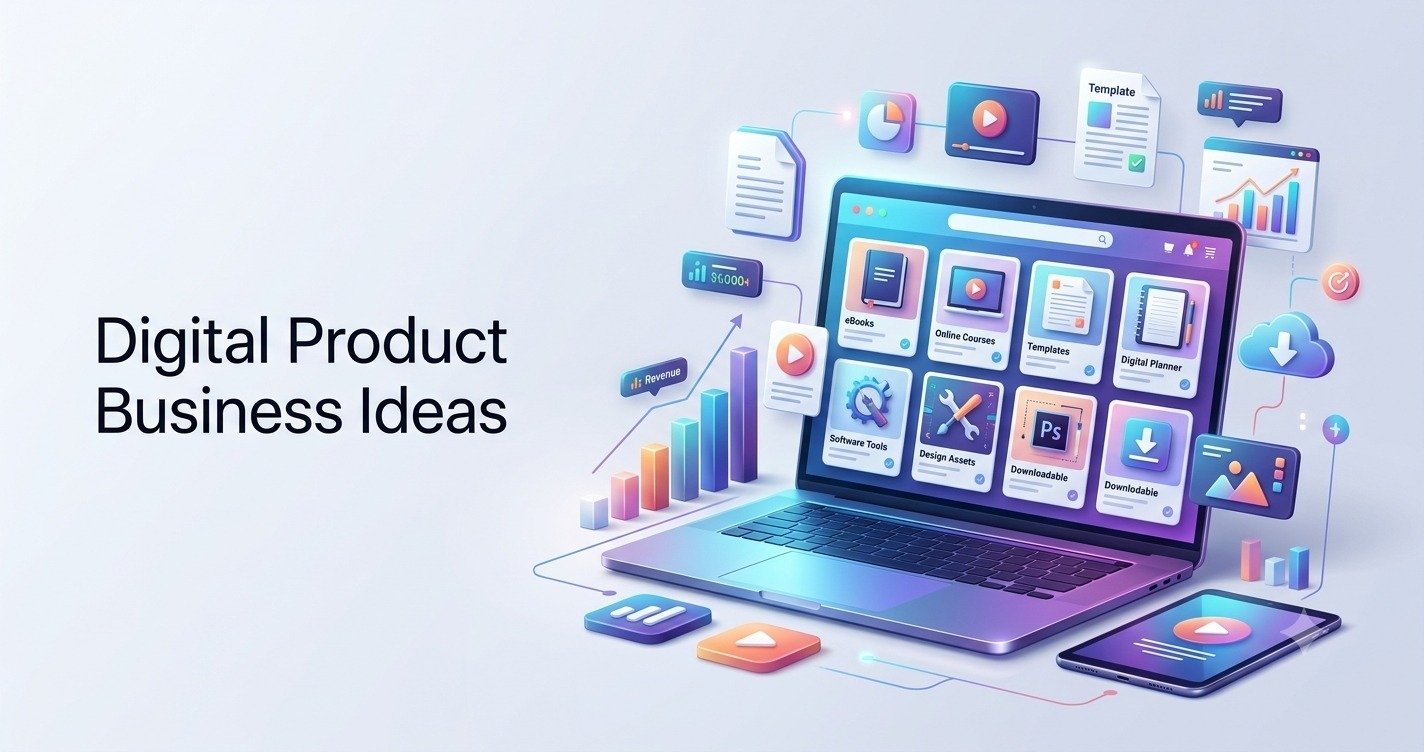
Starting an online business no longer requires a warehouse full of products, complicated logistics, or a large upfront investment. Digital Product Business Ideas offer a different path: create something useful once, deliver it electronically, and continue selling it to customers who need the same solution. The product might be an ebook, course, Canva template, spreadsheet, AI workflow, design asset, software tool, or specialized business resource.
The important part is not simply creating something digital. A successful product solves a recognizable problem. A freelancer may need a better client-management system. A student may need a structured study planner. A small business may want ready-to-use marketing templates. A designer may need professional assets that save hours of work.
That is why the best digital products are usually built around time savings, convenience, expertise, organization, creativity, or a specific business outcome.
This guide explores 25 practical digital product business ideas for 2026, from beginner-friendly downloads to advanced software and AI-powered products. It also explains how each idea works, who can benefit from it, and what makes it commercially useful.
What Is a Digital Product Business?
A digital product business creates and sells goods that exist in electronic form rather than as physical inventory. Customers receive the product through a download, email, online account, license key, or private access link. Common examples include ebooks, online courses, templates, printables, software, digital art, stock media, memberships, and AI-enhanced resources.
The basic model is straightforward. You identify a problem, create a digital solution, package it professionally, and make it available through a website, marketplace, or another sales channel. Once the product exists, delivery can often be automated, meaning the same product can reach many customers without being manufactured or shipped individually.
That does not mean every digital product is automatically profitable. The real advantage comes from the economics and flexibility of the model. There is normally no physical inventory to store, no parcel to prepare for each order, and no manufacturing cycle after every sale. The main investment is usually in research, creation, testing, marketing, platform fees, and ongoing updates. Shopify also identifies low overhead, automated delivery, flexible pricing models, and the ability to sell repeatedly as major advantages of digital products.
There are several business models within this category. A creator can sell a $10 printable, a $50 template bundle, a $200 course, a recurring membership, or a subscription-based software tool. Some products are one-time purchases, while others provide continuous access to new resources.
For example, imagine a freelance SEO consultant who repeatedly creates keyword research sheets, content briefs, audit documents, and reporting dashboards. Instead of rebuilding the same resources for every project, the consultant could turn the best systems into a digital marketing toolkit and sell it to other marketers.
The same principle works across industries. A teacher can create lesson resources. A photographer can sell presets. A designer can create icon packs. A developer can build a niche plugin. An accountant can create financial spreadsheets. A career coach can sell interview workbooks.
The strongest opportunity usually comes from combining expertise + a specific audience + a repeated problem.
Why Start a Digital Products Business in 2026?
A digital products business can be attractive in 2026 because creators have access to better design, automation, AI, ecommerce, and content-production tools than ever before. At the same time, customers increasingly expect information, resources, and software to be available instantly.
The biggest advantage is operational simplicity. A physical product may require manufacturing, packaging, inventory management, warehousing, and shipping. A digital product can often be delivered automatically after payment. Shopify currently supports digital formats ranging from ebooks and workbooks to templates, courses, videos, music, art, and hosted content.
There is also a wide range of entry points. Someone with limited technical skills can start with an ebook, checklist, planner, or Canva template. Someone with professional expertise can build a course or business toolkit. A designer can create digital assets. A developer can build a plugin or micro-SaaS application.
Another reason this model is interesting is specialization. You do not necessarily need to compete with the biggest creators in a broad category. A narrowly targeted product can be more useful than a generic one.
Consider these two ideas:
| Broad Product | More Specific Opportunity |
| Social media templates | LinkedIn templates for B2B SaaS founders |
| Business planner | Business planner for freelance photographers |
| SEO guide | Local SEO guide for dental clinics |
| Budget spreadsheet | Cash-flow tracker for small agencies |
| AI prompts | AI research workflow for content marketers |
The second column gives customers a clearer reason to buy.
AI is another major development. Current 2026 digital-product guides specifically identify AI-enhanced products, prompt collections, and AI workflow templates as emerging opportunities. But the strongest AI products are not simply collections of generic generated content. They combine AI with human expertise, testing, organization, and a specific use case.
There is also an important reality check: digital products face competition. Free alternatives are everywhere, and some marketplaces charge meaningful commissions. Shopify recommends validating demand before investing heavily in product development, while Printful similarly emphasizes products that solve repeat problems such as saving time, teaching skills, improving organization, or helping buyers create faster.
So the real question is not, “Can I make a digital product?”
It is:
“Can I create something useful enough that a particular group of people would rather buy it than build it themselves?”
That is the foundation of a sustainable digital product business.
25 Best Digital Product Business Ideas
The best Digital Product Business Ideas are built around clear customer needs rather than whatever happens to be trending on social media. A product can be simple and still perform well if it saves time, removes complexity, teaches a valuable skill, or gives customers a ready-made solution.
Current 2026 research repeatedly highlights ebooks, online courses, printables, templates, tools, licensed content, premium libraries, memberships, digital art, and AI-enhanced products as major digital-product categories.
Before choosing an idea, evaluate it using four practical questions:
1. Is there a real problem?
A product should solve something customers already experience.
2. Is the outcome valuable?
Saving two hours, improving a business process, or learning a marketable skill can justify a purchase.
3. Can you differentiate it?
A specific audience, better workflow, stronger design, or deeper expertise can separate your product from generic alternatives.
4. Can you deliver it consistently?
Software, memberships, and frequently updated resources require more ongoing work than a static PDF.
It is also useful to think about product complexity. Beginner-friendly digital products often include templates, printables, guides, and worksheets. Intermediate products include courses, design bundles, and business systems. Advanced products include plugins, apps, micro-SaaS, and subscription platforms.
The following 25 ideas cover that entire range.
1. eBooks and Digital Guides
eBooks and digital guides are among the easiest digital products to sell online because they allow creators to package knowledge into a structured resource. They can be short practical guides, detailed handbooks, tutorials, industry reports, recipe collections, career resources, or specialist manuals.
The strongest opportunity is usually not a broad subject. It is a specific problem with a clear outcome. “Marketing Guide” is extremely broad. “Local SEO Guide for Small Dental Practices” immediately tells a potential customer what the resource is designed to accomplish.
A useful ebook should provide more than information that readers can find in a few free searches. It can combine frameworks, examples, checklists, workflows, case explanations, and practical exercises. Shopify also recommends differentiating ebooks through expertise, depth, or a clear unique selling proposition when free alternatives are abundant.
Creators can increase value by adding worksheets, templates, resource lists, or bonus chapters. A marketing ebook, for example, could include a content calendar and campaign-planning worksheet.
This model is particularly suitable for consultants, educators, freelancers, bloggers, and professionals who already possess specialized knowledge.
The key is to sell a shortcut to an outcome, not simply a collection of pages.
2. Online Courses and Workshops
Online courses turn expertise into a structured learning experience. They can include recorded lessons, demonstrations, slides, quizzes, assignments, downloadable resources, or live workshops.
The strongest course ideas start with the learner’s desired result. Instead of creating a course called “Learn Digital Marketing,” create something more specific, such as “Build a B2B Content Strategy From Scratch.”
This makes the value easier to understand.
Courses also work well when the subject requires demonstration. A designer can record a complete design workflow. A developer can demonstrate how to build an application. A photographer can show a complete editing process.
A workshop can be an easier entry point than a large course. You can teach one focused skill in a live session, record it, and later package the recording with supporting resources.
The major advantage is scalability. Once a course is created, the same core lessons can potentially be delivered to many students. Shopify identifies online courses as one of the leading digital product categories and recommends designing them around clear learner outcomes.
However, quality matters. A course should have a logical progression, useful examples, clear explanations, and updated information.
3. Canva Templates
Canva templates are practical design resources that help customers create professional visual content without starting from a blank page.
Potential products include social media posts, presentations, brochures, media kits, resumes, lead magnets, ebooks, flyers, pitch decks, and business documents.
The biggest opportunity comes from specialization.
Instead of creating a generic “Instagram Template Pack,” create something like “Instagram Templates for Real Estate Agents.” The second product immediately communicates its target audience and use case.
Templates should be easy to customize. Use consistent typography, logical spacing, editable elements, and clear instructions.
You can also increase the perceived value by adding content prompts, caption ideas, brand guidelines, or a content calendar.
For example, a social media template bundle could contain 30 post designs plus a 30-day content plan. Now the customer is buying a small marketing system rather than a collection of graphics.
Canva products are especially suitable for designers, marketers, social media managers, and freelancers.
Always use original or properly licensed assets. A visually attractive template does not become a legitimate commercial product if its underlying assets cannot legally be redistributed.
4. Notion Templates
Notion templates turn a blank workspace into a ready-to-use system for managing information, projects, tasks, content, clients, or personal goals.
Examples include content calendars, CRM dashboards, project management systems, study planners, habit trackers, business dashboards, and freelancer workspaces.
The strongest Notion products solve a workflow problem.
A generic “Productivity Dashboard” may struggle to stand out. A “Notion Client Management System for Freelancers” has a much clearer use case.
A good template should include useful databases, views, filters, sample information, navigation, and setup instructions. Customers should be able to understand the workflow without spending hours figuring out how everything works.
You can also build product bundles. A freelancer system might include client management, project tracking, content planning, invoices, and meeting notes.
The product becomes more valuable when it represents a complete workflow rather than a visually impressive dashboard.
Notion templates are a strong choice for people who understand productivity systems, project management, business operations, education, or content creation.
5. Excel and Google Sheets Templates
Excel and Google Sheets templates are excellent examples of digital products that solve practical business and personal problems.
Possible products include budgeting tools, financial trackers, pricing calculators, inventory sheets, project dashboards, content calendars, sales trackers, marketing reports, and business planners.
Their value comes from removing repetitive work.
Imagine a freelancer who needs to calculate project costs, hourly rates, expenses, taxes, and profit margins. A well-built calculator can make that process significantly faster.
Business customers can be especially valuable because a spreadsheet that saves several hours every month may justify a higher price than a simple consumer printable.
The product should be tested carefully. Formulas need to work, instructions should be clear, and users should understand which cells they are expected to edit.
You can also provide versions for different users—for example, a freelancer version, agency version, and small-business version.
This is a strong low-cost digital product category because the creator can start with expertise and spreadsheet skills rather than expensive equipment.
6. Digital Planners and Journals
Digital planners and journals help customers organize their lives or workflows on tablets, computers, or compatible note-taking applications.
Popular ideas include daily planners, weekly planners, study planners, budget planners, meal planners, fitness trackers, travel planners, and goal-setting journals.
The design needs to balance aesthetics with usability.
A planner should make it easy to navigate between sections, enter information, track progress, and review previous entries. A beautiful design that becomes frustrating to use will quickly lose its appeal.
Specific audiences can make the product stronger. A student planner might include assignment tracking, exam preparation, class schedules, and study goals. A freelancer planner could include project deadlines, client tasks, income tracking, and weekly priorities.
You can also create themed bundles with matching stickers, trackers, worksheets, and covers.
Before listing the product, clearly explain the file format and intended application. Buyers should know whether they are receiving a printable PDF, interactive planner, or application-specific template.
7. Printable Worksheets and Checklists
Printable worksheets and checklists are simple digital products, but their usefulness can be surprisingly high when they address a focused task.
Examples include business planning worksheets, travel checklists, classroom resources, wedding planners, project checklists, household organizers, interview preparation sheets, and client onboarding forms.
The best products are usually narrow.
A “Business Worksheet” is vague. A “Client Discovery Questionnaire for Freelance Designers” immediately communicates its purpose.
You can sell individual resources or package several related worksheets into a toolkit.
For example, a freelancer bundle could include:
- Client questionnaire
- Project brief
- Pricing worksheet
- Onboarding checklist
- Revision tracker
- Project completion checklist
This transforms small files into a complete workflow.
Printable products can also serve as entry-level products. A creator might offer a simple checklist as a low-priced product or free lead magnet, then introduce customers to larger paid resources.
Shopify’s current digital-product guidance continues to list printables as a major category, while its printable-business guide emphasizes research, design, testing, bundling, platform selection, and clear instructions.
8. Social Media Templates
Social media templates help businesses and creators publish consistent content without designing every post from scratch.
Products can include Instagram carousel templates, LinkedIn graphics, story designs, Pinterest layouts, promotional posts, YouTube thumbnails, and campaign graphics.
The opportunity becomes stronger when the product is built for one audience.
For example:
- LinkedIn templates for consultants
- Instagram templates for restaurants
- Social media kits for real estate agents
- Content templates for SaaS companies
- Promotional templates for coaches
You can add content prompts and publishing ideas to increase practical value.
A “30-Day Social Media Kit for Local Businesses” could contain 30 editable designs, caption prompts, a content calendar, and a basic publishing checklist.
This approach addresses a bigger problem than design alone: what should I post, and how can I make it look professional?
Templates should also be reviewed periodically because platform dimensions and preferred content formats change.
The goal is to help customers publish faster and more consistently—not simply give them attractive graphics.
9. Resume and CV Templates
Resume and CV templates are practical products for job seekers, graduates, freelancers, and professionals.
A good template should prioritize readability, hierarchy, customization, and compatibility with common editing software. It should make important information easy to find rather than burying it under excessive visual decoration.
Different industries can justify different designs.
A graphic designer may want a visually distinctive portfolio-oriented resume. An engineer may need a more structured technical format. An academic may need space for publications and research.
Related products can include cover letters, portfolio templates, job application trackers, interview preparation worksheets, and LinkedIn profile guides.
Avoid exaggerated promises such as guaranteeing interviews or employment. A template can improve presentation and organization, but it cannot control an employer’s decision.
The value proposition should instead focus on helping users present their experience clearly and professionally.
This category can work particularly well when several documents are bundled together into a complete job-search toolkit.
10. Business Templates and Documents
Business templates can become high-value digital products to sell because companies repeatedly create similar documents and workflows.
Potential products include proposals, client briefs, onboarding forms, meeting agendas, project plans, SOPs, reports, invoices, business planning worksheets, and operational checklists.
The strongest products target a specific role or industry.
For example, a generic proposal template may have many free competitors. A “Client Proposal and Onboarding Toolkit for Freelance Web Designers” has a more defined market.
A complete toolkit might contain a proposal, discovery questionnaire, project scope document, onboarding checklist, meeting agenda, revision tracker, and completion document.
This is also where professional terminology matters. If a product helps businesses document procedures, it should use clear process steps, ownership, inputs, outputs, and review points.
If the product involves legal, tax, regulatory, or financial advice, it should not pretend to replace a qualified professional.
For anyone searching for resources that explain business policy, this category can also include policy-document templates and internal procedure resources—but such templates should clearly state when professional or jurisdiction-specific review is needed.
11. AI Prompt Packs
AI prompt packs package carefully designed instructions for completing specific tasks with AI systems.
Generic prompt collections are increasingly easy to create, so differentiation is essential.
Instead of selling “100 AI prompts,” build a specialized resource such as:
AI Content Research Prompt Pack for SEO Teams
It could contain prompts for topic discovery, competitor analysis, search-intent classification, content briefs, information extraction, editing, and quality checks.
The product becomes more useful when every prompt includes context, variables, examples, expected outputs, and instructions.
A strong prompt pack should help the customer achieve a repeatable result.
The creator also needs to account for changing AI models. Prompts that perform well with one model or workflow may require modification as tools evolve.
AI prompt products are therefore better treated as living resources rather than permanent collections of text.
Current 2026 digital-product guides specifically identify custom AI prompt collections as an emerging category, while emphasizing that AI products become stronger when combined with expertise in a particular field.
12. AI Workflow Templates
AI workflow templates are more advanced than prompt packs because they organize multiple AI-assisted steps into a repeatable process.
A workflow might help with content research, customer support, meeting summaries, sales prospecting, marketing planning, document analysis, or internal knowledge management.
For example, an SEO workflow could include:
- Topic research
- Search-intent analysis
- Competitor review
- Content brief creation
- Drafting
- Fact-checking
- Optimization
- Human review
The customer receives a process rather than a collection of isolated prompts.
This makes AI workflow templates one of the more interesting AI digital product ideas for 2026.
However, responsible design matters. A workflow should explain where human review is required, particularly when dealing with factual, financial, legal, medical, confidential, or business-critical information.
The best product combines automation with quality control.
You can package an AI workflow as a Notion system, PDF playbook, spreadsheet, prompt library, automation blueprint, or combination of these formats.
13. Stock Photos and Videos
Stock photos and videos allow creators to license visual content for websites, advertisements, social media, presentations, videos, and marketing campaigns.
Generic stock imagery is highly competitive, so niche collections are often more interesting.
Examples include:
- SaaS workplace footage
- Healthcare environments
- Local business photography
- Food preparation videos
- Travel scenes
- Professional headshot resources
- Technology visuals
- Industry-specific B-roll
A specialized collection can solve a recurring problem for marketers who cannot easily find authentic visuals for their audience.
Licensing needs to be clear. Buyers should know whether they can use the files commercially, modify them, include them in client projects, or use them in advertisements.
If recognizable people, private property, trademarks, or other protected elements appear, appropriate rights and permissions may be required.
Watermarks can help protect previews, but customers need a clean licensed version after purchase.
Shopify and other current guides continue to include licensed digital content, product photography, stock footage, music, and similar creative assets among digital product categories.
14. Digital Art and Illustrations
Digital art can be sold as illustrations, icon sets, wallpapers, stickers, backgrounds, brushes, patterns, character assets, and other downloadable creative resources.
The strongest commercial opportunity is often tied to a specific use case.
For example, instead of selling “100 illustrations,” an artist might create:
SaaS Onboarding Illustration Pack for Product Designers
This immediately identifies the buyer and purpose.
Businesses and designers often purchase digital art because creating consistent assets internally can take significant time.
File quality matters. Customers should receive the appropriate formats, dimensions, resolutions, and licensing information.
You can also separate personal-use and commercial-use licenses when appropriate.
Consistency is particularly important in asset packs. An icon collection should have a coherent visual style, while an illustration bundle should feel like one complete system.
Digital art can therefore become more valuable when it is designed as a professional resource rather than simply a collection of attractive images.
15. Lightroom Presets and Design Assets
Lightroom presets help creators speed up repetitive editing work and maintain visual consistency.
Photographers, influencers, wedding professionals, travel creators, and businesses may use presets to achieve a particular look across large numbers of photographs.
A strong preset pack should show realistic before-and-after examples and explain which lighting conditions work best.
Different niches can be developed around different photography styles:
- Wedding photography
- Travel photography
- Indoor portraits
- Food photography
- Outdoor lifestyle photography
- Social media content
The broader category can also include Photoshop actions, LUTs, brushes, textures, mockups, Figma resources, and other design assets.
Shopify specifically includes photo presets, brushes, design files, and other creative resources among digital products suitable for online selling.
Testing is important. Assets should behave as advertised, and installation instructions should be straightforward.
A creator can also build recurring revenue by releasing new asset collections rather than relying on one static pack.
16. Fonts, Icons, and Graphics
Fonts, icons, patterns, textures, mockups, and graphic collections are useful digital resources for designers, marketers, developers, and businesses.
Their commercial value comes largely from saving production time.
A designer might prefer purchasing a professionally organized icon system instead of drawing hundreds of icons manually. A startup might purchase a presentation graphics kit instead of building every visual from scratch.
Niche positioning can make these products more discoverable.
Examples include:
- SaaS interface icon packs
- Healthcare icons
- Restaurant graphics
- Business presentation assets
- Minimal UI kits
- Social media graphic bundles
- Startup branding resources
Licensing is one of the most important parts of this business.
Customers need to understand whether they can use the assets in commercial projects, client work, websites, advertisements, apps, or products for resale.
You also need appropriate rights to every asset included in the product.
A strong product page should therefore explain both what the buyer receives and what the buyer is allowed to do with it.
17. Website Themes and Templates
Website themes and templates help users launch websites without designing every page from scratch.
They can target WordPress, Shopify, Webflow, Framer, and other platforms.
The strongest products tend to target specific website types.
Examples include:
- SaaS landing pages
- Consultant websites
- Agency websites
- Restaurant websites
- Portfolio sites
- Ecommerce stores
- Local service businesses
- Coach and creator websites
A good template should be responsive, organized, customizable, and supported by clear documentation.
You can increase value by including multiple layouts, reusable sections, design variations, and setup instructions.
Website templates are more demanding than PDFs because compatibility and maintenance matter. Platform updates can change how themes and integrations work.
This creates an opportunity for recurring revenue. Instead of selling only a static theme, a creator can offer continued updates, new templates, or access to a growing design library.
The product is therefore not simply a design file; it can become part of a broader digital product ecosystem.
18. WordPress Plugins and Tools
WordPress plugins are an advanced digital-product business idea for developers who can identify and solve specific website problems.
Potential products include SEO utilities, form enhancements, analytics integrations, content tools, booking functions, workflow features, performance tools, and specialized business functionality.
The best plugin ideas often come from repeated manual tasks.
For example, if a particular group of website owners repeatedly performs the same operation using several steps, a focused plugin could simplify the workflow.
Unlike a static template, software requires ongoing responsibility. Developers need to consider compatibility, security, updates, documentation, customer support, and testing.
Security deserves particular attention. Poorly developed plugins can create vulnerabilities or break websites.
A freemium model can work well: offer a useful free version and charge for advanced functionality, integrations, updates, or support.
Subscription pricing can also make sense when customers receive continuous maintenance.
This is a good example of how digital products can evolve from downloadable files into full software businesses.
19. Mobile Apps and Micro-SaaS Products
Mobile apps and micro-SaaS products are among the most technically demanding ideas on this list, but they can also create strong recurring-revenue opportunities.
Micro-SaaS focuses on a narrow problem instead of attempting to become a giant all-purpose platform.
Examples might include:
- Niche calculators
- Reporting dashboards
- Appointment tools
- Content planning software
- Invoice utilities
- Industry-specific AI assistants
- Data conversion tools
- Small workflow automation apps
Before building one, validate the problem.
Look at existing competitors, read customer reviews, search relevant communities, examine recurring complaints, and talk to potential users.
A technically impressive application with no urgent problem is still a weak business.
Software also introduces costs that simpler digital products do not have, including hosting, maintenance, API usage, customer support, security, and ongoing development.
The best micro-SaaS products often do one job extremely well.
That narrow focus can actually become the competitive advantage.
20. Memberships and Digital Communities
Memberships turn digital content, resources, education, or community access into a recurring business model.
Members might receive premium articles, templates, courses, research, workshops, software features, exclusive downloads, or access to a private community.
The critical difference from a one-time digital product is the need for ongoing value.
A customer will continue paying only if there is a reason to return.
For example, a marketing membership could release new templates every month. A professional community could provide workshops, discussions, research, networking, and resources.
Memberships can also grow naturally from an existing product business.
A creator might begin with a template pack, build an audience, release additional products, and eventually offer a subscription that provides access to the entire resource library.
This model works best when the creator has a sustainable publishing or community strategy.
Launching a membership purely because recurring revenue sounds attractive is risky. First determine what customers will continuously need.
Also Read: Best SaaS SEO Tools to Boost Your Website Rankings in 2026
21. Paid Newsletters
Paid newsletters turn specialized information, research, analysis, recommendations, or educational content into a recurring digital product.
The strongest newsletters usually serve a defined audience.
Possible niches include technology research, marketing intelligence, industry analysis, professional opportunities, ecommerce trends, business analysis, or specialized educational content.
The customer is not simply paying for articles. They are paying to save research time, filter information, or gain useful insights.
That means the newsletter needs a clear promise.
For example:
Weekly AI Workflow Brief for Small Business Owners
is more specific than:
AI Newsletter
A paid newsletter can also include additional digital products such as spreadsheets, databases, reports, templates, or research documents.
Accuracy becomes especially important when the subject involves professional or financial decisions.
The strongest newsletters build trust through consistent quality, transparent sourcing, useful analysis, and a clearly defined editorial focus.
22. Digital Workbooks and Toolkits
Digital workbooks combine information with practical implementation.
An ebook might tell someone what to do. A workbook asks them to complete exercises, make decisions, record information, and apply the framework.
Examples include:
- Business planning workbooks
- Marketing strategy kits
- Career workbooks
- Brand strategy guides
- Startup planning resources
- Goal-setting systems
- Customer research toolkits
Toolkits can combine several related digital products into one package.
For example, a marketing toolkit could include a customer research worksheet, positioning framework, content calendar, campaign planner, KPI tracker, and reporting template.
This gives customers a complete process rather than one isolated file.
Workbooks are especially useful for consultants, coaches, educators, marketers, and other professionals who want to turn their frameworks into scalable products.
The best products should have a defined outcome.
Instead of “Marketing Workbook,” consider something more specific such as:
30-Day Content Strategy Workbook for Small Businesses
The second version immediately communicates the intended result.
23. Business Courses and Training Materials
Business training materials target companies and professional teams rather than only individual consumers.
Possible products include employee onboarding resources, sales training, customer-service materials, leadership workbooks, workshop slides, professional development courses, and internal process guides.
B2B customers can sometimes justify higher-value products because organizations may be purchasing resources that save training time or standardize internal processes.
A complete training package could include:
- Presentation slides
- Facilitator guide
- Participant workbook
- Exercises
- Knowledge checks
- Implementation checklist
The quality standard should be high because businesses expect clear structure and professional presentation.
If the material involves compliance, law, finance, taxation, workplace regulation, or another specialized field, it should be reviewed appropriately and should not imply that a generic template replaces professional advice.
This category also creates licensing opportunities. Instead of selling one individual copy, you can offer appropriate team or organization licenses.
24. Digital Marketing Resources
Digital marketing resources are useful when they help marketers execute recurring tasks faster.
Possible products include SEO templates, content calendars, keyword research sheets, campaign planners, email frameworks, reporting dashboards, social media systems, customer research templates, and marketing checklists.
The market is broad, so specialization is critical.
For example:
Generic: SEO Template
Specific: Local SEO Audit Toolkit for Small Businesses
The second product gives the buyer a clear reason to investigate it.
You can also bundle several resources into one workflow.
An SEO toolkit could include keyword research sheets, content briefs, competitor analysis templates, on-page checklists, reporting dashboards, and editorial calendars.
The product should be based on a real process rather than generic advice.
Marketing also changes quickly. Search algorithms, advertising platforms, AI tools, analytics systems, and social networks evolve, so resources may require updates.
This creates an opportunity for premium versions that include periodic updates and new resources.
25. Industry-Specific Digital Products
Industry-specific digital products are designed for one profession, business type, or niche audience.
This approach can be extremely effective because the product is built around a particular workflow rather than a generic category.
Consider the difference:
Generic: Business Planner
Niche: Business Planning Toolkit for Freelance Photographers
The second product tells the customer exactly who it is for.
Industry-specific products can include templates, calculators, guides, checklists, training, reports, databases, workflows, or software.
Potential niches include real estate, education, restaurants, accounting, consulting, recruiting, photography, ecommerce, SaaS, construction, professional services, and many other industries.
The strongest opportunities usually come from firsthand knowledge of repetitive problems.
Ask:
- What task do professionals repeat every week?
- What information do they repeatedly organize?
- What document do they repeatedly create?
- What calculation do they repeatedly perform?
- What process is unnecessarily slow?
- What do customers frequently ask them to explain?
The answer can reveal a product opportunity.
This is also where Digital Product Business Ideas become more defensible. Instead of competing with thousands of general templates, you can build a solution around a narrow workflow that requires genuine understanding of the audience.
Niche does not mean tiny. It means specific enough that the customer immediately recognizes the product as relevant.
That clarity can become one of your strongest competitive advantages.