
Getting people to a Shopify store is only the beginning. The more important question is what happens after someone lands on the site. Do they understand the offer, trust the seller, see enough value, and feel comfortable completing the purchase?
For digital product businesses, this distinction matters even more. A store can attract thousands of visitors through Google, TikTok, YouTube, email, or paid advertising and still generate disappointing revenue if the buying experience does not match visitor expectations.
This is where the digital product conversion rate benchmark for Shopify stores using AI tools becomes useful. A benchmark gives merchants a reference point, but it should not be treated as a universal pass-or-fail score. Conversion performance depends heavily on the product, price, audience, traffic source, device, brand reputation, and purchase intent.
A $12 productivity template aimed at an audience that already knows what it wants behaves very differently from a $399 professional course being introduced to a first-time visitor.
For U.S. digital product sellers, another factor is increasingly important: buyers have become accustomed to fast, transparent online experiences. They expect clear pricing, quick answers, secure payment options, straightforward refund terms, mobile-friendly pages, and enough product information to make a decision without contacting the seller.
AI is adding another layer to this experience. Recommendation systems, conversational assistants, behavioral personalization, search improvements, automated merchandising, and analytics can help remove unnecessary steps between discovery and purchase. But AI should solve a real customer problem rather than simply being added because it is fashionable.
The strongest Shopify stores therefore look beyond traffic numbers. They examine where visitors hesitate, which pages create confusion, which traffic sources produce qualified buyers, and what happens immediately before a customer abandons the purchase.
What Conversion Rate Actually Tells a Digital Product Seller
A Shopify conversion rate measures the percentage of visitors who complete a defined conversion action. For most digital product stores, the primary conversion is a completed purchase.
The basic calculation is:
Conversion Rate = (Completed Purchases ÷ Relevant Visitors) × 100
For example, suppose a store receives 5,000 eligible sessions during a month and generates 150 completed purchases. Its basic purchase conversion rate would be 3%.
That number is useful, but it does not tell the entire story.
A merchant should also understand where those visitors came from. A visitor arriving from a highly specific Google search may behave very differently from someone who clicked a broad social media post. Treating both groups as one audience can make an otherwise healthy store appear weaker than it actually is.
Device-level performance matters too. If desktop visitors convert at a healthy rate while mobile visitors leave much more frequently, the overall number can hide a mobile usability problem. The same principle applies to new versus returning visitors, paid versus organic traffic, and low-priced versus premium products.
Digital product sellers should also distinguish between a store-wide conversion rate and a product-level conversion rate. A popular $15 template might convert strongly while a $250 course receives considerable traffic but very few sales. Combining them into one number can make optimization decisions less precise.
For that reason, the benchmark should be the starting point for investigation, not the final objective.
Shopify Conversion Benchmarks Need More Context Than a Single Percentage
There is no single conversion percentage that automatically defines a successful Shopify digital product business.
A store’s realistic performance range can change substantially based on product category, price, brand familiarity, audience intent, traffic source, geography, seasonality, and the amount of information required before purchase.
A low-priced downloadable template can often be purchased after a short evaluation. A software-related digital product, professional course, or expensive business resource may require considerably more research. Visitors may read several pages, compare competitors, watch a demonstration, or return later before buying.
This is particularly relevant when analyzing U.S. traffic. A merchant may see a large amount of American traffic but still have a low purchase rate if those visitors are researching rather than buying. Geographic traffic alone does not equal commercial intent.
Instead of asking, “Is my conversion rate good enough?” ask more specific questions:
Which audience converts best?
Which product creates the most completed purchases?
Which acquisition channel brings buyers rather than browsers?
Where do users leave the buying journey?
Does conversion change significantly between mobile and desktop?
Those questions produce much more actionable information than comparing one percentage with a generic industry figure.
A useful benchmark should therefore be treated as a reference range. Your own historical performance is often the more valuable benchmark because it reflects your specific product, audience, pricing model, and customer journey.
Even a seemingly small improvement can have a meaningful revenue effect. If a store receives 10,000 qualified visitors and increases its conversion rate from 2% to 3%, it moves from 200 purchases to 300 purchases without requiring another 5,000 visitors.
That is why improving the efficiency of existing traffic can sometimes be more valuable than continuously increasing advertising spend.
Why Digital Products Have a Different Conversion Journey
Selling a digital product removes several obstacles associated with physical ecommerce, but that does not automatically make conversion easy.
There is no warehouse inventory to manage, no shipping box to prepare, and generally no delivery truck involved. A customer can often receive access almost immediately after payment.
That convenience creates a major advantage: the distance between deciding to buy and receiving the product is extremely short.
Consider someone searching for a spreadsheet template to organize a small business. If the product page immediately demonstrates the template, explains what is included, shows screenshots, states the price, answers compatibility questions, and provides clear purchase instructions, the customer may not need a long sales process.
However, digital products have their own trust problem.
Customers cannot physically examine an ebook, course, template, prompt library, software resource, or downloadable asset before purchasing. They have to judge its quality from the information presented by the seller.
That makes product previews especially important.
Instead of saying that a template is “professional and easy to use,” a merchant can show actual pages, explain the workflow, demonstrate a real use case, and clarify what the customer receives after payment.
The same principle applies to courses and software resources. Buyers want to know not just what the product contains, but what they will be able to accomplish with it.
For U.S. consumers, transparent policies can further reduce hesitation. Clear refund terms, billing information, contact details, privacy information, and straightforward descriptions help remove uncertainty before checkout.
The Real Conversion Advantage Is Value Delivery, Not Just Instant Access
Instant delivery is useful, but it is not enough to create a strong conversion rate.
The deeper advantage of digital products is that they can deliver a solution without the physical limitations of traditional ecommerce.
A buyer can purchase a resume template at night, download a business spreadsheet immediately, begin an online course within minutes, or start using a digital workflow without waiting for a package.
This creates an opportunity for merchants to position products around time saved, problems solved, or outcomes achieved.
For example, instead of focusing entirely on the number of pages in an ebook, the product page can explain who the ebook is for, what problem it addresses, and what the reader can realistically learn from it.
A Notion template can be presented as a way to organize a particular workflow rather than merely as a collection of database pages.
An AI resource can explain the task it simplifies, demonstrate the workflow, and show where human judgment is still required.
This outcome-oriented approach is especially important because digital products are often compared against free alternatives. A buyer may be asking, “Why should I pay for this when I can find something similar for free?”
The product page needs to answer that question before checkout.
How AI Can Improve the Shopify Digital Product Buying Experience
AI can influence conversion at several points in the customer journey, but its value depends on implementation.
An AI-powered search system can help visitors find a relevant product when they do not know the exact product name. A conversational assistant can answer questions about compatibility, contents, intended users, or product differences.
Recommendation systems can introduce related products after a visitor views or purchases something. For example, someone purchasing a marketing template could potentially be shown a complementary content calendar or reporting spreadsheet.
Personalization can also be used to make landing pages more relevant. A visitor arriving from a specific campaign could be presented with messaging that matches the problem highlighted in that campaign rather than receiving generic store-wide copy.
Another opportunity is behavioral analysis. AI-assisted analytics can help merchants identify unusual patterns such as high product-page engagement followed by checkout abandonment, repeated searches for an unavailable product, or significant differences between mobile and desktop behavior.
But there is an important limitation: AI cannot repair a fundamentally weak offer.
If the product is poorly positioned, overpriced for its perceived value, confusingly described, or supported by weak trust signals, adding an AI chatbot will not magically create demand.
AI works best when it removes friction from an already useful customer experience.
What U.S. Buyers May Need Before They Trust a Digital Product
Trust is one of the most important conversion factors for downloadable products because the customer is buying something they cannot physically inspect.
A U.S.-focused Shopify store should make essential purchase information easy to locate rather than forcing visitors to search through several pages.
The product page should make the following questions easy to answer:
What exactly am I buying?
Who is this product designed for?
What files, features, or lessons are included?
How will I receive access?
Does it work with the software or platform I use?
Can I see a sample before purchasing?
What happens if I have a problem?
Is there a refund policy?
Who is behind the product?
Clear answers reduce uncertainty and allow visitors to make an informed decision.
Social proof can help as well, but it should be specific. A vague statement such as “thousands of happy customers” is less informative than a genuine review explaining how the product was used and what problem it solved.
Screenshots, previews, demonstrations, FAQs, creator information, support details, and transparent policies can collectively provide the evidence a buyer needs.
Product Pages Often Decide Whether Traffic Becomes Revenue
Many merchants spend heavily on acquiring visitors but give insufficient attention to the product page itself.
For digital products, the page should quickly communicate the relationship between problem, solution, value, and proof.
The headline should establish what the product does. The supporting copy should explain who it is for and why it matters. Visual previews should make the product tangible. The pricing section should remove ambiguity. Testimonials or examples should provide evidence. The call to action should be easy to identify.
The page should also anticipate objections.
If customers commonly ask whether a template works with Google Sheets, Excel, Canva, Notion, or another platform, that information should appear before checkout. If a course requires a particular skill level, state it clearly.
Every unanswered question creates another reason for a visitor to delay the purchase.
This is one area where AI-assisted analysis can be particularly useful. Instead of guessing what customers need, merchants can analyze search queries, support questions, reviews, and on-site behavior to identify recurring objections and then incorporate those answers into the product page.
Checkout Friction Can Destroy an Otherwise Strong Conversion Rate
A visitor can be completely convinced by a product and still abandon the purchase if checkout becomes confusing.
Digital products should generally have a straightforward purchasing path. Unnecessary fields, unclear pricing, unexpected charges, difficult account requirements, or confusing payment steps can create friction at the final stage.
Mobile optimization deserves special attention because many customers browse and purchase from smartphones. Buttons should be easy to tap, important information should remain readable, and the checkout process should not feel unnecessarily complicated on a smaller screen.
Merchants should also investigate checkout abandonment rather than assuming every lost visitor disliked the product.
A customer who reaches checkout has demonstrated substantially more intent than someone who leaves immediately from a landing page. That makes checkout behavior particularly valuable for optimization.
A Better Way to Measure Digital Product Conversion Performance
Rather than monitoring one store-wide conversion rate, Shopify merchants can build a more useful performance picture by segmenting their data.
Compare new and returning visitors. Separate organic search from paid traffic. Examine mobile and desktop behavior independently. Look at individual products instead of combining every offer. Review conversion by landing page and acquisition campaign.
For example, suppose organic traffic converts at 3.8%, email traffic at 5.2%, and broad social traffic at 0.9%. Increasing social traffic simply because it generates more visitors may not be the best strategy. Improving targeting or reallocating resources toward higher-intent channels could produce better revenue.
The same logic applies to AI tools. Do not judge an AI feature because it sounds advanced. Measure whether it improves a meaningful business outcome.
If an AI recommendation feature increases product discovery but produces no additional purchases, its implementation may need adjustment. If an AI assistant reduces repetitive support questions while helping qualified visitors reach the correct product, it may be delivering value even if its direct conversion impact is modest.
The objective is not to make a Shopify store look technologically advanced. The objective is to make the buying journey more efficient.
The Most Useful Benchmark Is the One You Can Improve
A conversion benchmark can tell a Shopify merchant whether performance deserves investigation, but it cannot explain why visitors are not buying.
That explanation comes from the data behind the percentage.
For digital products, strong conversion performance usually develops from several improvements working together: clearer positioning, better product demonstrations, stronger trust signals, useful pricing structures, faster pages, mobile usability, transparent policies, smoother checkout, and relevant personalization.
AI can strengthen many of these areas, particularly search, recommendations, customer assistance, personalization, and behavioral analysis. Yet the technology should remain secondary to the customer problem.
The strongest strategy is therefore not to chase a particular percentage simply because another Shopify store reports it. Build a baseline, segment the audience, identify the largest point of friction, make one meaningful improvement, and measure the result.
For a U.S.-focused digital product business, that approach creates something much more valuable than a generic conversion benchmark: a repeatable system for turning qualified traffic into customers.
Factors That Affect Conversion Rates
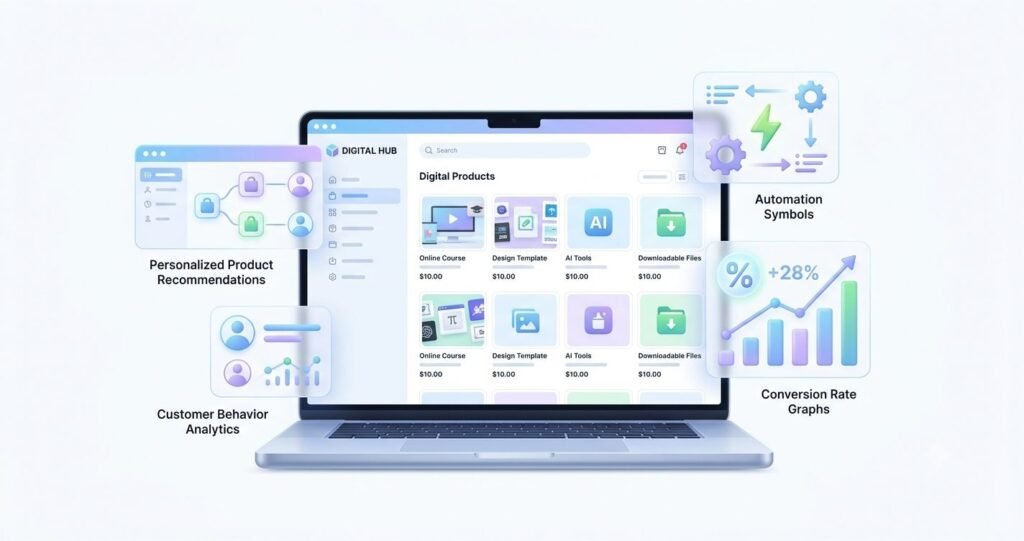
Every Shopify store receives visitors, but not every visitor becomes a customer. The difference usually comes down to a combination of factors that influence trust, usability, and purchasing confidence. Understanding these elements allows store owners to identify weaknesses before they reduce sales.
Traffic quality is one of the most important factors. Visitors arriving through highly targeted search queries or email campaigns generally convert better than untargeted audiences. Bringing the right people to your store is often more valuable than simply increasing traffic volume.
Product pages also have a direct impact on conversions. High-quality images, video demonstrations, detailed descriptions, benefit-focused copy, FAQs, and realistic previews help customers understand exactly what they are buying. Unclear product pages increase hesitation and lead to abandoned sessions.
Website speed is equally critical. Even a few extra seconds of loading time can reduce user engagement, especially on mobile devices. Fast-loading Shopify themes, optimized images, and lightweight apps contribute to a smoother shopping experience that encourages visitors to continue toward checkout.
Pricing strategy influences buyer psychology as well. Customers compare value rather than price alone. Clear pricing, transparent refund policies, limited-time offers, and product bundles often improve perceived value while increasing average order value.
Trust signals are another major contributor. Customer reviews, secure payment badges, creator credentials, money-back guarantees, and authentic testimonials reassure buyers that they are making a safe purchase. Digital products rely heavily on credibility because customers cannot physically inspect the item before buying.
Artificial intelligence further strengthens conversion optimization. AI-powered product recommendations, predictive search, personalized content, and automated customer support reduce friction throughout the buying journey. By presenting the right product at the right moment, AI helps customers reach purchasing decisions faster while improving their overall shopping experience.
Finally, the checkout process should remain simple and distraction-free. Every unnecessary field, confusing step, or unexpected cost increases abandonment risk. Successful Shopify stores continuously monitor customer behavior, test improvements, and refine every stage of the purchase journey to maximize conversions over time.
Best AI Tools for Shopify Stores
Artificial intelligence has become one of the biggest competitive advantages for Shopify merchants, especially those selling digital products. Instead of relying on guesswork, modern AI tools analyze customer behavior, automate repetitive tasks, personalize shopping experiences, and help increase conversions without increasing advertising costs. For stores selling ebooks, AI prompts, templates, courses, software, or digital downloads, AI is no longer just an optional feature—it has become part of a successful conversion strategy.
The biggest reason AI tools improve conversion rates is personalization. Every visitor behaves differently. Some compare prices, some need more product information, while others simply need reassurance before making a purchase. AI identifies these patterns and delivers the right content at the right time.
For example, an AI-powered recommendation engine can suggest a bundle of Canva templates to someone viewing a social media planner instead of showing random products. This increases both conversion rates and average order value because the recommendations match the customer’s intent.
AI chatbots are equally valuable. Unlike traditional live chat, AI assistants respond instantly, answer product questions, explain licensing terms, recommend products, and remain available 24/7. This reduces customer hesitation, especially for first-time buyers purchasing digital products.
Content generation tools also play an important role. Writing persuasive product descriptions for dozens of digital products can take weeks. AI copywriting tools help create optimized descriptions that focus on benefits rather than features while maintaining SEO best practices.
Another growing category is AI analytics. Instead of simply reporting visitor numbers, these tools explain why customers abandon carts, where users lose interest, and which pages generate the highest conversions. This allows store owners to make informed improvements rather than relying on assumptions.
Personalization platforms also improve user experience by displaying different products, offers, or recommendations based on visitor behavior. Returning customers may see premium bundles, while first-time visitors receive beginner-friendly products or educational resources.
Although AI simplifies many tasks, successful Shopify stores still rely on human oversight. AI should support decision-making rather than replace it. Store owners who combine AI insights with customer feedback usually achieve better long-term results than those relying entirely on automation.
The goal isn’t to install dozens of AI apps. Too many applications can slow down a Shopify store and create unnecessary complexity. Instead, choose tools that solve specific problems, such as improving product discovery, increasing trust, reducing customer support workload, or optimizing product pages.
Recommended AI Tools for Shopify Stores
| AI Tool Type | Primary Purpose | Conversion Benefit |
| AI Chatbot | Instant customer support | Reduces hesitation before purchase |
| AI Product Recommendation Engine | Personalized product suggestions | Increases conversions and average order value |
| AI Copywriting Tool | SEO-friendly product descriptions | Improves engagement and search visibility |
| AI Email Automation | Personalized follow-up campaigns | Recovers abandoned customers |
| AI Analytics Platform | Visitor behavior analysis | Identifies conversion bottlenecks |
| AI Search & Discovery | Smarter product search | Helps visitors find products faster |
Choosing the right AI tools depends on your business model rather than trends. A digital template store may benefit most from recommendation engines, while an online course business might gain more value from AI chatbots and email automation. Focus on solving customer problems first, and higher conversions usually follow naturally.
How to Improve Conversion Rates
Improving your Shopify conversion rate doesn’t always require more traffic. In many cases, optimizing the buying experience delivers better results than spending additional money on advertising. Every improvement that reduces friction helps more visitors become customers, making your existing traffic significantly more valuable.
The first step is understanding visitor intent. Someone searching for “AI marketing prompt bundle” already knows what they want. Your product page should immediately explain how your digital product solves that problem instead of forcing visitors to search for basic information.
Product pages deserve special attention because they are often the deciding factor in a purchase. Instead of listing technical features, explain practical outcomes. For example, rather than saying a template includes 50 pages, explain how it helps users save hours of work every week. Benefits influence purchasing decisions more than specifications.
Visual content also matters. High-quality screenshots, preview videos, downloadable samples, or interactive demonstrations help customers understand exactly what they will receive. Since digital products cannot be physically inspected, realistic previews reduce uncertainty and increase buyer confidence.
Trust is another essential factor. Customer reviews, creator credentials, secure payment badges, refund policies, and frequently asked questions reassure buyers that they are purchasing from a reliable business. Trust often becomes the deciding factor when several stores sell similar digital products.
Website speed should never be ignored. Visitors expect pages to load almost instantly, especially on mobile devices. Compressing images, limiting unnecessary Shopify apps, and choosing a lightweight theme improve user experience while reducing bounce rates.
Checkout optimization is equally important. Every additional step increases the chance that customers will leave before completing payment. Keep forms simple, display pricing clearly, avoid unexpected charges, and offer familiar payment options whenever possible.
Artificial intelligence further strengthens conversion optimization by identifying visitor behavior patterns. AI-powered recommendation systems, predictive search, personalized product suggestions, and automated email reminders help customers continue their buying journey without feeling overwhelmed.
Continuous testing separates successful Shopify stores from average ones. Small changes to headlines, product images, pricing layouts, call-to-action buttons, or checkout design can produce noticeable improvements over time. Rather than making multiple changes at once, test one element, measure the results, and then optimize further.
Practical Ways to Increase Shopify Conversion Rates
| Optimization Strategy | Why It Works |
| Improve product descriptions | Explains value clearly and builds confidence |
| Add customer reviews | Creates trust and reduces buying hesitation |
| Use AI product recommendations | Personalizes the shopping experience |
| Speed up page loading | Keeps visitors engaged longer |
| Simplify checkout | Reduces cart abandonment |
| Offer product bundles | Increases average order value |
| Include FAQ sections | Answers objections before purchase |
| Test different CTAs | Identifies higher-converting messaging |
| Optimize for mobile | Improves experience for most shoppers |
| Analyze user behavior regularly | Finds opportunities for continuous improvement |
Conversion rate optimization is an ongoing process rather than a one-time project. Customer expectations change, competitors evolve, and buying behavior shifts over time. Store owners who regularly analyze performance, test improvements, and adapt their strategy consistently outperform those who rely solely on attracting more visitors.
Common Conversion Mistakes Shopify Digital Product Stores Make
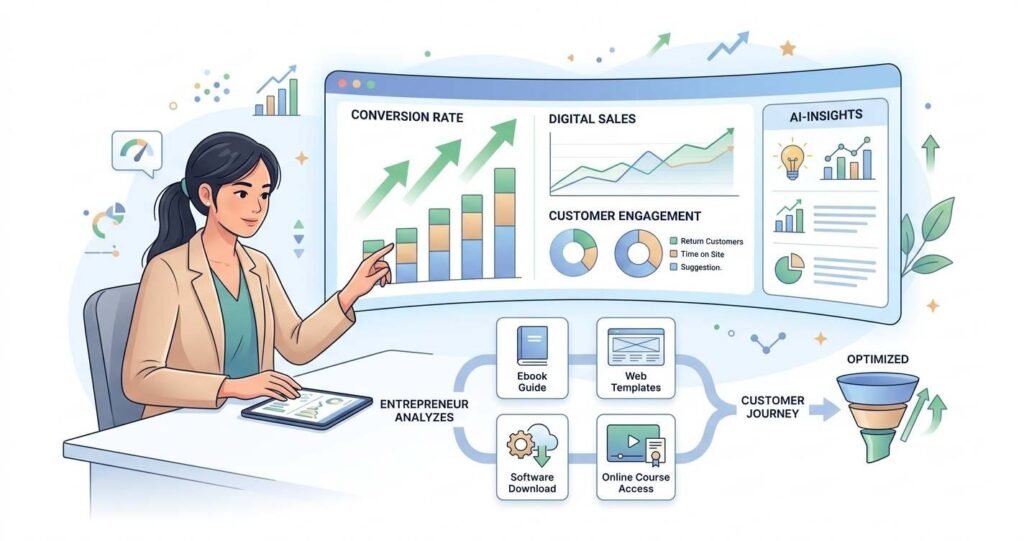
Many Shopify store owners focus heavily on getting more visitors but ignore the reasons why those visitors leave without buying. A high amount of traffic does not guarantee revenue if the store experience fails to build trust, communicate value, or guide customers toward a purchase decision.
For digital product businesses, conversion mistakes can be even more costly because customers cannot physically examine the product before buying. They depend on your website presentation, product information, reviews, and overall credibility. A small mistake on a product page can create doubt and cause potential buyers to leave.
One of the most common mistakes is creating product pages that focus only on features instead of benefits. Many sellers describe what their product contains but fail to explain why customers need it. For example, saying “100 AI prompts included” provides information, but explaining “save hours of research work with ready-to-use AI prompts” communicates value.
Another major issue is unclear product positioning. Visitors should immediately understand who the product is for, what problem it solves, and what result they can expect. If customers need to spend several minutes figuring out the purpose of a product, the chances of conversion decrease.
Poor-quality previews are another conversion barrier. Digital products require strong visual presentation because buyers cannot touch or test them physically. Screenshots, demo videos, sample downloads, and detailed previews help remove uncertainty and increase purchase confidence.
Many stores also underestimate the importance of social proof. Without reviews, testimonials, case examples, or user feedback, visitors may hesitate because they are unsure whether the product delivers real value. Trust signals are especially important for new stores trying to compete against established brands.
A complicated checkout process is another common problem. Extra steps, limited payment options, unclear pricing, or unexpected fees can cause customers to abandon their purchase. The easier the checkout experience, the higher the probability of completing a transaction.
Ignoring mobile optimization is also a serious mistake. A large percentage of ecommerce visitors browse and purchase through smartphones. A product page that looks attractive on desktop but performs poorly on mobile can lose valuable customers.
Using too many Shopify apps without considering performance is another hidden issue. While AI tools and marketing apps can improve conversions, excessive applications may slow down your website, create conflicts, and negatively affect user experience.
Common Shopify Conversion Mistakes and Their Solutions
| Conversion Mistake | Why It Hurts Sales | Better Approach |
| Weak product descriptions | Customers do not understand value | Focus on benefits and outcomes |
| Missing product previews | Creates uncertainty | Add screenshots, demos, and samples |
| No customer reviews | Reduces trust | Collect testimonials and feedback |
| Slow website speed | Visitors leave before buying | Optimize apps and images |
| Complicated checkout | Increases abandonment | Keep checkout simple |
| Poor mobile experience | Loses mobile shoppers | Design mobile-first pages |
| No clear target audience | Message feels generic | Define ideal customer clearly |
| Overusing AI automation | Creates unnatural experiences | Combine AI with human strategy |
Avoiding these mistakes requires regular analysis of customer behavior. Tools such as heatmaps, analytics platforms, and AI-powered insights can reveal where visitors stop engaging. Instead of guessing what customers want, successful Shopify merchants study real behavior and make improvements based on evidence.
The strongest digital product stores are not necessarily those with the most expensive tools. They are the ones that understand their audience, communicate value clearly, remove buying barriers, and continuously improve the customer journey.
Also Read: How to Create High-Converting Shopify Product Pages
Conversion Rate Optimization Tips for Shopify AI Tool Stores
Conversion rate optimization (CRO) is the process of improving different parts of your Shopify store to increase the percentage of visitors who become customers. For digital product stores, effective CRO combines customer psychology, website usability, persuasive content, analytics, and artificial intelligence.
The first optimization strategy is improving your product value communication. Customers do not buy digital products because of files, features, or technical details alone. They buy outcomes. A successful product page clearly explains the transformation customers will experience after using the product.
For example, an AI prompt library should not only mention the number of prompts included. It should explain how those prompts help marketers create content faster, improve productivity, or reduce repetitive tasks. Clear outcomes create stronger purchase motivation.
Another powerful strategy is using AI personalization. AI tools can analyze browsing behavior and recommend products based on customer interests. A visitor viewing beginner AI templates may receive recommendations for starter bundles, while experienced users may see advanced resources.
Improving trust elements is also essential. Add customer reviews, creator information, refund policies, frequently asked questions, and secure payment indicators. These elements reduce doubts and make visitors feel more confident during the decision-making process.
A/B testing is another important CRO practice. Instead of assuming what works best, test different headlines, product images, pricing structures, call-to-action buttons, and page layouts. Even small improvements can create significant changes when applied to thousands of visitors.
Email optimization should also be part of your conversion strategy. Many visitors are interested but not ready to purchase immediately. Automated emails, abandoned cart reminders, educational content, and personalized recommendations can bring potential customers back.
AI analytics tools can make this process faster by identifying patterns in customer behavior. They can highlight pages with high exits, predict customer preferences, and suggest areas where improvements may have the biggest impact.
Also Read: Impact of Digital Publishing Formats on Readership in 2026
Step-by-Step Shopify Conversion Rate Optimization Process
Step 1: Analyze Current Performance
Review conversion rate, traffic sources, bounce rates, and customer behavior to understand existing problems.
Step 2: Improve Product Pages
Optimize headlines, descriptions, visuals, testimonials, and FAQs to communicate value clearly.
Step 3: Reduce Buying Friction
Simplify navigation, improve checkout, remove unnecessary steps, and provide clear information.
Step 4: Add AI-Powered Personalization
Use AI recommendations, chat support, and smart search features to improve customer experience.
Step 5: Test and Measure Results
Run controlled experiments and continue improving based on actual performance data.
Frequently Asked Questions
1. What is a good conversion rate for a Shopify digital product store?
A good Shopify digital product conversion rate depends on product type, audience, and traffic quality. Many stores consider 2–3% a healthy range, while optimized stores with strong branding and targeted visitors can achieve higher results.
2. Can AI tools increase Shopify conversion rates?
Yes, AI tools can improve conversions by personalizing recommendations, answering customer questions, optimizing content, and identifying customer behavior patterns. However, results depend on how effectively these tools are implemented.
3. Why is my Shopify store getting traffic but no sales?
Common reasons include weak product pages, unclear value, lack of trust signals, poor pricing strategy, slow website performance, or attracting visitors who are not interested in your product.
4. Which AI tools are best for improving Shopify conversion rates?
The best AI tools depend on your needs. AI chatbots, recommendation engines, analytics platforms, email automation tools, and AI copywriting solutions are commonly used to improve ecommerce performance.
5. How long does it take to improve Shopify conversion rates?
Conversion improvements depend on the current condition of your store. Some changes, such as improving product descriptions or checkout experience, can show results quickly, while advanced testing and personalization require continuous optimization.