
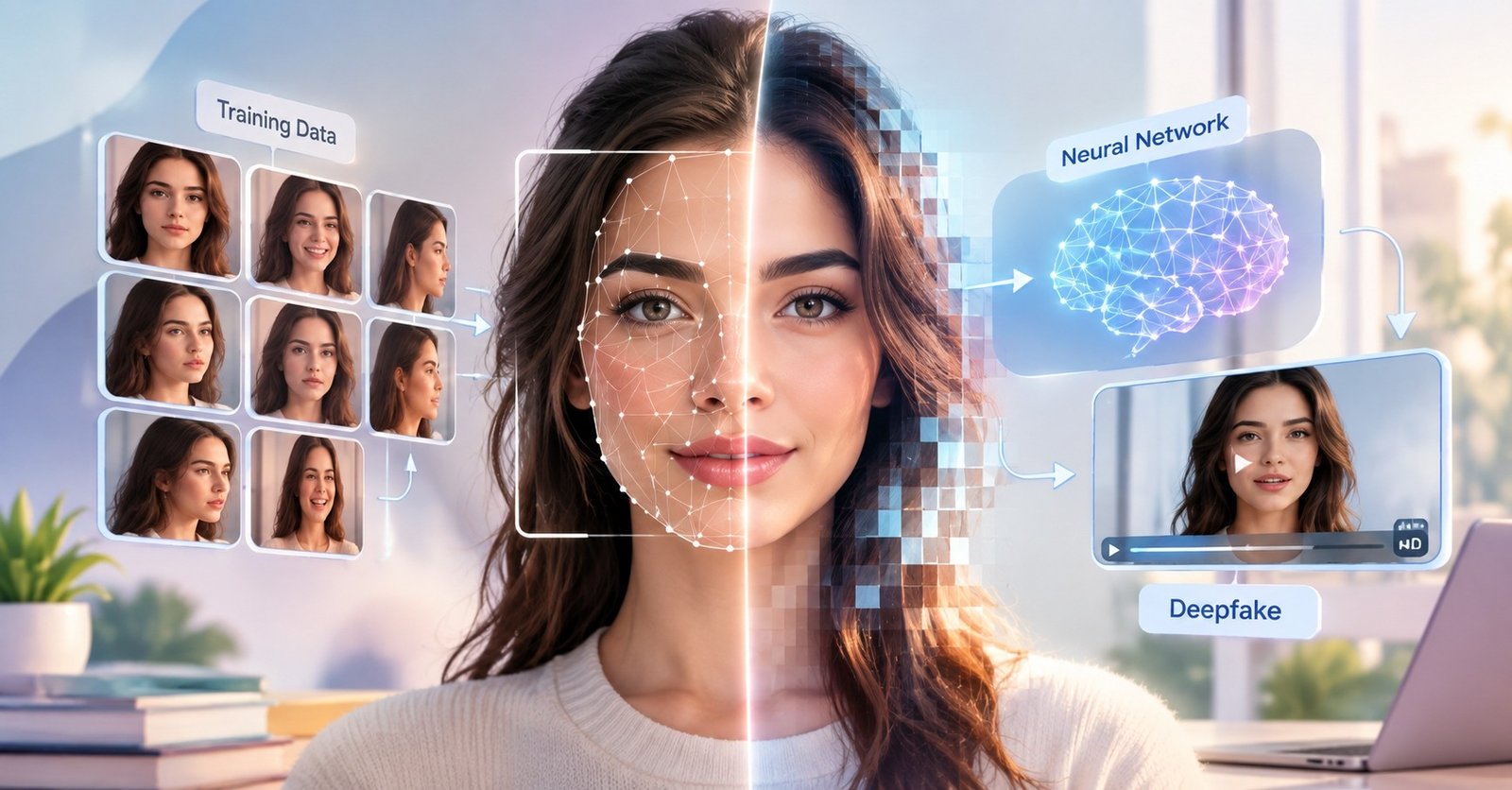
Deepfake technology has moved from experimental face-swapping systems to sophisticated generative AI capable of producing convincing images, videos, and audio. But behind the realistic results is a fairly understandable process: neural networks learn patterns from real media and use those patterns to generate or manipulate synthetic content.
The phrase how deepfake technology works neural networks explained points to the most important part of the technology: understanding what the neural network learns, how that information is represented, and how it is turned into a new image or video.
Modern deepfakes can rely on several types of generative models. Earlier systems commonly used autoencoders and generative adversarial networks (GANs), while newer systems increasingly use diffusion-based approaches and combinations of different architectures.
What Is Deepfake Technology?
A deepfake is synthetic media created or manipulated with deep-learning techniques. It can involve replacing someone’s face, changing facial expressions, synchronizing lips with different speech, generating a person’s voice, or creating visual content that never existed in the original recording.
The important point is that a deepfake is not simply a photograph pasted over another photograph. A neural network learns statistical patterns from many examples and then uses those learned patterns to reconstruct or generate new content.
For example, a model trained on many images of a person’s face can learn characteristics such as facial shape, eye position, skin texture, expressions, and how the face changes with different poses and lighting.
The model does not store a simple collection of pictures and choose one whenever it needs an answer. Instead, training adjusts millions of numerical parameters so the network becomes better at representing the patterns present in its training data.
This is why deepfakes are closely connected with generative AI. The system is learning a representation of the data and then using that representation to produce something new.
There is also an important distinction between different types of deepfake manipulation. Face swapping changes one person’s identity while often preserving the source video’s pose or expression. Face reenactment can change expressions or head movements. Other systems can generate entirely synthetic faces or synchronize a face with newly generated speech. Research surveys commonly divide the field into areas such as face swapping, face reenactment, talking-face generation, facial attribute editing, and detection.
How Neural Networks Learn Faces
The foundation of how deepfake technology works neural networks explained is the training process.
Imagine giving a neural network thousands of images containing the same person’s face. The images may show different expressions, camera angles, backgrounds, distances, and lighting conditions.
During training, the network repeatedly processes these examples and produces an output. The difference between its output and the expected result creates an error signal. An optimization process then adjusts the network’s parameters to reduce that error.
After many training iterations, the network becomes better at identifying and representing useful visual features.
It can learn patterns involving:
- facial proportions
- eyes and eyebrows
- nose and mouth structure
- skin texture
- head orientation
- facial expressions
- lighting relationships
- movement patterns
This does not mean the network understands a face in exactly the same way a human does. It learns numerical representations that are useful for the task it was trained to perform.
This distinction matters because a deepfake model does not need a human-like understanding of identity. It only needs to learn enough statistical structure to reproduce convincing visual patterns.
The quality of the training data therefore matters enormously. Poorly aligned, low-quality, or insufficiently varied examples can produce artifacts, unnatural expressions, inconsistent lighting, or poor identity preservation.
How Deepfake Training Works
Before a model can generate convincing media, the training data normally needs considerable preparation.
For face-based systems, images or video frames may first be processed to locate faces. The faces can then be aligned so that important facial landmarks appear in consistent positions.
This preprocessing step is easy to overlook, but it can have a major effect on the final result.
Suppose one training image contains a face looking directly at the camera while another contains the same person with their head tilted. A model has to deal with these differences while learning which information represents identity and which information represents pose.
Once the training examples have been prepared, the neural network repeatedly processes them. Depending on the architecture, the training objective can involve reconstruction accuracy, adversarial feedback, noise removal, or other optimization targets.
The model gradually changes its internal parameters.
A simplified pipeline looks like this:
Real media → preprocessing → neural-network training → learned representation → generation/manipulation → refinement → synthetic output
Training and generation are also two different stages. The expensive learning process happens beforehand. Once a sufficiently capable model has been trained, generating or manipulating new content can be much faster.
This is one reason modern deepfake tools can produce results far more quickly than early experimental systems.
How Autoencoders Create Deepfakes
Autoencoders provide one of the clearest ways to understand how deepfake technology works neural networks explained from first principles.
An autoencoder has two major components: an encoder and a decoder.
The encoder takes an input image and compresses important information into a smaller internal representation called a latent representation or latent code.
The decoder then uses that representation to reconstruct the original image.
In simplified form:
Face → Encoder → Latent representation → Decoder → Reconstructed face
The interesting part is what happens when this architecture is adapted for face swapping.
A classic setup can use a shared encoder with separate decoders trained for different identities. The encoder learns a representation containing information that can include pose, expression, and other facial characteristics, while the separate decoders learn how to reconstruct the identities they were trained on.
That creates the possibility of decoding the same underlying information through a different identity-specific decoder.
For example:
Person A’s face → shared encoder → Person B’s decoder → reconstructed face resembling Person B
The resulting image can retain aspects of the original input such as expression or head position while changing the identity-related appearance.
Research literature describes this encoder-decoder approach as a fundamental mechanism behind early deepfake generation.
Why the Latent Space Matters
The latent representation is one of the most useful concepts for understanding deepfakes.
Instead of treating an image as millions of individual pixels, the model transforms it into a compact numerical representation containing information useful for reconstruction.
You can think of this as a compressed description of the input.
The network may represent information related to:
identity + pose + expression + lighting + other visual features
The exact organization of these features is not necessarily clean or human-readable. Neural networks do not automatically create separate boxes labeled “identity” and “smile.”
But training can encourage representations that make these factors useful for reconstruction or manipulation.
This is one reason deepfake generation is more sophisticated than ordinary image editing.
How GANs Improve Fake Media
Generative Adversarial Networks, or GANs, introduced another powerful idea.
Instead of relying only on reconstruction accuracy, a GAN uses two neural networks:
Generator → creates synthetic content
Discriminator → judges whether content looks real or fake
The generator tries to create an output that resembles real training data. The discriminator tries to distinguish genuine examples from generated ones.
During training, both networks improve.
If the discriminator easily recognizes a generated face as fake, the generator receives a signal that its output needs improvement. As training continues, the generator becomes better at producing realistic results while the discriminator becomes better at finding subtle differences.
This adversarial relationship helped make synthetic faces and manipulated media considerably more realistic. GANs have been an important part of deepfake research and generation, although they should not be treated as the only technology behind modern deepfakes.
One limitation is that GAN training can be difficult. Models may become unstable, suffer from mode collapse, or struggle to represent sufficient diversity in the generated data.
For deepfake applications, GAN-based systems can also leave statistical artifacts that specialized detection systems may learn to identify.
How Diffusion Models Create Deepfakes
Diffusion models represent a major change in the way modern generative systems can create synthetic media.
Instead of beginning with an image and simply reconstructing it, a diffusion model is trained around a process of adding and removing noise.
During training, an image is progressively corrupted with noise. The model learns how to predict or reverse that corruption.
During generation, the process runs in the opposite direction:
Noise → denoising steps → structured image
With enough learned information, the model can transform noisy representations into highly detailed visual content.
Diffusion models have become increasingly important in generative media because they can produce highly detailed and flexible outputs. Recent deepfake research describes the progression from autoencoders and GANs toward diffusion-based generation, while newer work is also examining additional architectures such as flow-based approaches.
This is one area where older deepfake explanations can become outdated. Explaining deepfakes only through GANs gives readers an incomplete picture of the current generative-AI landscape.
Also Read: T-Mobile tests AI technology to boost 5G network speeds in 2026
How Deepfake Videos Are Generated
Creating a convincing deepfake video involves more than generating a single realistic face.
A video contains many consecutive frames. The generated face therefore has to remain visually consistent as the person moves, turns their head, changes expression, and encounters different lighting conditions.
A simplified pipeline can involve:
Face detection → face alignment → feature extraction → generation or identity transformation → blending → frame refinement → video output
The system first identifies the relevant facial region. The face can then be aligned and processed by the selected generative model.
After a synthetic face is produced, it must fit naturally into the surrounding video.
This requires attention to factors such as:
- facial position
- scale
- head orientation
- skin tone
- lighting
- sharpness
- boundaries
- expression
- frame-to-frame consistency
That final point is especially important.
A generated image may look convincing when viewed alone but still fail as a video if the face changes subtly between frames. This produces flickering, unstable features, or unnatural movement.
Modern deepfake systems therefore have to solve not only spatial realism but also temporal consistency.
Why Deepfakes Look So Real
The realism of a deepfake comes from several factors working together rather than from one magical neural network.
First, modern models can learn extremely detailed patterns from large and diverse datasets.
Second, generative architectures can reconstruct or synthesize fine visual features such as skin texture, hair, facial details, and lighting.
Third, modern systems can combine multiple stages of processing. One model may handle generation while additional processing improves resolution, alignment, blending, or temporal stability.
There is also a psychological factor.
Humans are remarkably good at recognizing familiar faces, but we are not perfect at detecting subtle pixel-level inconsistencies in rapidly moving video. If identity, expression, lighting, and movement are sufficiently coherent, a viewer may accept synthetic media as genuine.
However, realism is not guaranteed.
Common weaknesses can still include unnatural eyes, inconsistent teeth, strange hair boundaries, incorrect shadows, mismatched lighting, facial flicker, or inconsistencies between speech and lip movement.
These weaknesses are becoming less obvious as generative models improve.
What Other Articles Often Miss
A useful explanation of deepfakes should go beyond simply saying that “AI swaps one face for another.”
One overlooked issue is factor separation.
A face contains multiple kinds of information. Identity answers “who is this?” while pose answers “which direction is the head facing?” Expression answers “what is the person doing with their face?” Lighting describes the visual environment.
A successful manipulation often needs to change one factor without destroying the others.
For example, a face-swap system may need to transfer Person B’s identity while preserving Person A’s head movement and expression.
Another overlooked issue is data diversity.
If a model sees a person’s face only from one angle, it has less information about how that identity appears from other viewpoints. More varied training examples can help the model learn a broader representation.
A third issue is quality versus consistency.
A system may generate an extremely detailed single frame but still produce poor video if that detail changes unpredictably from frame to frame.
Finally, deepfake technology is not one fixed algorithm. It is better understood as a rapidly changing family of techniques that can combine different neural architectures depending on the intended task.
Can Neural Networks Detect Deepfakes?
The same broad field of machine learning used to generate synthetic media can also be used to detect it.
Detection models can search for patterns associated with manipulation, including unusual facial textures, blending artifacts, frequency-domain patterns, inconsistent motion, or differences in learned representations.
However, detection is a moving target.
When generation methods improve, the visual artifacts that detectors rely on can change or disappear. Recent research is exploring foundation models and representation-based methods that may identify differences between authentic and synthetic media without relying entirely on obvious visual defects.
This creates an ongoing cycle:
Better generation → harder detection → improved detection → improved generation
That arms race is one of the central technical challenges surrounding synthetic media.
Also Read: Network Technology: Types, Uses, and How It Works in 2026
The Future of Deepfake Technology
The future of deepfakes is unlikely to depend on a single architecture.
Autoencoders remain important for understanding and implementing targeted face manipulation. GANs established many of the techniques that made realistic synthetic faces possible. Diffusion models have pushed generative quality and flexibility further, while newer research is also examining flow-based and other generative approaches.
The bigger trend is toward systems that can control multiple aspects of media at once.
Instead of simply changing a face, future systems can increasingly manipulate identity, expression, pose, voice, lighting, environment, and motion within a unified generative workflow.
That creates legitimate opportunities in entertainment, visual effects, education, accessibility, and digital characters. It also creates serious challenges involving impersonation, fraud, misinformation, privacy, and consent.
Understanding the underlying neural networks is therefore useful for more than technical curiosity. It helps people understand why synthetic media is becoming increasingly convincing and why detecting it is becoming more difficult.
Conclusion
The simplest way to understand how deepfake technology works neural networks explained is to think of it as a learning-and-generation pipeline.
A neural network receives large amounts of real media and learns statistical patterns from that data. Autoencoders can compress and reconstruct facial information, GANs can improve realism through adversarial training, and diffusion models can generate detailed content by learning to reverse noise.
The difficult part is not simply generating a realistic face. A convincing deepfake must also maintain identity, expression, pose, lighting, spatial alignment, and—especially in video—consistency across time.
That is why modern deepfakes are better understood as a combination of deep learning, representation learning, generative modeling, image processing, and temporal modeling rather than a simple face-swapping trick.
As generative models continue to improve, understanding these foundations will become increasingly important for recognizing both the capabilities and limitations of synthetic media.


One Response