Retail stores generate enormous amounts of visual information every day. Customers move between aisles, products are picked from shelves, checkout counters process purchases, and employees constantly manage stock and store operations. Traditionally, most of these activities have been monitored manually or recorded through conventional security cameras. However, modern artificial intelligence is changing how retailers understand and manage their physical stores.
Retail AI Vision Technology refers to the use of artificial intelligence, computer vision, and machine learning to interpret images and videos captured inside retail environments. Instead of simply recording what happens, these systems analyze visual information to recognize products, identify activities, monitor shelf conditions, and generate useful operational insights.
For example, consider a supermarket with thousands of products across multiple aisles. Employees cannot continuously inspect every shelf to identify missing products or incorrect placements. An AI-powered vision system can examine camera feeds, detect empty shelf spaces, and notify employees when products need restocking. This helps stores respond to problems before they affect the shopping experience.
An important distinction is that computer vision does not automatically mean facial recognition or personal identification. Many retail applications focus entirely on products, shelves, objects, and anonymous movement patterns. A store can understand customer traffic without identifying individual shoppers.
The technology also supports different retail environments. Fashion retailers can monitor product displays, pharmacies can check shelf availability, and shopping malls can understand how visitors move through common areas. E-commerce businesses can use related visual AI capabilities for product recognition, image search, and virtual product experiences.
Another important aspect is that these systems do not necessarily replace existing retail infrastructure. Many businesses can integrate AI software with compatible security cameras, point-of-sale systems, inventory databases, and store management platforms.
The main purpose is to transform visual information into practical business intelligence. Rather than asking employees to review hours of recorded footage or manually inspect every shelf, retailers can receive targeted alerts and reports.
Ultimately, this technology connects physical store activities with digital decision-making. It helps businesses understand what is happening, identify operational problems, and determine where improvements are needed.
How AI Vision Systems Work in Retail
Understanding the working process is essential because the technology involves more than installing cameras and connecting them to artificial intelligence software. A complete system combines image capture, data processing, object recognition, tracking, and business applications.
The process generally begins with cameras installed in selected areas, such as store entrances, aisles, product shelves, and checkout counters. These cameras capture images or video streams that provide information about store activities. Depending on the application, retailers may use existing surveillance cameras or install specialized cameras with suitable resolution and positioning.
The captured visual information is then processed by computer vision models. These models have been trained to recognize particular objects and visual patterns. For example, a system designed for shelf monitoring may identify product packages, empty spaces, misplaced items, and differences between expected and actual shelf arrangements.
Object detection is one of the important techniques involved. It identifies objects within an image and estimates their locations. Object tracking can then follow recognized objects across multiple video frames. This allows a system to understand movement over time rather than analyzing individual images independently.
After recognition, the system interprets the information according to a specific retail task. If a shelf has an unexpected gap, it may generate a restocking alert. If checkout footage indicates that an item was handled without being scanned, it may request staff verification.
A particularly important part of this process is connecting visual results with existing business information. For example, recognizing a product is more useful when the system can compare its shelf availability with the store’s inventory database. This connection helps distinguish an actual stock problem from a temporary display issue.
Retail AI Vision Technology can process information locally through edge computing or send selected data to cloud-based infrastructure. Edge processing is useful when a retailer needs quick responses or wants to limit the amount of video transferred outside the store.
The final stage is presenting results through dashboards, notifications, or integrations with existing retail software. Employees receive information they can act on instead of having to interpret raw camera footage themselves.
However, accuracy depends on camera placement, lighting, image quality, model training, and the complexity of the retail environment. A poorly positioned camera or an obstructed shelf can reduce detection quality.
Therefore, successful implementation requires a complete workflow in which visual recognition, business data, and human decision-making work together.
Key Technologies Behind Retail AI Vision
Several technologies work together to make intelligent visual analysis possible. Understanding their individual roles helps retailers choose suitable systems instead of treating artificial intelligence as a single solution.
Computer Vision: Computer vision enables software to interpret images and videos. It provides the foundation for recognizing products, detecting shelf gaps, identifying objects, and understanding activities within a store. For example, a supermarket can use it to compare shelf images against expected product arrangements.
Machine Learning: Machine learning allows systems to identify patterns from training data and improve their predictions. Retailers can use trained models to classify products, recognize common visual conditions, and identify unusual activities. The quality and diversity of training data directly affect how reliably these systems perform.
Deep Learning: Deep learning uses neural networks to recognize complex visual patterns. Convolutional neural networks and modern object-detection architectures can identify multiple products or objects within the same image. These models are particularly useful when products have similar shapes, colors, or packaging.
Object Detection and Tracking: Object detection locates products and other objects in images, while tracking connects detections across consecutive video frames. Together, these methods help analyze customer movement, checkout interactions, and product handling.
Optical Character Recognition (OCR): OCR extracts text from images. In retail, it can help read price labels, product packaging, shelf tags, and printed information. This is particularly useful when a retailer needs to compare displayed prices with product records.
Edge AI: Edge AI runs artificial intelligence models on local hardware, such as store servers or compatible devices near cameras. This reduces dependence on sending every video frame to a remote server. It can also support faster alerts and more controlled data handling.
Cloud Computing: Cloud platforms provide centralized infrastructure for storing selected information, managing models, analyzing results across multiple locations, and generating reports. Large retail chains can use cloud services to compare operational performance between branches.
Sensor Fusion: Some advanced systems combine camera information with RFID readers, barcode scanners, weight sensors, and point-of-sale data. This can improve reliability because decisions are based on multiple sources instead of visual information alone.
For example, a camera may detect that a product has been removed from a shelf. An RFID reader or inventory system can provide additional information about the item’s movement. Combining these signals can help retailers understand whether the product was purchased, transferred, or simply moved elsewhere.
The strength of Retail AI Vision Technology comes from combining these technologies according to a specific business requirement. Not every store needs every component. A small retailer may only require shelf monitoring, while a large supermarket chain may need computer vision, edge infrastructure, cloud analytics, and POS integration.
Smart Inventory and Shelf Monitoring
Inventory management is one of the most practical applications of visual artificial intelligence because product availability directly affects sales and customer satisfaction. A product may exist in a retailer’s inventory database but still be unavailable to shoppers if it has not been placed correctly on the shelf.
Traditional inventory processes often depend on barcode scanning, periodic stock counts, and employee inspections. These methods remain useful, but they may not provide continuous visibility into shelf conditions. An item can become unavailable between inspections, especially in busy stores.
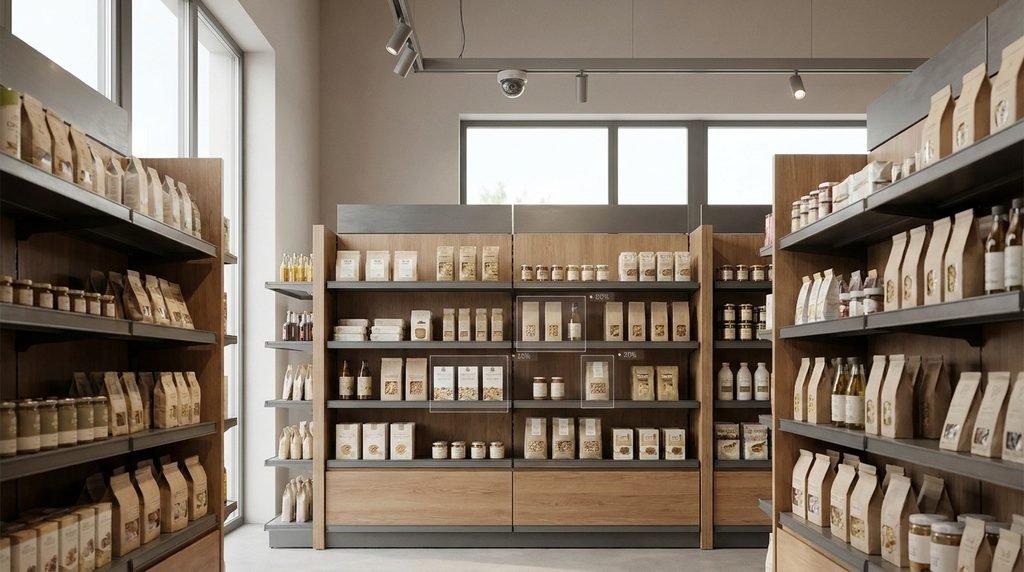
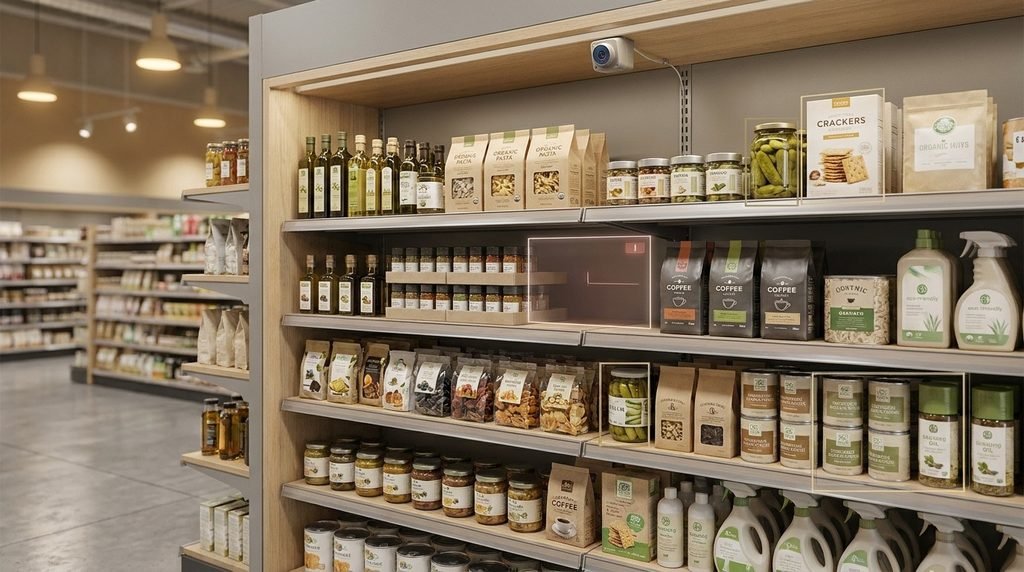
With Retail AI Vision Technology, cameras can monitor product displays and identify visible changes in shelf conditions. The system may detect empty spaces, missing products, misplaced packages, and differences between the expected product arrangement and the actual display.
Consider a grocery store selling bottled drinks. If a particular shelf section becomes empty, a vision model can recognize the missing product area and generate an alert for employees. Staff can then check the stockroom and replenish the shelf when inventory is available.
Another useful application is planogram compliance. A planogram is a visual layout that specifies where products should be placed on retail shelves. Retailers use these arrangements to maintain consistent displays, improve product visibility, and follow merchandising agreements. Computer vision can compare shelf images with expected arrangements and identify products that are positioned incorrectly.
However, there is an important technical limitation. A camera cannot always determine the exact number of products hidden behind other packages or stored in closed containers. Visual shelf monitoring should therefore complement inventory databases, barcode scanning, and other stock-management methods rather than replace them entirely.
A more advanced approach combines visual information with sales records. When the system detects fewer products on a shelf, the inventory platform can compare that observation with recent transactions and recorded stock movements.
This creates a more useful picture of product availability. Retailers can distinguish between a shelf that needs replenishment and a product that has genuinely run out of stock.
Another benefit is identifying recurring problems. If certain products repeatedly disappear from shelves faster than employees can replenish them, managers can investigate demand patterns, replenishment schedules, and staffing requirements.
The value is not simply counting products. It is reducing the gap between what a retailer believes is available and what customers can actually purchase.
Customer Behavior and Store Analytics
Understanding customer behavior is important for retailers because product placement, store layouts, and shopping experiences influence purchasing decisions. Online businesses already collect detailed information about browsing activities and customer interactions. Physical stores, however, have traditionally had fewer ways to analyze how shoppers move through their environments.
Computer vision provides another method for understanding these interactions without necessarily identifying individual customers.
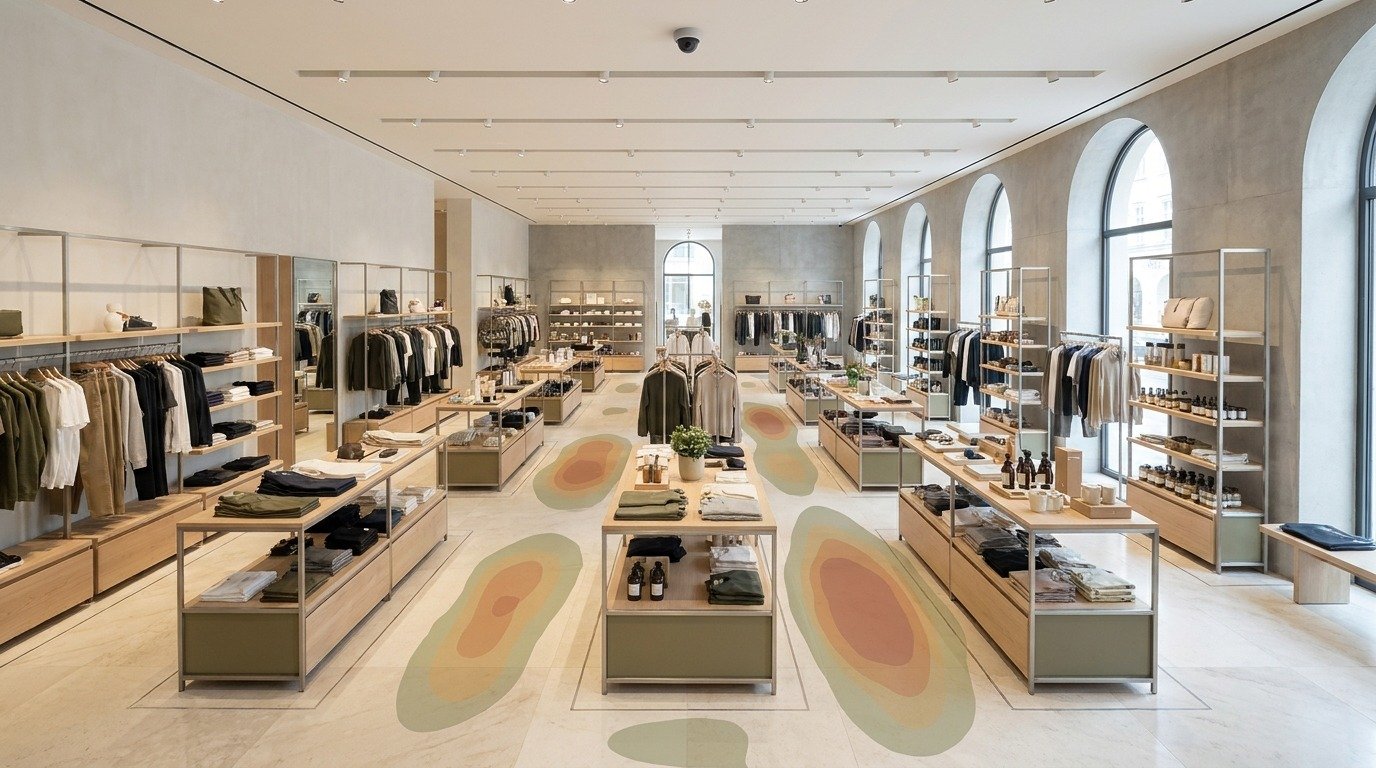
Using camera-based analytics, retailers can measure store traffic, estimate how many people enter different areas, analyze movement patterns, and identify sections where shoppers spend more time. These insights help managers understand how effectively the physical store is organized.
For example, a clothing retailer may discover that customers frequently visit a particular display but rarely approach the checkout area afterward. This information could encourage managers to review product availability, pricing, display placement, or the shopping journey.
Heatmaps are another useful feature. They represent areas of higher and lower activity within a store. A heatmap can show which aisles receive the most attention and which sections customers rarely visit.
Dwell-time analysis measures how long visitors remain within a selected area. Longer dwell time does not automatically mean stronger purchase interest, but it can provide useful context when compared with sales information and other store metrics.
Retail AI Vision Technology can also help evaluate store layouts after changes have been introduced. Managers can compare customer movement before and after relocating a product category, changing an aisle arrangement, or introducing a new promotional display.
For example, a supermarket may move frequently purchased products to different aisles to improve navigation. By comparing traffic patterns, managers can assess whether customers are finding those products more easily or experiencing unnecessary movement.
However, customer analytics should be interpreted carefully. A camera cannot reliably determine why someone stopped in front of a product or whether they genuinely intend to purchase it. Visual observations describe behavior, not necessarily motivation.
Combining movement data with transaction records, product availability, and customer feedback can provide a more complete understanding.
Retailers should also prefer anonymous aggregate measurements whenever individual identification is unnecessary. This allows businesses to improve store layouts and customer experiences while reducing privacy risks.
The real benefit is making physical retail environments easier to understand and improve through measurable observations rather than assumptions.
Automated Checkout and Loss Prevention
Checkout operations are another area where computer vision can make a meaningful difference. Traditional checkout systems usually depend on employees or customers scanning product barcodes individually. Although this process is familiar and reliable, it can create delays during busy shopping periods.
Some retailers are introducing computer vision-based checkout systems to reduce manual steps. These solutions may use overhead cameras, shelf sensors, weight measurements, RFID technology, and payment integration to identify products selected by shoppers.
In a cashierless shopping environment, customers may enter a store using an authorized payment account, select products, and leave without visiting a conventional checkout counter. The system combines information from cameras and other sensors to create a record of selected items. The payment process is then handled through the retailer’s configured transaction system.
However, not every automated checkout solution works in exactly the same way. Some systems rely heavily on cameras, while others use a combination of computer vision, weight sensors, RFID, and other technologies.
Self-checkout loss prevention is another important application. Customers may accidentally miss scanning an item, place products incorrectly, or experience problems when barcodes fail to register. In other situations, intentional scanning avoidance can result in financial losses.
Retail AI Vision Technology can analyze checkout activity and identify situations that require further inspection. For example, a vision system may detect that an item appears to have entered a shopping bag without a corresponding scan event.
The system can then notify an employee to review the transaction. This is important because an automated alert should not automatically be treated as proof of theft. Camera angles, product occlusion, similar packaging, and fast customer movements can create false detections.
More advanced solutions connect checkout cameras with point-of-sale records. This allows the system to compare visible product handling with recorded transactions and identify potential inconsistencies.
Intel’s retail loss-prevention reference implementation provides an example of how video streams, object recognition, and tracking can support checkout monitoring.
An effective system should prioritize accurate detection, clear evidence, and human verification. Staff should have the ability to review flagged events before taking action.
These applications can improve checkout efficiency and help retailers investigate unusual transaction patterns. Nevertheless, automated systems need regular testing and appropriate privacy controls to ensure that convenience and security do not come at the expense of customer trust.
Retail AI Vision Benefits and Challenges
Visual artificial intelligence offers several operational advantages, but its value depends on how effectively a retailer integrates it into everyday business processes.
One major benefit is improved visibility. Managers can receive information about shelf conditions, store traffic, and checkout activities without relying entirely on manual inspections. This can help employees identify problems earlier and prioritize tasks.
Another advantage is operational efficiency. Automated shelf monitoring can reduce repetitive inspection work, while store analytics can help managers evaluate how space and staffing are being used.
The technology can also support better decision-making. For example, retailers can compare customer traffic with sales performance to identify products that receive attention but generate relatively few purchases. Managers can then investigate possible causes, such as pricing, product availability, or display quality.
Retail AI Vision Technology can also help businesses improve consistency across multiple locations. A retail chain can use similar monitoring rules across different branches and compare operational performance through centralized reporting.
Despite these advantages, implementation involves several challenges.
Initial Infrastructure Costs: Businesses may need suitable cameras, local processing equipment, networking infrastructure, software licenses, and system integration. Costs vary according to store size, camera coverage, accuracy requirements, and deployment complexity.
Detection Accuracy: Computer vision models can make mistakes when lighting changes, products overlap, shelves become crowded, or camera views are blocked. These conditions may generate false alerts or missed detections.
Product Recognition Complexity: Retail stores frequently introduce new packaging, promotional labels, seasonal products, and similar-looking items. Models need suitable training data and regular updates to recognize changing product catalogs.
System Integration: A vision platform may need to communicate with existing POS, ERP, inventory, and workforce management systems. Incompatible data formats or outdated infrastructure can complicate implementation.
Employee Adoption: Staff need clear instructions about what alerts mean, how to verify them, and when manual intervention is necessary. Poorly designed notifications can create unnecessary work.
Measuring Return on Investment: Installing AI software does not automatically guarantee higher revenue or lower operating costs. Retailers should measure specific outcomes such as shelf availability, inventory accuracy, inspection time, checkout errors, and confirmed loss-prevention incidents.
A practical strategy is to begin with one clearly defined problem, establish a performance baseline, and run a limited pilot. Once the results are verified, the retailer can decide whether expanding the system makes financial and operational sense.
Also Read: AI Vision Technology 2026: Uses, Trends and the Future
Privacy and the Future of AI Vision in Retail
As visual AI becomes more common in physical stores, privacy and responsible data management are becoming essential parts of implementation. Retailers must understand that camera footage may contain sensitive information about customers, employees, and their activities.
One important consideration is the difference between anonymous behavioral analysis and personal identification. A system that counts visitors or measures general movement patterns does not necessarily need to identify individual people. However, facial recognition and identity-based tracking introduce additional privacy concerns and may be subject to stricter legal requirements.
Retailers should determine what information they actually need before collecting or processing video data. If anonymous counting is sufficient, collecting identifiable information may be unnecessary.
Data retention is another important issue. Businesses should define how long video footage and analytical records are stored, who can access them, and when information should be deleted. Access controls, encryption, secure networks, and regular security assessments can reduce the risk of unauthorized access.
Retailers must also consider applicable privacy and surveillance laws in the locations where their stores operate. Clear notices, appropriate legal grounds for processing, and transparent policies help customers understand how camera-based systems are used.
Looking ahead, several developments are likely to influence the next generation of retail vision systems.
Edge AI will become increasingly important. Processing video near the camera can support faster responses and reduce the need to transfer large amounts of raw footage to cloud servers.
Multimodal AI will improve contextual understanding. Future systems may combine images, transaction records, inventory information, and other data sources to interpret store activities more accurately.
Predictive shelf intelligence may become more advanced. Instead of only identifying empty spaces, systems could combine historical sales and current shelf observations to help prioritize replenishment activities.
AI-assisted employees may receive real-time operational guidance. Handheld devices equipped with cameras could help staff identify products, check shelf arrangements, and locate inventory more efficiently.
Retail analytics may become more connected. Businesses could combine physical-store observations with online shopping data to understand product demand across different sales channels.
Frequently Asked Questions
1. What is retail AI vision technology used for?
It is used to analyze visual information inside retail environments. Common applications include shelf monitoring, inventory visibility, customer traffic analysis, automated checkout, product recognition, and loss prevention.
2. How is AI vision different from traditional CCTV?
Traditional CCTV primarily records video for observation and later review. AI vision systems analyze images and videos to recognize objects, detect patterns, and generate alerts or operational insights.
3. Can AI vision track inventory in real time?
It can monitor visible products and shelf conditions continuously or at configured intervals. However, exact inventory counts usually require integration with POS systems, stock databases, barcode scanning, or other inventory technologies.
4. Does retail computer vision require new cameras?
Not always. Some systems can work with existing cameras if their resolution, positioning, frame rate, and connectivity meet the software requirements. Specialized applications may require additional cameras or sensors.
5. Is AI vision technology expensive for small retailers?
Costs depend on the number of cameras, processing requirements, software, and integration needs. Small retailers can begin with limited applications, such as shelf monitoring, rather than deploying a complete store-wide system.
6. Does AI vision identify individual customers?
Not necessarily. Many applications use anonymous object detection, movement analysis, and visitor counting without identifying individuals. Facial recognition is a separate capability and requires additional privacy considerations.
7. Can AI vision prevent shoplifting completely?
No. It can identify certain suspicious patterns and checkout inconsistencies, but it cannot guarantee that every theft will be detected. Human verification and other security measures remain important.
8. What is the future of computer vision in retail?
Future developments are likely to include better edge processing, improved product recognition, connected inventory intelligence, more advanced checkout automation, and privacy-conscious store analytics.
Conclusion
Physical retail is becoming increasingly data-driven, and visual intelligence is helping businesses understand activities that were previously difficult to measure. From monitoring shelves and analyzing customer movement to supporting checkout operations, computer vision provides retailers with practical ways to improve store management.
The most successful implementations will not simply collect more video or automate every task. They will focus on solving specific operational problems, connecting visual information with reliable business data, and keeping employees involved in important decisions.
For retailers considering this technology, the best starting point is to identify one measurable challenge, test a suitable solution, and evaluate its actual impact before expanding across the business. When implemented responsibly, AI-powered vision can become a valuable part of a smarter, more responsive retail environment.