
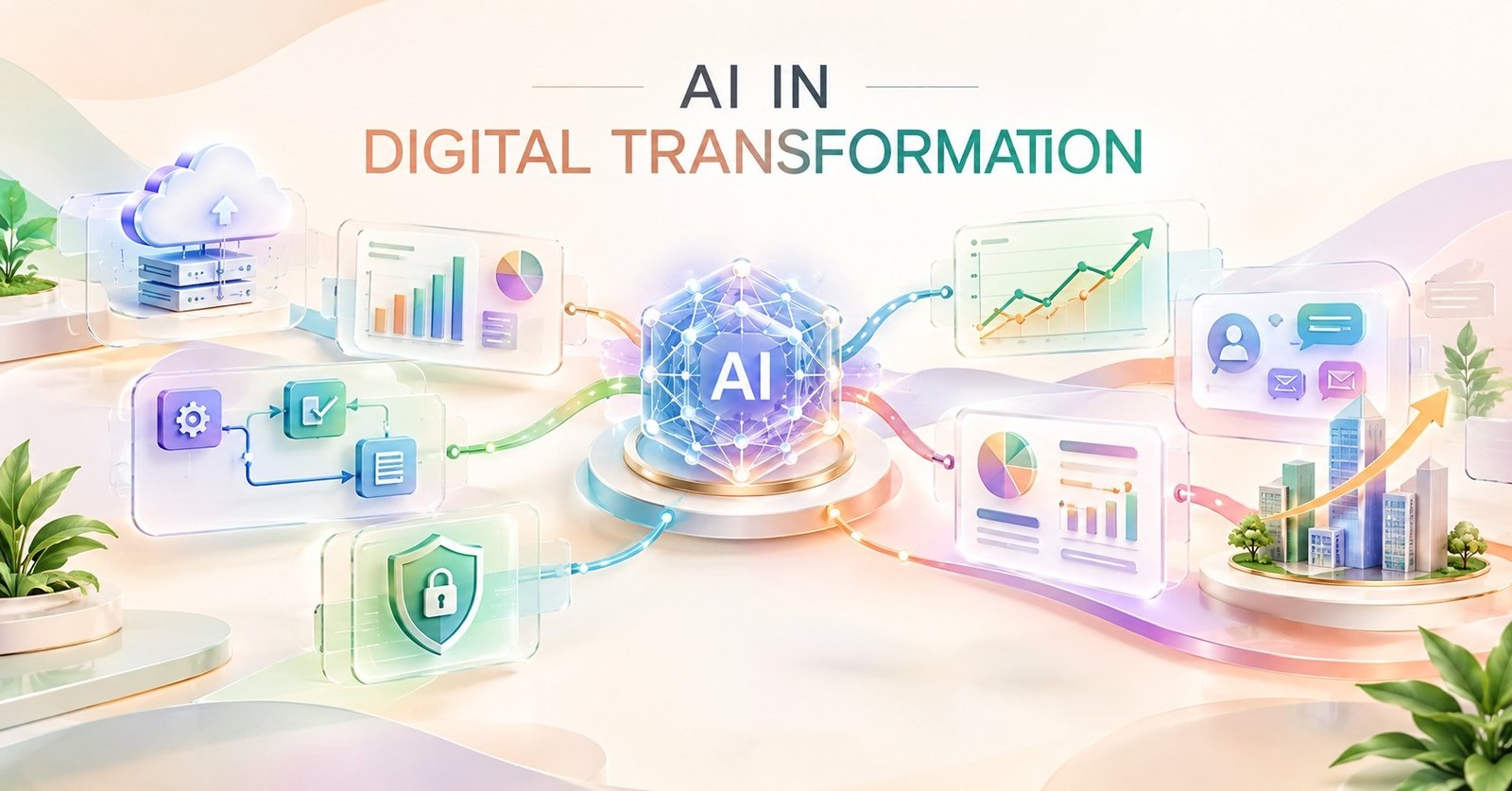
Artificial intelligence is rapidly changing how businesses operate, compete, and grow in the digital era. Artificial Artificial intelligence is changing how organizations manage information, serve customers, and improve everyday business operations. Tasks that once required hours of manual effort can now be completed with intelligent software, automated workflows, and data-driven systems. From analyzing customer behavior to predicting operational problems, AI is creating new opportunities for businesses of different sizes.
However, the real advantage of artificial intelligence does not come from adopting every new application. It comes from identifying the right problems and using technology to solve them efficiently. Businesses need systems that improve productivity, support employees, protect sensitive information, and deliver measurable results.
The growing interest in droven.io ai in digital transformation reflects a broader business conversation about making artificial intelligence useful beyond experimentation. Companies are increasingly exploring how AI can fit into existing processes, support strategic decisions, and help them adapt to changing customer expectations.
Understanding this transition requires looking at the relationship between technology, people, and organizational goals. AI can create substantial value, but its effectiveness depends on implementation quality, reliable information, and a clear understanding of what success should look like.
Understanding the Business Value of AI-Powered Transformation
Artificial intelligence becomes valuable when it addresses a specific operational challenge. Instead of viewing AI as an isolated technology, businesses should evaluate how intelligent systems can improve the way work is completed, information is interpreted, and decisions are made.
For example, an online retailer might struggle to keep inventory aligned with changing demand. An AI-powered forecasting system can analyze historical purchases, seasonal patterns, and current sales activity to help managers make better stocking decisions. Similarly, a customer support department can use intelligent assistants to identify common questions and provide relevant answers without requiring employees to handle every interaction manually.
The concept behind droven.io ai in digital transformation can be explored through this practical, business-oriented perspective. The emphasis is on understanding how artificial intelligence connects with operational improvements rather than assuming that installing a new tool automatically creates meaningful change.
Several AI capabilities contribute to this process. Machine learning identifies patterns in data, predictive analytics estimates possible future outcomes, natural language processing helps systems interpret human language, and generative AI assists with producing and summarizing information.
These capabilities serve different purposes, so selecting the appropriate technology matters. A company looking to extract information from invoices may benefit from intelligent document processing, while a business trying to understand customer churn may need predictive analytics.
Before investing in a solution, decision-makers should consider three questions: What problem needs to be solved? How will the proposed system improve the existing process? Which measurable result will demonstrate success?
Answering these questions helps businesses avoid unnecessary spending and prioritize initiatives with practical value. It also makes it easier to explain the purpose of AI adoption to employees and stakeholders.
Ultimately, successful AI transformation is not about collecting the largest number of digital tools. It is about building a more capable organization in which technology supports people, improves workflows, and contributes to clearly defined business objectives.
How Digital Transformation Reshapes Everyday Business Processes
Digital transformation involves redesigning how an organization operates by combining digital technologies, improved processes, and changes in the way people work. It goes beyond moving documents online or replacing outdated software with a modern application.
Consider a business that manages customer inquiries through separate email accounts, spreadsheets, and departmental databases. Employees may spend considerable time searching for information, updating records, and asking colleagues for missing details. Introducing an integrated system can make information easier to access, but the greatest improvement occurs when the company also redesigns its communication and decision-making processes.
Artificial intelligence can strengthen this transformation by identifying patterns, reducing repetitive work, and helping employees retrieve useful information more quickly. When connected to suitable business systems, AI may support activities ranging from sales forecasting to document classification and customer service.
Customer expectations are another reason organizations are rethinking their operations. Buyers increasingly expect convenient digital experiences, timely communication, and consistent service across websites, mobile applications, and support channels. Businesses that struggle to coordinate these interactions can lose opportunities even when their products are competitive.
Different departments can benefit in different ways. Marketing teams can analyze campaign performance, sales professionals can prioritize promising leads, finance departments can streamline reporting, and human resources teams can simplify administrative workflows. Each application should be evaluated according to its specific requirements and risks.
Nevertheless, transformation cannot follow an identical roadmap in every organization. A small company using cloud-based software may implement improvements relatively quickly, whereas a large enterprise may need to address legacy infrastructure, data migration, regulatory obligations, and complex approval processes.
A sensible starting point is to identify one process with a clear performance problem. Record its current cost, completion time, error rate, and effect on customers. Introduce a targeted improvement, compare the results against the original baseline, and expand the initiative only when the evidence supports doing so.
This measured approach reduces implementation risk and gives employees an opportunity to understand the benefits before additional changes are introduced. Digital transformation becomes a continuous improvement strategy rather than a one-time technology project.
Six Practical Ways Artificial Intelligence Improves Business Performance
The most effective AI applications usually address recognizable business needs. Their benefits become easier to evaluate when organizations connect each capability with a specific workflow and a measurable outcome.
Intelligent automation is one important application. AI-assisted systems can classify incoming documents, extract relevant information, organize requests, and move suitable tasks through predefined workflows. Employees can then devote more attention to decisions that require experience, communication, or creative thinking.
Customer experience is another area of opportunity. AI assistants can answer routine questions, retrieve information from approved knowledge sources, and direct complicated requests to the appropriate employee. Human representatives remain important for sensitive complaints, unusual situations, and cases requiring empathy or negotiation.
Businesses can also use AI to analyze large datasets. Predictive models may help identify changing demand, estimate customer churn, detect unusual transactions, or recognize maintenance warning signs. These predictions are not guarantees, but they can provide useful signals for informed decision-making.
Marketing teams can use AI to group audiences, summarize customer feedback, identify campaign trends, and adapt communications to relevant customer needs. Finance departments can apply similar capabilities to reporting, document processing, and anomaly detection.
The following table illustrates how these applications can improve existing workflows.
| Business challenge | AI-enabled solution | Practical performance indicator |
| Employees repeatedly enter information | Intelligent data extraction | Time required per record |
| Support teams receive similar questions | AI-assisted customer support | First-response time |
| Inventory decisions rely on outdated assumptions | Demand forecasting | Stockout and excess inventory rates |
| Marketing teams struggle to interpret campaign data | AI-assisted performance analysis | Conversion rate and acquisition cost |
| Financial reports require extensive manual preparation | Automated reporting workflows | Reporting turnaround time |
| Equipment problems are identified after breakdowns | Predictive maintenance analytics | Unplanned downtime |
| Customer feedback is difficult to categorize | Natural language analysis | Time needed to identify recurring issues |
These improvements should be measured rather than assumed. An automated process might reduce completion time but introduce new review requirements. A chatbot might answer questions quickly while still requiring human intervention for a substantial proportion of requests.
For this reason, businesses should evaluate overall performance instead of focusing on a single attractive metric. Time savings, accuracy, customer satisfaction, employee workload, and total operating cost provide a more balanced picture.
The broader lesson associated with droven.io ai in digital transformation is that AI delivers its strongest value when it improves an entire business process instead of optimizing one isolated activity without considering the surrounding workflow.
Cloud-Based AI and the Changing Economics of Innovation
Cloud computing has made many AI capabilities more accessible to organizations that cannot justify building and maintaining their own specialized infrastructure. Businesses can now access hosted models, analytical services, automation platforms, and development tools through existing cloud environments.
This changes how companies evaluate technology investments. Instead of purchasing extensive computing infrastructure before testing an idea, an organization may be able to run a limited pilot using an existing service. If the solution proves useful, it can expand gradually according to operational requirements.
Smaller businesses can benefit particularly from this flexibility. A growing company may use a cloud-based AI assistant for internal knowledge retrieval, automate document handling through an existing business platform, or analyze customer feedback without establishing a dedicated machine-learning department.
However, easy access does not eliminate implementation costs. Subscription fees, usage charges, integration work, employee training, monitoring, and data preparation can all influence the total cost of ownership. A solution that appears inexpensive at the beginning may become costly when usage increases.
Security and governance also require attention. Before employees submit business information to an AI service, the organization should understand its data-retention practices, access controls, contractual protections, and permitted uses of submitted information.
Sensitive information should be handled according to organizational policies and applicable legal obligations. Access should be limited to authorized users, and AI integrations should follow the same security principles applied to other business systems.
A practical implementation strategy begins with a low-risk use case, establishes a spending limit, and defines conditions for expanding the project. This allows the organization to evaluate both business value and operational risks before making a larger commitment.
Cloud-based AI can lower the barriers to experimentation, but disciplined planning remains essential for sustainable adoption.
The Foundations Every Organization Needs Before Scaling AI
An AI system can perform poorly even when its underlying technology is sophisticated. The reason is often found in the surrounding business environment rather than the model itself.
Data quality is one of the most important requirements. Inconsistent records, outdated customer details, duplicate entries, and incomplete transaction histories can undermine the usefulness of AI-generated insights. Businesses should establish clear data ownership, validation procedures, and rules for correcting inaccurate information.
Employee readiness is equally important. Staff members need to understand what a system can do, where its limitations lie, and when they should question its output. Training should focus on realistic workplace tasks rather than abstract explanations of artificial intelligence.
Human oversight is especially important when AI influences decisions involving money, legal obligations, customer eligibility, or business-critical operations. Organizations should identify which outputs require approval, who is accountable for the final decision, and how errors will be corrected.
Privacy and cybersecurity must also be addressed before sensitive workflows are automated. Access permissions, audit logs, vendor assessments, and incident-response procedures help reduce the risks associated with unauthorized access or inappropriate use of information.
A structured adoption process can make these requirements easier to manage:
- Define the business problem: Identify a specific bottleneck, recurring error, or opportunity for improvement.
- Establish a baseline: Measure current costs, processing time, accuracy, and relevant customer outcomes.
- Assess data readiness: Confirm that the information required by the proposed solution is available, appropriate, and sufficiently reliable.
- Run a controlled pilot: Test the system with a limited workflow and clearly defined success criteria.
- Review performance and risk: Evaluate output quality, employee feedback, security implications, and total operating cost.
- Expand based on evidence: Increase adoption only when the pilot demonstrates worthwhile and repeatable improvements.
This framework gives decision-makers a practical way to connect technical implementation with business accountability. It also helps distinguish a promising demonstration from a dependable system that can support everyday operations.
Organizations exploring droven.io ai in digital transformation should therefore consider implementation readiness alongside the capabilities of individual AI tools. Reliable data, capable employees, clear responsibilities, and consistent evaluation are essential parts of the transformation process.
Measuring AI Success Beyond Productivity Gains
Productivity is an important reason to adopt artificial intelligence, but it should not be the only measure of success. A system that completes tasks faster may still fail to deliver value if its outputs require extensive correction or create additional work elsewhere.
A balanced measurement framework considers several dimensions. Operational metrics reveal whether processes have become faster or more reliable. Financial metrics show whether the benefits justify the implementation and maintenance costs. Customer indicators help determine whether service quality has improved, while employee feedback reveals whether the new workflow is genuinely useful.
For example, a company introducing AI-assisted customer support might track response time, resolution rate, escalation frequency, customer satisfaction, and the cost of handling each request. Reviewing these indicators together helps managers understand whether the system is improving the overall experience rather than simply generating faster replies.
Businesses should also monitor performance after deployment. Customer behavior changes, source data becomes outdated, software integrations evolve, and AI models may perform differently as operating conditions change. Regular evaluation helps organizations identify problems before they undermine confidence in the system.
A useful practice is to assign an owner to each AI initiative. That person should be responsible for reviewing performance indicators, coordinating corrective action, and reporting whether the solution continues to meet its objectives.
Documentation is another important element. Organizations should record why the system was introduced, which information it uses, where human review is required, and what conditions would justify modifying or discontinuing it.
This level of accountability helps leaders make better investment decisions. Successful projects can be expanded, underperforming systems can be improved, and unsuitable applications can be discontinued before they consume excessive resources.
The objective is not simply to demonstrate that a business uses artificial intelligence. It is to establish that the technology contributes measurable, sustainable improvements to the organization.
Also Read: Trulieve Network IT Modernization Standardization Store Technology Rollout
What the Next Stage of Digital Transformation Looks Like
The next phase of digital transformation will likely involve AI becoming less visible as a standalone feature and more deeply integrated into everyday business systems.
Instead of employees opening a separate AI application whenever they need assistance, intelligent capabilities can increasingly appear inside customer-service platforms, analytics dashboards, productivity applications, enterprise software, and internal workflows.
That shift changes the strategic question.
Businesses will not simply ask whether they should “use AI.” They will need to determine where AI should make decisions, where humans should remain responsible, what information AI can access, and how its performance should be monitored.
Droven. io AI in Digital Transformation can be viewed within this larger movement toward businesses that are more automated, data-informed, adaptable, and responsive.
The organizations most likely to benefit are not necessarily those that adopt the greatest number of AI products. They are the ones that understand their processes, establish clear objectives, prepare their people, protect their data, and continuously measure whether technology is producing meaningful results.
AI can provide extraordinary capabilities, but digital transformation succeeds when those capabilities are connected to real business needs.
Ultimately, the goal is not to make an organization look more technologically advanced. The goal is to make it more efficient, responsive, intelligent, and capable of delivering better value to customers. When AI is introduced with that purpose in mind, it becomes a practical component of long-term business transformation rather than another short-lived technology trend.

Core Technologies Behind AI Innovation
Artificial intelligence depends on several advanced technologies working together to solve business challenges. Understanding these technologies helps organizations choose the right solutions instead of investing in tools that may not align with their objectives. This is why discussions around Droven. io AI in Digital Transformation often focus on the technologies that power intelligent business systems rather than AI alone.
Machine Learning (ML) is one of the most important foundations of AI innovation. Instead of following fixed programming rules, machine learning systems learn from historical data and continuously improve their predictions. Businesses use ML for customer recommendations, fraud detection, sales forecasting, and demand prediction because the system becomes more accurate as it processes additional information.
Natural Language Processing (NLP) allows computers to understand and generate human language. This technology powers AI chatbots, virtual assistants, document analysis, translation tools, and voice recognition systems. Organizations use NLP to improve customer communication while reducing response times.
Computer Vision enables AI to interpret images and videos. Manufacturing companies use it for quality inspections, healthcare organizations analyze medical scans, retailers monitor inventory, and security teams detect suspicious activities through intelligent image recognition.
Another rapidly growing technology is Generative AI. Unlike traditional AI that mainly analyzes existing information, Generative AI creates new content including articles, reports, images, software code, marketing copy, and business documentation. This technology significantly improves productivity while supporting creative and knowledge-based tasks.
Cloud Computing provides the infrastructure that makes AI affordable and scalable. Instead of purchasing expensive hardware, organizations can access AI services through cloud platforms. This flexibility allows businesses to expand their AI capabilities without major infrastructure investments.
| AI Technology | Primary Purpose | Common Business Applications |
| Machine Learning | Learn from data | Forecasting, recommendations, fraud detection |
| Natural Language Processing | Understand human language | Chatbots, virtual assistants, document analysis |
| Computer Vision | Analyze images and videos | Quality inspection, healthcare imaging, security |
| Generative AI | Create new content | Content creation, coding, reporting, marketing |
| Cloud Computing | Deliver scalable AI services | AI deployment, storage, analytics |
Data analytics is another essential component. AI systems require accurate, organized, and reliable data to produce meaningful insights. Poor-quality data often leads to inaccurate predictions, making data governance an important part of every digital transformation strategy.
Cybersecurity technologies also play a critical role. As businesses collect more digital information, AI-powered security systems help identify threats, detect suspicious behavior, and respond to cyberattacks more quickly than traditional monitoring methods.
The increasing adoption of these technologies explains why Droven. io AI in Digital Transformation continues to attract attention among organizations planning long-term digital strategies. AI is no longer powered by a single technology but by an integrated ecosystem where machine learning, cloud computing, automation, analytics, cybersecurity, and intelligent software work together.
Businesses that understand these core technologies are better prepared to evaluate AI investments, prioritize digital initiatives, and build scalable solutions for future growth. Rather than following technology trends blindly, successful organizations focus on selecting AI technologies that solve real business problems and support measurable outcomes. This practical approach ensures that Droven. io AI in Digital Transformation becomes a long-term competitive advantage instead of a short-term technology experiment
Benefits for Modern Organizations
Artificial intelligence has become a powerful force behind modern business growth. Organizations are no longer using AI only for experimental projects; they are integrating intelligent systems into daily operations to improve efficiency, customer experience, decision-making, and long-term competitiveness. The impact of Droven. io AI in Digital Transformation can be understood by looking at how AI helps businesses move from traditional processes toward smarter, data-driven operations.
One of the biggest advantages of AI adoption is improved operational efficiency. Many businesses still spend significant time on repetitive tasks such as data entry, report generation, scheduling, and customer inquiries. AI-powered automation reduces manual workload and allows employees to focus on higher-value activities that require creativity, strategy, and human judgment.
Another important benefit is faster and more accurate decision-making. Traditional business decisions often depend on historical reports and limited analysis. AI systems can process massive amounts of data in real time, identify hidden patterns, and provide valuable insights. This enables managers to make decisions based on current market conditions rather than assumptions.
Customer experience has also become a major area where AI creates measurable improvements. Businesses can use AI to personalize recommendations, predict customer needs, automate support responses, and deliver more relevant interactions. A personalized experience increases customer satisfaction and helps companies build stronger relationships.
| Business Area | Traditional Approach | AI-Powered Approach | Key Benefit |
| Customer Support | Manual responses | AI assistants and chatbots | Faster service |
| Marketing | Broad campaigns | Personalized targeting | Better engagement |
| Data Analysis | Human-based reports | Real-time AI insights | Smarter decisions |
| Operations | Repetitive workflows | Intelligent automation | Higher productivity |
| Planning | Historical forecasting | Predictive analytics | Improved accuracy |
Cost optimization is another major advantage. While implementing AI requires investment, businesses often achieve long-term savings by reducing operational inefficiencies. Automated workflows lower processing time, minimize human errors, and improve resource allocation.
AI also supports innovation by helping organizations discover new opportunities. Companies can analyze customer behavior, identify emerging trends, and develop products that better match market demand. This ability to adapt quickly has become essential in competitive industries.
The role of Droven. io AI in Digital Transformation highlights that successful AI adoption is not simply about technology implementation. The real value comes from connecting AI solutions with clear business objectives. Organizations that understand their challenges and choose relevant AI applications are more likely to achieve sustainable improvements.
Modern businesses that combine artificial intelligence with strong strategies, skilled employees, and quality data can create a more flexible and future-ready organization. AI becomes not just a tool but a foundation for continuous improvement and digital growth.
Also Read: Digital product conversion rate benchmark shopify store AI tools
Real-World Industry Applications
Artificial intelligence is transforming industries by solving practical business challenges and creating new opportunities. Different sectors are adopting AI based on their unique needs, but the common goal remains the same: improving efficiency, reducing costs, and delivering better experiences. The growing importance of Droven. io AI in Digital Transformation reflects how businesses across industries are exploring AI-driven solutions to remain competitive.
Healthcare Industry
Healthcare organizations use AI to improve diagnosis, patient care, and operational management. Machine learning systems can analyze medical data, assist doctors in identifying health risks, and support faster decision-making.
AI-powered platforms also help hospitals manage appointments, patient records, and administrative workflows. By reducing paperwork and improving data accessibility, healthcare professionals can spend more time focusing on patient care.
Financial Services
Banks and financial institutions have been early adopters of AI technology. They use artificial intelligence for fraud detection, risk assessment, customer support, and automated financial analysis.
For example, AI systems can identify unusual transaction patterns within seconds and alert security teams before significant damage occurs. This improves both customer protection and operational efficiency.
Retail and E-Commerce
Retail businesses use AI to understand customer behavior and create personalized shopping experiences. Recommendation engines analyze previous purchases, browsing patterns, and preferences to suggest relevant products.
AI also improves inventory management by predicting demand trends. Retailers can avoid overstocking or shortages by using data-driven forecasting.
Manufacturing
Manufacturing companies use AI for predictive maintenance, quality control, and production optimization. Instead of waiting for machines to fail, AI systems monitor equipment performance and identify potential issues before breakdowns occur.
Computer vision technology also helps factories detect product defects automatically, improving quality standards and reducing waste.
| Industry | AI Application | Business Impact |
| Healthcare | Medical analysis and automation | Better patient outcomes |
| Finance | Fraud detection and forecasting | Improved security |
| Retail | Recommendations and demand prediction | Higher customer satisfaction |
| Manufacturing | Predictive maintenance | Reduced downtime |
| Education | Personalized learning systems | Better learning experiences |
Marketing and Customer Service
Marketing teams use AI to analyze audience behavior, optimize campaigns, and create personalized content. AI tools help businesses understand what customers want and when they are most likely to engage.
Customer service departments also benefit from AI chatbots and virtual assistants that provide immediate answers while allowing human agents to handle complex issues.
These examples show that artificial intelligence is not limited to one industry. It has become a flexible technology that adapts to different business environments.
As organizations continue exploring Droven. io AI in Digital Transformation, the focus is shifting from simply adopting AI tools to creating complete digital strategies where AI supports measurable business outcomes.
Common Challenges and Solutions
Although artificial intelligence provides significant benefits, successful implementation requires careful planning. Many organizations struggle not because AI lacks potential, but because they introduce technology without considering business goals, employee readiness, and data quality.
One common challenge is poor-quality data. AI systems depend on accurate and organized information to produce reliable results. If businesses use incomplete or outdated data, AI recommendations may become inaccurate.
The solution is creating strong data management practices. Organizations should improve data collection, establish security standards, and regularly review information quality before deploying AI systems.
Another challenge is employee resistance. Some workers worry that automation may replace their roles or create unnecessary complexity. This concern can slow adoption and reduce the effectiveness of AI projects.
Businesses can overcome this issue through training and communication. Employees should understand that AI is designed to support human capabilities rather than completely replace them. Proper education helps teams use AI tools more effectively.
| Challenge | Why It Happens | Practical Solution |
| Data problems | Poor information quality | Improve data management |
| Employee resistance | Lack of understanding | Provide AI training |
| High initial costs | Technology investment | Start with focused projects |
| Security concerns | Increased digital data | Strengthen cybersecurity |
| Integration issues | Old systems | Upgrade infrastructure gradually |
Another major concern is cybersecurity and privacy. As companies collect more digital information, protecting sensitive data becomes increasingly important. AI systems must be implemented with strong security controls to prevent unauthorized access.
Integration with existing systems can also create difficulties. Many organizations still rely on older software platforms that may not easily connect with modern AI solutions. A gradual implementation approach is often more effective than attempting a complete transformation immediately.
The success of Droven. io AI in Digital Transformation depends on understanding these challenges and addressing them strategically. Businesses should focus on realistic goals, measure results continuously, and improve their AI strategies over time.
AI transformation is not a single technology upgrade; it is an ongoing process that combines people, processes, and technology. Organizations that prepare properly can overcome these challenges and unlock the full potential of artificial intelligence.

Future Trends in AI Transformation
Artificial intelligence is evolving from a tool for completing individual tasks into a technology that can coordinate workflows, interpret changing conditions, and support complex business decisions. As digital transformation continues, organizations will have new opportunities to improve efficiency, understand customers, and develop services that respond to market demands.
One significant development is the expansion of generative AI. Businesses can use these systems to prepare content drafts, summarize lengthy documents, assist with software development, and extract useful information from large collections of business records. Rather than replacing every creative or analytical activity, generative AI can help professionals complete preliminary work faster while leaving important decisions and final quality checks to human experts.
AI agents represent another emerging area. These systems can work toward defined objectives by coordinating multiple steps, interacting with approved software tools, and responding to new information. For example, a sales team might use an AI agent to organize incoming leads, summarize customer records, and prepare follow-up recommendations. Human approval remains important when actions involve sensitive information, financial commitments, or significant customer consequences.
Predictive analytics is also becoming increasingly valuable. Instead of relying exclusively on historical reports, businesses can use analytical models to estimate future demand, identify potential disruptions, and recognize changes in customer behavior. Although forecasts are never completely certain, they can help managers prepare for different scenarios and allocate resources more effectively.
The future of droven.io ai in digital transformation can be understood through these developments, particularly the growing emphasis on practical applications that connect intelligent technology with measurable organizational outcomes.
Another important shift involves the integration of AI with connected devices and cloud infrastructure. Internet of Things (IoT) sensors can collect information from equipment, vehicles, and industrial environments, while AI systems analyze that information to identify unusual patterns. Edge AI can process selected information near the device itself, reducing dependence on continuous communication with remote servers when rapid responses are required.
These technologies may create new opportunities across manufacturing, retail, logistics, healthcare administration, and digital services. However, their benefits will depend on implementation quality, infrastructure readiness, security controls, and the reliability of the information being analyzed.
The following table highlights emerging technologies and their potential business applications.
| AI trend | Business application | Potential benefit |
| Generative AI | Content creation and coding assistance | Faster task completion |
| AI agents | Multistep workflow coordination | Reduced manual effort |
| Predictive analytics | Demand forecasting and risk detection | Better planning |
| Edge AI | Real-time device monitoring | Faster responses |
| Personalized AI | Relevant customer recommendations | Improved customer experience |
| Responsible AI | Oversight and risk management | Greater trust |
| AI cybersecurity | Suspicious activity detection | Earlier threat identification |
Personalization will also become more sophisticated as businesses learn to interpret customer preferences across different interactions. Online retailers, for instance, may use relevant browsing and purchase information to improve product recommendations. Service providers can analyze customer feedback to identify recurring problems and adapt their support processes.
Nevertheless, personalization should respect privacy expectations and applicable data protection requirements. Collecting more information does not automatically produce better customer experiences, particularly when data is inaccurate or used without appropriate safeguards.
Responsible AI will therefore become an increasingly important part of long-term technology planning. Organizations will need clear rules for data access, human oversight, output verification, and accountability when automated systems make mistakes. Businesses operating in regulated industries may also face additional requirements concerning documentation, risk assessment, and transparency.
Small and medium-sized businesses are likely to benefit from the expanding availability of cloud-based AI services. They may be able to access capabilities that previously required substantial technical infrastructure, allowing smaller teams to improve customer support, automate administrative tasks, and analyze business performance without developing every system internally.
However, affordability alone does not guarantee success. Organizations still need to evaluate integration costs, employee training, security, and the reliability of AI-generated results.
Ultimately, the next phase of AI transformation will reward businesses that combine technological experimentation with disciplined implementation. The objective is not simply to adopt advanced systems, but to build operations that are more responsive, reliable, and capable of adapting to changing conditions.
For organizations exploring droven.io ai in digital transformation, the most useful long-term perspective is to treat emerging AI technologies as strategic capabilities that must support specific business goals. Companies that invest in suitable use cases, dependable data, employee skills, and responsible oversight will be better positioned to turn future developments into sustainable operational improvements.
Final Thoughts
Artificial intelligence has moved from being a futuristic concept to a practical business solution that is reshaping industries worldwide. Companies are using AI to automate processes, analyze information, improve customer experiences, and make smarter decisions. The discussion around Droven. io AI in Digital Transformation highlights how artificial intelligence supports organizations in creating more efficient, innovative, and future-ready business models.
Digital transformation is not only about adopting advanced technology. It requires a complete approach that combines people, processes, data, and intelligent solutions. Businesses that successfully implement AI understand that technology works best when it supports clear objectives and solves real operational challenges.
Throughout this guide, we explored how AI accelerates business transformation through automation, predictive analytics, personalization, and intelligent decision-making. We also examined how different industries use AI, including healthcare, finance, retail, manufacturing, and customer service.
The biggest opportunity for organizations is not simply using AI tools but developing an AI-driven mindset. Companies need to identify where automation can create value, where data can improve decisions, and where intelligent systems can enhance customer relationships.
At the same time, businesses must approach AI adoption responsibly. Challenges such as data quality, cybersecurity, employee training, and system integration require careful planning. Organizations that address these areas are more likely to achieve sustainable results.
The future of digital transformation will be shaped by businesses that combine human creativity with artificial intelligence capabilities. AI will continue to evolve, but successful companies will focus on using it strategically rather than adopting technology without purpose.
For organizations exploring AI opportunities, the next logical step is to evaluate current workflows, identify improvement areas, and create a practical roadmap for implementation.
Droven. io AI in Digital Transformation represents an important conversation about how artificial intelligence can help modern businesses become more efficient, adaptable, and competitive in a rapidly changing digital world.
FAQs
What is Droven. io AI in Digital Transformation?
Droven. io AI in Digital Transformation refers to the use of artificial intelligence concepts and strategies to help businesses understand how AI supports automation, innovation, operational improvements, and modern digital transformation initiatives.
How does AI help businesses transform digitally?
AI helps businesses transform by automating repetitive tasks, analyzing large datasets, improving decision-making, personalizing customer experiences, and creating more efficient workflows.
What industries benefit most from AI transformation?
Industries including healthcare, finance, retail, manufacturing, education, and marketing benefit from AI through automation, predictive analytics, improved customer service, and smarter operations.
What are the biggest challenges of AI adoption?
The main challenges include data quality issues, cybersecurity risks, employee adaptation, integration with existing systems, and the need for proper AI strategy.
What is the future of AI in business transformation?
The future includes generative AI, autonomous AI agents, predictive systems, responsible AI practices, and deeper integration between AI and other digital technologies.