
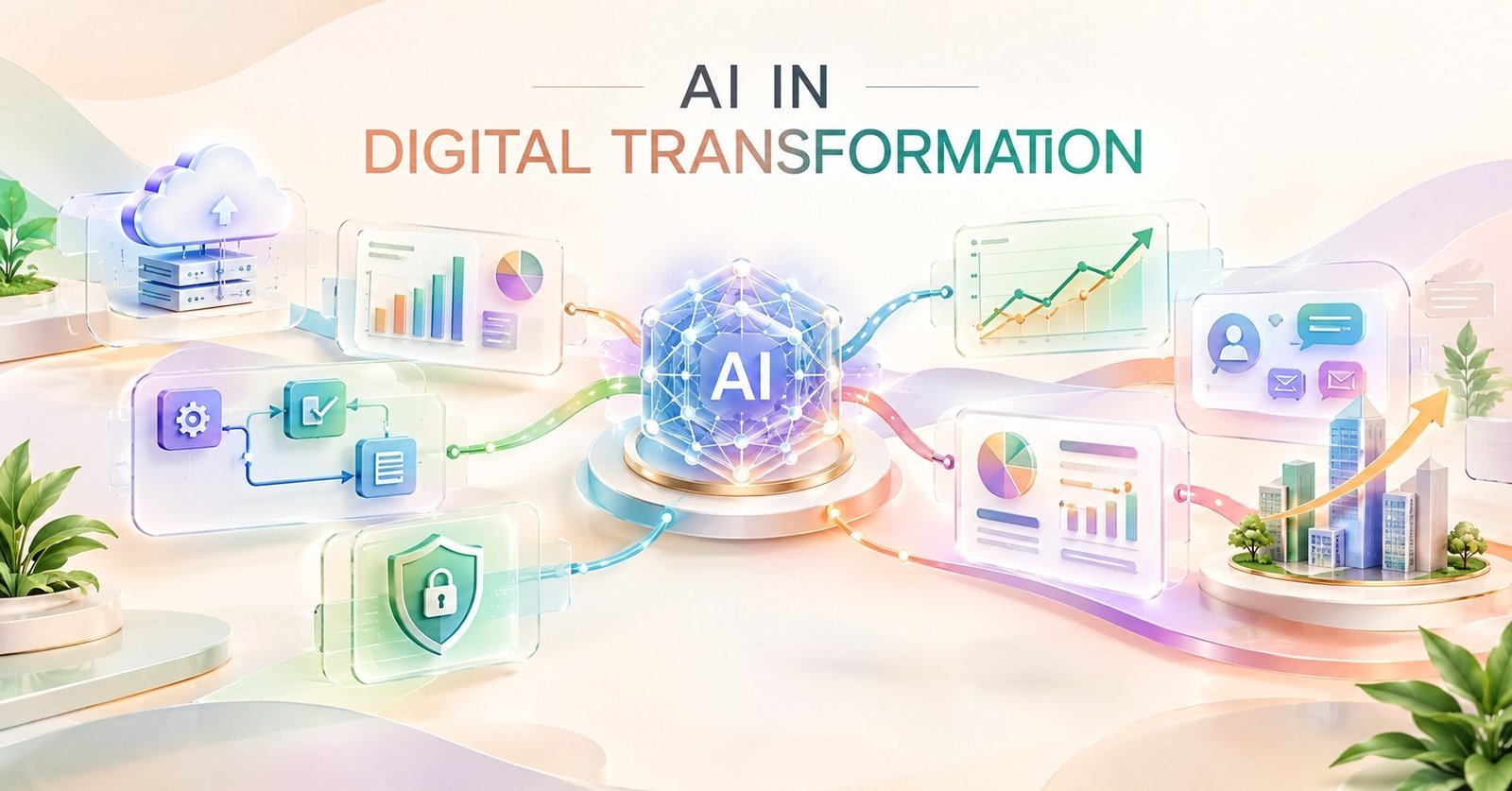
Artificial intelligence is rapidly changing how businesses operate, compete, and grow in the digital era. Artificial intelligence is moving from an experimental technology to a practical business capability. Organizations are using AI to reduce repetitive work, understand large datasets, improve customer interactions, and make faster operational decisions. This shift is changing not only the tools businesses use but also the way they design workflows and compete in digital markets.
Droven. io AI in Digital Transformation is relevant to this broader shift because businesses increasingly need practical guidance on connecting AI capabilities with real operational goals. Intelligent automation, predictive analytics, generative AI, and personalized customer experiences can all contribute to a more responsive organization when they are implemented for clearly defined problems.
The important point is that digital transformation is not achieved simply by adding an AI application. A successful transformation connects technology with people, processes, data, security, and measurable business objectives. This guide examines how that approach works, where AI can create the greatest value, and what organizations should consider before expanding their AI adoption.
What Does Droven.io AI Mean for Digital Transformation?
Droven.io AI can be understood as business-focused AI information and insights associated with Droven.io. Its relevance lies in explaining how artificial intelligence can be applied to practical business situations rather than treating AI as a purely technical subject.
For a business owner or manager, knowing how a machine-learning model works internally is often less important than understanding what problem the technology can solve. Can it reduce the time employees spend entering information? Can it help a sales team identify stronger prospects? Can it detect unusual financial activity? Can it provide customers with faster answers?
This practical perspective is increasingly important because AI adoption is no longer restricted to large technology companies. Smaller organizations can access cloud-based AI services, automation platforms, analytics systems, and generative AI applications without building their own AI infrastructure from the ground up.
Droven. io AI in Digital Transformation fits into this business-first conversation by focusing attention on how AI can support operational modernization and better decision-making.
One of the most useful ways to evaluate an AI initiative is to start with the business problem instead of the technology. A company might identify excessive customer-service workload before deciding whether a chatbot is appropriate. A finance team might identify slow reporting before considering automated analytics. This prevents organizations from adopting AI simply because a particular tool is currently popular.
AI can support several areas of business performance. Machine learning can identify patterns in historical information, predictive systems can help estimate future outcomes, automation can handle repetitive workflows, and generative AI can assist with drafting, summarization, research, and knowledge management.
However, implementation also introduces questions around data quality, privacy, cybersecurity, employee adoption, accuracy, and ongoing oversight. An AI system is only as useful as the information and workflow surrounding it.
For this reason, organizations should consider AI as part of a broader operating model. Employees need to understand how to use the system, managers need measurable performance indicators, and organizations need processes for reviewing AI-generated results.
The most effective AI strategy is therefore not necessarily the one with the largest number of AI tools. It is the one that connects a small number of useful technologies with clearly defined business outcomes.
Digital Transformation Is More Than Adopting New Technology
Digital transformation refers to a fundamental improvement in how an organization operates, serves customers, manages information, and creates value through digital technologies.
It is easy to confuse transformation with modernization. Replacing an old spreadsheet with a cloud application may improve a particular process, but transformation goes further. It can change how departments share information, how decisions are made, how customers interact with the business, and how products or services are delivered.
This distinction matters because technology alone cannot solve organizational problems.
A company may purchase an advanced analytics platform and still make poor decisions if its data is incomplete. It may install an automation system but create new bottlenecks if the underlying workflow was poorly designed. It may deploy an AI assistant without preparing employees to review its output.
Successful transformation combines technology with process redesign and organizational change.
AI has accelerated this movement because modern systems can process information and recognize patterns at a scale that would be difficult for teams to handle manually. Businesses can use these capabilities to identify trends, automate repetitive activities, personalize customer interactions, and support decision-making.
Customer expectations are another major driver. People increasingly expect businesses to provide quick responses, convenient digital services, personalized experiences, and consistent interactions across websites, applications, email, and other channels.
This expectation affects nearly every department.
Marketing teams can use behavioral data to create more relevant campaigns. Sales teams can prioritize leads based on predictive signals. HR departments can automate administrative stages of recruitment and onboarding. Finance teams can streamline reporting and forecasting. Customer-service departments can use AI assistants to handle routine requests while directing complicated cases to human agents.
There is no universal transformation roadmap, however. A large enterprise with complex legacy infrastructure may require a very different approach from a small U.S. business using cloud-based software.
A practical strategy is to identify a limited number of high-impact processes first. Measure the existing cost, time, error rate, or customer impact, introduce a targeted improvement, and then evaluate the result.
This approach also makes employee adoption easier because teams can see a direct connection between the technology and their daily responsibilities.
Leadership remains essential throughout the process. Executives need to establish priorities, allocate resources, communicate expectations, and ensure that technology investments are measured against meaningful business outcomes.
Digital transformation should therefore be viewed as a continuous operating strategy rather than a project that ends after new software is installed.
Where Artificial Intelligence Creates the Biggest Business Impact
AI can accelerate transformation because it changes how organizations handle information, routine work, customer interactions, and forecasting.
One of its clearest applications is intelligent automation. Employees often spend significant amounts of time performing repetitive activities such as categorizing documents, transferring information between systems, preparing routine reports, or responding to common questions. Automating suitable tasks can free employees to concentrate on activities requiring judgment and creativity.
Customer service provides another strong example. An AI assistant can respond to straightforward questions, retrieve relevant information, classify requests, and escalate more complicated issues. The goal should not necessarily be to replace human representatives. A better approach is often to let AI handle predictable interactions while humans manage cases requiring empathy, negotiation, or complex reasoning.
Marketing is also changing through AI-assisted analysis. Systems can identify patterns in customer behavior, segment audiences, evaluate campaign performance, and help marketers personalize communications.
Finance departments can use AI for tasks such as anomaly detection, forecasting, document processing, and financial analysis. These capabilities can help teams identify unusual transactions or changes in business performance earlier.
Droven. io AI in Digital Transformation becomes particularly relevant when examining this shift from isolated automation to organization-wide process improvement.
| Traditional Approach | AI-Enabled Approach | Potential Business Benefit |
| Manual information entry | Automated data extraction | Less repetitive work and fewer manual errors |
| Repetitive customer questions | AI-assisted support | Faster initial responses |
| Historical sales review | Predictive analysis | Better planning and forecasting |
| Broad marketing messages | Data-informed personalization | More relevant customer communication |
| Manually prepared reports | Automated analytics | Faster access to business insights |
| Reactive maintenance | Predictive monitoring | Earlier identification of potential failures |
The value of AI becomes even clearer when organizations use it to move from reactive decisions toward predictive ones.
A retailer can use demand signals to improve inventory planning. A manufacturer can monitor equipment data for warning patterns. A financial team can identify anomalies before they become larger problems. A service company can analyze customer behavior to identify potential churn.
These applications demonstrate that AI is not limited to chatbots or content generation. Its broader role is to help organizations make better use of information and respond to changing conditions more quickly.
Why Cloud AI Is Making Transformation More Accessible
One major change in the AI landscape is the availability of cloud-based services.
In the past, sophisticated technology often required specialized infrastructure, significant capital investment, and dedicated technical teams. Cloud platforms have reduced many of these barriers by allowing organizations to access computing resources and AI capabilities as needed.
This is particularly useful for small and medium-sized businesses. Instead of developing every capability internally, a company can integrate existing services into its workflows and expand them as demand grows.
But accessibility should not be confused with simplicity.
Organizations still need to determine what information can be shared with an AI service, how sensitive data is protected, who has permission to access AI systems, and how generated results are reviewed.
Data governance becomes increasingly important as AI becomes embedded in everyday operations. Companies should know where important data comes from, whether it is accurate, who can access it, and how it moves between systems.
This is one reason an incremental implementation strategy is often safer than attempting an organization-wide AI rollout immediately.
The Hidden Requirements Behind Successful AI Adoption
AI implementation can fail even when the underlying technology is capable.
One common reason is poor data. If an organization has inconsistent, outdated, duplicated, or incomplete information, an AI system may produce unreliable results. Technology cannot automatically turn low-quality input into dependable business intelligence.
Another challenge is employee adoption. People may resist new systems if they believe AI will disrupt their roles, increase monitoring, or create additional work. Clear communication and practical training can make adoption considerably smoother.
Organizations also need human oversight. AI-generated information should not automatically be treated as correct, especially when decisions involve financial, legal, operational, or customer consequences.
A useful implementation framework starts with a specific problem, establishes a measurable baseline, tests a limited solution, evaluates the outcome, and expands only when the results justify further investment.
This creates a feedback loop instead of treating AI adoption as a one-time technology purchase.
Building a More Practical AI Transformation Strategy
Businesses considering AI should resist the temptation to automate everything at once.
A better starting point is to map important workflows and identify areas where employees spend large amounts of time on predictable tasks. The organization can then estimate the potential value of automation by considering factors such as time saved, error reduction, response speed, customer satisfaction, or revenue impact.
The next step is selecting technology that fits the existing environment. A sophisticated system is not automatically better if employees cannot use it effectively or if integrating it requires disproportionate effort.
Testing should happen before large-scale deployment. A limited pilot can reveal technical problems, unexpected costs, data issues, and employee concerns while the project is still manageable.
Performance should then be measured against the original baseline.
For example, if an AI support system is introduced, the organization can monitor response time, resolution rates, escalation rates, customer satisfaction, and workload changes. If an automation workflow is introduced in finance, the business can measure processing time and error rates before and after implementation.
This outcome-based approach keeps AI investment connected to business value.
Also Read: Trulieve Network IT Modernization Standardization Store Technology Rollout
What the Next Stage of Digital Transformation Looks Like
The next phase of digital transformation will likely involve AI becoming less visible as a standalone feature and more deeply integrated into everyday business systems.
Instead of employees opening a separate AI application whenever they need assistance, intelligent capabilities can increasingly appear inside customer-service platforms, analytics dashboards, productivity applications, enterprise software, and internal workflows.
That shift changes the strategic question.
Businesses will not simply ask whether they should “use AI.” They will need to determine where AI should make decisions, where humans should remain responsible, what information AI can access, and how its performance should be monitored.
Droven. io AI in Digital Transformation can be viewed within this larger movement toward businesses that are more automated, data-informed, adaptable, and responsive.
The organizations most likely to benefit are not necessarily those that adopt the greatest number of AI products. They are the ones that understand their processes, establish clear objectives, prepare their people, protect their data, and continuously measure whether technology is producing meaningful results.
AI can provide extraordinary capabilities, but digital transformation succeeds when those capabilities are connected to real business needs.
Ultimately, the goal is not to make an organization look more technologically advanced. The goal is to make it more efficient, responsive, intelligent, and capable of delivering better value to customers. When AI is introduced with that purpose in mind, it becomes a practical component of long-term business transformation rather than another short-lived technology trend.

Core Technologies Behind AI Innovation
Artificial intelligence depends on several advanced technologies working together to solve business challenges. Understanding these technologies helps organizations choose the right solutions instead of investing in tools that may not align with their objectives. This is why discussions around Droven. io AI in Digital Transformation often focus on the technologies that power intelligent business systems rather than AI alone.
Machine Learning (ML) is one of the most important foundations of AI innovation. Instead of following fixed programming rules, machine learning systems learn from historical data and continuously improve their predictions. Businesses use ML for customer recommendations, fraud detection, sales forecasting, and demand prediction because the system becomes more accurate as it processes additional information.
Natural Language Processing (NLP) allows computers to understand and generate human language. This technology powers AI chatbots, virtual assistants, document analysis, translation tools, and voice recognition systems. Organizations use NLP to improve customer communication while reducing response times.
Computer Vision enables AI to interpret images and videos. Manufacturing companies use it for quality inspections, healthcare organizations analyze medical scans, retailers monitor inventory, and security teams detect suspicious activities through intelligent image recognition.
Another rapidly growing technology is Generative AI. Unlike traditional AI that mainly analyzes existing information, Generative AI creates new content including articles, reports, images, software code, marketing copy, and business documentation. This technology significantly improves productivity while supporting creative and knowledge-based tasks.
Cloud Computing provides the infrastructure that makes AI affordable and scalable. Instead of purchasing expensive hardware, organizations can access AI services through cloud platforms. This flexibility allows businesses to expand their AI capabilities without major infrastructure investments.
| AI Technology | Primary Purpose | Common Business Applications |
| Machine Learning | Learn from data | Forecasting, recommendations, fraud detection |
| Natural Language Processing | Understand human language | Chatbots, virtual assistants, document analysis |
| Computer Vision | Analyze images and videos | Quality inspection, healthcare imaging, security |
| Generative AI | Create new content | Content creation, coding, reporting, marketing |
| Cloud Computing | Deliver scalable AI services | AI deployment, storage, analytics |
Data analytics is another essential component. AI systems require accurate, organized, and reliable data to produce meaningful insights. Poor-quality data often leads to inaccurate predictions, making data governance an important part of every digital transformation strategy.
Cybersecurity technologies also play a critical role. As businesses collect more digital information, AI-powered security systems help identify threats, detect suspicious behavior, and respond to cyberattacks more quickly than traditional monitoring methods.
The increasing adoption of these technologies explains why Droven. io AI in Digital Transformation continues to attract attention among organizations planning long-term digital strategies. AI is no longer powered by a single technology but by an integrated ecosystem where machine learning, cloud computing, automation, analytics, cybersecurity, and intelligent software work together.
Businesses that understand these core technologies are better prepared to evaluate AI investments, prioritize digital initiatives, and build scalable solutions for future growth. Rather than following technology trends blindly, successful organizations focus on selecting AI technologies that solve real business problems and support measurable outcomes. This practical approach ensures that Droven. io AI in Digital Transformation becomes a long-term competitive advantage instead of a short-term technology experiment
Benefits for Modern Organizations
Artificial intelligence has become a powerful force behind modern business growth. Organizations are no longer using AI only for experimental projects; they are integrating intelligent systems into daily operations to improve efficiency, customer experience, decision-making, and long-term competitiveness. The impact of Droven. io AI in Digital Transformation can be understood by looking at how AI helps businesses move from traditional processes toward smarter, data-driven operations.
One of the biggest advantages of AI adoption is improved operational efficiency. Many businesses still spend significant time on repetitive tasks such as data entry, report generation, scheduling, and customer inquiries. AI-powered automation reduces manual workload and allows employees to focus on higher-value activities that require creativity, strategy, and human judgment.
Another important benefit is faster and more accurate decision-making. Traditional business decisions often depend on historical reports and limited analysis. AI systems can process massive amounts of data in real time, identify hidden patterns, and provide valuable insights. This enables managers to make decisions based on current market conditions rather than assumptions.
Customer experience has also become a major area where AI creates measurable improvements. Businesses can use AI to personalize recommendations, predict customer needs, automate support responses, and deliver more relevant interactions. A personalized experience increases customer satisfaction and helps companies build stronger relationships.
| Business Area | Traditional Approach | AI-Powered Approach | Key Benefit |
| Customer Support | Manual responses | AI assistants and chatbots | Faster service |
| Marketing | Broad campaigns | Personalized targeting | Better engagement |
| Data Analysis | Human-based reports | Real-time AI insights | Smarter decisions |
| Operations | Repetitive workflows | Intelligent automation | Higher productivity |
| Planning | Historical forecasting | Predictive analytics | Improved accuracy |
Cost optimization is another major advantage. While implementing AI requires investment, businesses often achieve long-term savings by reducing operational inefficiencies. Automated workflows lower processing time, minimize human errors, and improve resource allocation.
AI also supports innovation by helping organizations discover new opportunities. Companies can analyze customer behavior, identify emerging trends, and develop products that better match market demand. This ability to adapt quickly has become essential in competitive industries.
The role of Droven. io AI in Digital Transformation highlights that successful AI adoption is not simply about technology implementation. The real value comes from connecting AI solutions with clear business objectives. Organizations that understand their challenges and choose relevant AI applications are more likely to achieve sustainable improvements.
Modern businesses that combine artificial intelligence with strong strategies, skilled employees, and quality data can create a more flexible and future-ready organization. AI becomes not just a tool but a foundation for continuous improvement and digital growth.
Also Read: Digital product conversion rate benchmark shopify store AI tools
Real-World Industry Applications
Artificial intelligence is transforming industries by solving practical business challenges and creating new opportunities. Different sectors are adopting AI based on their unique needs, but the common goal remains the same: improving efficiency, reducing costs, and delivering better experiences. The growing importance of Droven. io AI in Digital Transformation reflects how businesses across industries are exploring AI-driven solutions to remain competitive.
Healthcare Industry
Healthcare organizations use AI to improve diagnosis, patient care, and operational management. Machine learning systems can analyze medical data, assist doctors in identifying health risks, and support faster decision-making.
AI-powered platforms also help hospitals manage appointments, patient records, and administrative workflows. By reducing paperwork and improving data accessibility, healthcare professionals can spend more time focusing on patient care.
Financial Services
Banks and financial institutions have been early adopters of AI technology. They use artificial intelligence for fraud detection, risk assessment, customer support, and automated financial analysis.
For example, AI systems can identify unusual transaction patterns within seconds and alert security teams before significant damage occurs. This improves both customer protection and operational efficiency.
Retail and E-Commerce
Retail businesses use AI to understand customer behavior and create personalized shopping experiences. Recommendation engines analyze previous purchases, browsing patterns, and preferences to suggest relevant products.
AI also improves inventory management by predicting demand trends. Retailers can avoid overstocking or shortages by using data-driven forecasting.
Manufacturing
Manufacturing companies use AI for predictive maintenance, quality control, and production optimization. Instead of waiting for machines to fail, AI systems monitor equipment performance and identify potential issues before breakdowns occur.
Computer vision technology also helps factories detect product defects automatically, improving quality standards and reducing waste.
| Industry | AI Application | Business Impact |
| Healthcare | Medical analysis and automation | Better patient outcomes |
| Finance | Fraud detection and forecasting | Improved security |
| Retail | Recommendations and demand prediction | Higher customer satisfaction |
| Manufacturing | Predictive maintenance | Reduced downtime |
| Education | Personalized learning systems | Better learning experiences |
Marketing and Customer Service
Marketing teams use AI to analyze audience behavior, optimize campaigns, and create personalized content. AI tools help businesses understand what customers want and when they are most likely to engage.
Customer service departments also benefit from AI chatbots and virtual assistants that provide immediate answers while allowing human agents to handle complex issues.
These examples show that artificial intelligence is not limited to one industry. It has become a flexible technology that adapts to different business environments.
As organizations continue exploring Droven. io AI in Digital Transformation, the focus is shifting from simply adopting AI tools to creating complete digital strategies where AI supports measurable business outcomes.
Common Challenges and Solutions
Although artificial intelligence provides significant benefits, successful implementation requires careful planning. Many organizations struggle not because AI lacks potential, but because they introduce technology without considering business goals, employee readiness, and data quality.
One common challenge is poor-quality data. AI systems depend on accurate and organized information to produce reliable results. If businesses use incomplete or outdated data, AI recommendations may become inaccurate.
The solution is creating strong data management practices. Organizations should improve data collection, establish security standards, and regularly review information quality before deploying AI systems.
Another challenge is employee resistance. Some workers worry that automation may replace their roles or create unnecessary complexity. This concern can slow adoption and reduce the effectiveness of AI projects.
Businesses can overcome this issue through training and communication. Employees should understand that AI is designed to support human capabilities rather than completely replace them. Proper education helps teams use AI tools more effectively.
| Challenge | Why It Happens | Practical Solution |
| Data problems | Poor information quality | Improve data management |
| Employee resistance | Lack of understanding | Provide AI training |
| High initial costs | Technology investment | Start with focused projects |
| Security concerns | Increased digital data | Strengthen cybersecurity |
| Integration issues | Old systems | Upgrade infrastructure gradually |
Another major concern is cybersecurity and privacy. As companies collect more digital information, protecting sensitive data becomes increasingly important. AI systems must be implemented with strong security controls to prevent unauthorized access.
Integration with existing systems can also create difficulties. Many organizations still rely on older software platforms that may not easily connect with modern AI solutions. A gradual implementation approach is often more effective than attempting a complete transformation immediately.
The success of Droven. io AI in Digital Transformation depends on understanding these challenges and addressing them strategically. Businesses should focus on realistic goals, measure results continuously, and improve their AI strategies over time.
AI transformation is not a single technology upgrade; it is an ongoing process that combines people, processes, and technology. Organizations that prepare properly can overcome these challenges and unlock the full potential of artificial intelligence.

Future Trends in AI Transformation
The future of artificial intelligence is moving beyond simple automation toward more intelligent, adaptive, and business-focused solutions. As organizations continue their digital transformation journeys, AI will become deeply integrated into everyday operations, helping companies predict changes, improve experiences, and create new opportunities.
One major trend is the growth of Generative AI. Unlike traditional AI systems that mainly analyze existing information, generative AI can create new content, designs, software code, reports, and business insights. Companies are increasingly using these capabilities to improve productivity, accelerate creative processes, and support faster innovation.
Another important trend is the rise of AI-powered autonomous systems. Future AI solutions will be able to complete complex tasks with less human intervention. Businesses may use intelligent agents to manage workflows, analyze market conditions, optimize resources, and recommend strategic actions.
The combination of AI with other emerging technologies will also reshape digital transformation. AI combined with cloud computing, Internet of Things (IoT), blockchain, and advanced analytics will create more connected and intelligent business ecosystems.
| Future AI Trend | Business Impact |
| Generative AI | Faster content creation and innovation |
| AI Agents | Automated decision-making and workflows |
| Predictive Analytics | Better forecasting and planning |
| Edge AI | Faster real-time processing |
| Responsible AI | Safer and more ethical technology adoption |
Personalization will become even more important in the future. Customers increasingly expect businesses to understand their needs and provide customized experiences. AI will help organizations analyze customer behavior in real time and deliver more relevant products, services, and communications.
Another key development is the focus on responsible AI. As artificial intelligence becomes more powerful, companies will need transparent systems, ethical guidelines, and strong privacy protection. Businesses that prioritize responsible AI practices will build greater trust with customers and stakeholders.
The future of Droven. io AI in Digital Transformation represents a shift from viewing AI as a simple productivity tool to recognizing it as a strategic business capability. Organizations will increasingly use AI to improve decision-making, discover new revenue opportunities, and build more adaptable operations.
Small and medium-sized businesses will also benefit from wider AI accessibility. Cloud-based AI platforms and affordable automation solutions will allow smaller companies to compete with larger organizations by improving efficiency and customer engagement.
However, the businesses that gain the greatest advantage will not necessarily be those that adopt the most advanced technology. They will be the organizations that understand their goals, prepare their teams, maintain quality data, and use AI to solve meaningful business problems.
Artificial intelligence will continue evolving rapidly, but its long-term value will depend on how effectively businesses integrate it into their overall digital strategies.
Final Thoughts
Artificial intelligence has moved from being a futuristic concept to a practical business solution that is reshaping industries worldwide. Companies are using AI to automate processes, analyze information, improve customer experiences, and make smarter decisions. The discussion around Droven. io AI in Digital Transformation highlights how artificial intelligence supports organizations in creating more efficient, innovative, and future-ready business models.
Digital transformation is not only about adopting advanced technology. It requires a complete approach that combines people, processes, data, and intelligent solutions. Businesses that successfully implement AI understand that technology works best when it supports clear objectives and solves real operational challenges.
Throughout this guide, we explored how AI accelerates business transformation through automation, predictive analytics, personalization, and intelligent decision-making. We also examined how different industries use AI, including healthcare, finance, retail, manufacturing, and customer service.
The biggest opportunity for organizations is not simply using AI tools but developing an AI-driven mindset. Companies need to identify where automation can create value, where data can improve decisions, and where intelligent systems can enhance customer relationships.
At the same time, businesses must approach AI adoption responsibly. Challenges such as data quality, cybersecurity, employee training, and system integration require careful planning. Organizations that address these areas are more likely to achieve sustainable results.
The future of digital transformation will be shaped by businesses that combine human creativity with artificial intelligence capabilities. AI will continue to evolve, but successful companies will focus on using it strategically rather than adopting technology without purpose.
For organizations exploring AI opportunities, the next logical step is to evaluate current workflows, identify improvement areas, and create a practical roadmap for implementation.
Droven. io AI in Digital Transformation represents an important conversation about how artificial intelligence can help modern businesses become more efficient, adaptable, and competitive in a rapidly changing digital world.
FAQs
What is Droven. io AI in Digital Transformation?
Droven. io AI in Digital Transformation refers to the use of artificial intelligence concepts and strategies to help businesses understand how AI supports automation, innovation, operational improvements, and modern digital transformation initiatives.
How does AI help businesses transform digitally?
AI helps businesses transform by automating repetitive tasks, analyzing large datasets, improving decision-making, personalizing customer experiences, and creating more efficient workflows.
What industries benefit most from AI transformation?
Industries including healthcare, finance, retail, manufacturing, education, and marketing benefit from AI through automation, predictive analytics, improved customer service, and smarter operations.
What are the biggest challenges of AI adoption?
The main challenges include data quality issues, cybersecurity risks, employee adaptation, integration with existing systems, and the need for proper AI strategy.
What is the future of AI in business transformation?
The future includes generative AI, autonomous AI agents, predictive systems, responsible AI practices, and deeper integration between AI and other digital technologies.