
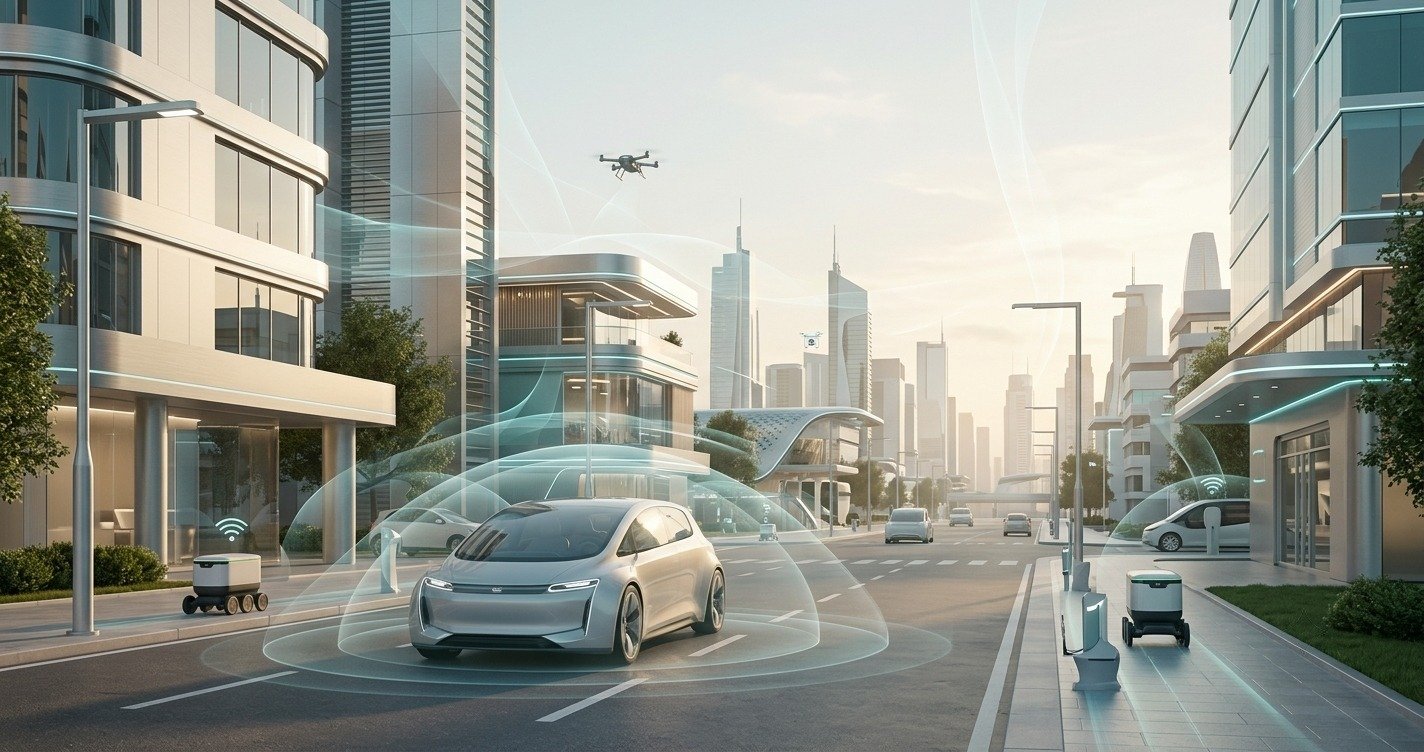
Wireless connectivity is moving toward a new stage where networks will do much more than connect phones to the internet. The next generation is expected to combine high-speed communication with artificial intelligence, distributed computing, sensing, automation, and highly connected devices. This is where 6G enters the picture.
Unlike previous generations, the goal is not simply to make mobile internet faster. The next network generation is being designed to create a more intelligent connection between people, machines, physical environments, data, and computing resources. Industry research already points toward AI-native networks, integrated sensing, autonomous systems, immersive experiences, and new services that go beyond traditional connectivity.
For people searching for 6G network technology, the important questions are straightforward: What is it, how will it work, how is it different from 5G, what will it be used for, and when will people actually be able to use it? This guide answers those questions while separating current facts from future expectations.
What Is 6G Network Technology?
6G network technology refers to the sixth generation of cellular wireless communication. It is being developed as the successor to 5G and is generally associated with the mobile networks expected to emerge around the beginning of the 2030s. The International Telecommunication Union uses the name IMT-2030 for the framework surrounding this next generation of mobile technology.
The important point is that 6G is still under development. It is not a mature consumer network that people can simply activate on their phones today. Standards, technologies, spectrum approaches, and performance requirements are still being developed and evaluated.
The idea behind 6G goes beyond faster downloads. Future networks are expected to connect communication with AI, computing, positioning, sensing, and automation. Ericsson describes this direction as an intelligent fabric that brings together cloud, compute, connectivity, and AI.
That means a future network could potentially help an application decide where computing should happen, provide information about objects and environments, and support autonomous systems while maintaining reliable communication.
This is also why the term 6G technology covers a much wider area than radio speed. It includes new network architectures, advanced antennas, spectrum technologies, AI-based network management, distributed computing, integrated sensing, and improved automation.
In simple terms, 6G can be understood as a future wireless platform designed not only to move data but also to help intelligent digital systems communicate, sense, compute, and respond in real time.
The technology is therefore aimed at a world where smartphones are only one category of connected device. AI assistants, robots, smart glasses, vehicles, industrial machines, sensors, drones, and other intelligent systems could all become important users of future networks.
How Does 6G Network Technology Work?
The exact architecture of future networks is still being standardized, so it would be misleading to describe one final 6G design as if it already exists. However, current research provides a clear direction.
At the radio level, future networks are expected to use a combination of existing cellular spectrum and additional spectrum that can provide greater capacity. Higher-frequency technologies are being investigated for situations where extremely large amounts of data need to be transferred. At the same time, the network must remain efficient and practical enough for wide-area deployment.
Advanced antenna systems will also play an important role. Techniques related to massive MIMO, beamforming, distributed antennas, and coordinated transmission can help networks manage more devices and provide better spatial control of wireless signals.
Another major difference is the role of computing. Instead of treating the network as a simple pipeline that carries information between a device and a distant data center, future systems can distribute computing between devices, edge locations, network infrastructure, and cloud platforms.
This approach is particularly important for AI. An application could potentially send an AI workload to an appropriate computing location based on latency, processing requirements, privacy, available hardware, and network conditions. Ericsson’s current research describes this as a 6G AI compute continuum extending from the far edge toward the cloud.
AI is also expected to operate inside the network itself. Instead of humans manually managing every part of a complex infrastructure, intelligent automation could monitor traffic, predict problems, optimize resources, and adjust network behavior.
Another major concept is integrated sensing and communication, or ISAC. It could allow network infrastructure to use radio signals not only for communication but also to detect and track objects or understand aspects of the surrounding environment.
So, rather than asking whether 6G is simply a faster wireless connection, it is more accurate to think of it as a distributed communication, computing, AI, and sensing platform.
What Are the Key 6G Technologies?
Several technologies are being investigated to make future networks more capable. One of the most important is AI-native networking. In current networks, AI can be added to specific functions. In future systems, AI is expected to become much more deeply integrated into network software, automation, optimization, and service delivery.
Higher-frequency spectrum is another important area. Researchers are exploring ways to use additional spectrum, including higher-frequency ranges, to provide greater capacity. However, higher frequencies can introduce challenges involving coverage, propagation, obstacles, hardware complexity, and energy consumption. This means simply moving to a higher frequency is not enough; the complete network design has to account for these limitations.
Advanced MIMO and antenna technologies are also important. A future 6G wireless technology system could use sophisticated spatial processing to serve many devices and manage signals more efficiently.
Edge and distributed computing are equally important. AI applications often need fast responses, and sending every workload to a distant cloud server can introduce unnecessary delay. By distributing compute resources closer to users and devices, future networks could support more responsive AI and real-time applications.
Integrated sensing and communication is another major research direction. Instead of building completely separate communication and sensing infrastructure, the same network could potentially contribute to both functions. For example, network signals could help detect or track objects, support autonomous mobility, or provide spatial information. Ericsson identifies drone detection, automated guided vehicles, and autonomous systems as potential sensing applications.
Non-terrestrial networks are also part of the broader vision. Future mobile systems are expected to work across different types of connectivity, potentially helping create more consistent coverage across terrestrial and aerial environments.
Network programmability will also become increasingly important. Rather than providing connectivity as a fixed service, future networks could expose capabilities through APIs, allowing developers and enterprises to use services related to connectivity, sensing, positioning, compute, and data.
Together, these technologies explain why the term 6G technology is much broader than the idea of simply increasing download speed.
What Are the Main Features of 6G?
The expected features of future networks are closely connected to the changing demands of AI, automation, immersive applications, and massive numbers of connected devices.
One major feature is significantly improved network capacity. Future applications could generate much more traffic than today’s smartphones, particularly when AI systems, high-resolution media, connected machines, and immersive applications become more common.
Low latency is another important objective. Many future applications will require fast interaction between devices, networks, computing systems, and physical environments. However, latency figures often quoted online should be treated as targets or research goals rather than guaranteed consumer performance.
Another major feature is reliability. Autonomous vehicles, industrial robots, emergency systems, and other critical applications cannot depend on a connection that works well only under ideal conditions. Future networks therefore need to provide predictable and dependable performance.
AI integration is perhaps the feature that most clearly distinguishes the future vision. The network itself is expected to become more intelligent, automated, and adaptive. Ericsson describes AI-native design across network layers as one of the key expectations for the 2030s.
Sensing is another important capability. Through integrated sensing and communication, future networks could potentially provide information about objects and environments. This could support applications such as autonomous mobility, industrial monitoring, drone detection, and spatial services.
Energy efficiency will also matter. A network that supports dramatically more devices and computing cannot simply consume proportionally more energy. Future designs are therefore expected to focus on leaner architectures, automation, and improved energy performance.
The broader vision also includes ubiquitous connectivity, immersive communication, massive communication, AI and communication, and integrated sensing. These areas align with the evolving IMT-2030 framework for future mobile systems.
How Is 6G Different From 5G?
The simplest difference is that 6G is intended to build on 5G rather than completely replace its purpose.
5G already provides higher speeds, lower latency, massive device connectivity, and support for applications such as industrial IoT and fixed wireless access. The problem is that future digital systems may demand much more than connectivity alone.
This is where the 6G network vision becomes different. Future networks are expected to combine connectivity with AI, computing, sensing, positioning, and programmable services.
For example, a 5G network can provide connectivity to an autonomous vehicle. A future network could potentially provide the vehicle with connectivity while also supporting positioning, sensing information, distributed AI processing, and other network-based services.
Another difference is the role of AI. 5G networks can use AI for optimization and management, but future systems are expected to make AI much more deeply integrated into the network architecture.
The same applies to sensing. Current wireless networks are primarily designed to transmit information. Future systems could use wireless infrastructure to gather information about physical surroundings as well.
The relationship between the two generations is therefore evolutionary. Current industry research expects 6G to build on 5G Standalone and 5G-Advanced rather than appearing as an isolated technology. Ericsson specifically describes 6G as a continuation of the 5G evolution toward a more intelligent and programmable network platform.
This means 5G will remain important even after 6G begins appearing. Existing networks, spectrum, infrastructure, devices, and applications will not disappear overnight. Instead, future deployments are expected to coexist with and gradually extend the capabilities developed during the 5G era.
What Will 6G Be Used For?
The potential applications of 6G are much broader than faster mobile internet. One major area is immersive communication. Advanced AR, mixed reality, and other spatial experiences could require high data rates, reliable connectivity, low latency, and strong uplink performance.
Autonomous mobility is another major use case. Cars, drones, delivery robots, and other autonomous machines need reliable communication, positioning, sensing, and access to computing resources. A future network could bring several of these capabilities together.
Healthcare could also benefit from better connectivity and immersive communication. Remote consultations already exist through today’s networks, but future systems could support richer video, spatial experiences, connected medical devices, and AI-assisted services. These applications remain future-oriented rather than guaranteed commercial capabilities.
Smart cities are another important area. A connected city could combine sensors, positioning, communication, digital twins, and AI to monitor traffic, infrastructure, public safety, and other urban systems. Ericsson’s current 6G vision includes connected AI cities in which network-generated spatial information and connected sensors contribute to a dynamically updated digital twin.
Industrial automation could become another major application. Factories may use connected robots, automated guided vehicles, predictive maintenance systems, and AI-based quality control. Distributed computing could allow some AI workloads to run close to industrial equipment, reducing the need to send every task to a distant cloud.
The technology could also support massive IoT deployments. Farms, buildings, factories, transportation systems, utilities, and cities may contain huge numbers of sensors and intelligent devices.
This is why searches for 6G technology applications and 6G network applications generally point toward a combination of communication, automation, AI, sensing, robotics, immersive experiences, and connected infrastructure.
The most interesting shift is that future networks may become platforms for applications rather than simply the underlying connection. Developers and enterprises could access network capabilities through APIs, including connectivity, sensing, positioning, computing, and data services.
Also Read: Student Placement Software: Smarter Ways to Manage Placements
When Will 6G Networks Be Available?
6G is not commercially available in the same way that 5G is today. The technology is still moving through research, standardization, testing, and evaluation.
Current industry expectations generally place initial commercial deployments around 2030, although the exact timing will vary by country, operator, spectrum availability, standards, equipment maturity, and business demand.
Ericsson currently describes initial 6G deployments as expected around 2030, followed by further evolution during the 2030s.
This means people should be careful with headlines claiming that 6G has already launched commercially. Demonstrations, research trials, prototypes, laboratory experiments, and early standardization activities are not the same thing as a nationwide consumer 6G network.
The term 6G mobile network therefore describes an emerging technology rather than something most consumers can subscribe to today.
The transition will also take time. When commercial 6G networks start appearing, 5G will not suddenly disappear. Operators will likely continue using existing infrastructure while introducing new capabilities and spectrum gradually.
For consumers, the first visible changes may also come through new devices and applications rather than a simple “6G speed” upgrade. AI-powered wearables, autonomous systems, advanced AR devices, robotics, and other connected products could drive demand for the capabilities being developed for the 2030s.
Another important point is that standards matter. A technology becomes commercially useful when network operators, device manufacturers, infrastructure companies, regulators, and standards organizations align around interoperable specifications. That is why current standardization work is just as important as individual laboratory demonstrations.
What Are the Challenges of 6G?
The future of 6G is promising, but developing a network capable of supporting these ambitions is not simple.
One challenge is spectrum. Higher-frequency bands can offer large amounts of bandwidth, but they can also have more difficult propagation characteristics. Signals may be more affected by obstacles, distance, and environmental conditions. Engineers therefore need new approaches to coverage, antennas, network planning, and spectrum management.
Energy consumption is another concern. A future network may need to support more devices, more AI processing, more sensing, and much higher traffic. If these capabilities are implemented inefficiently, energy demand could increase significantly. This is why sustainability and energy-efficient architecture are important themes in current 6G research.
Security and privacy will also become more complicated. When networks begin handling more AI workloads, sensing information, positioning data, and machine-to-machine communication, the amount and sensitivity of data flowing through network infrastructure can increase.
Sensing introduces additional privacy questions because a network capable of detecting objects and understanding parts of an environment has capabilities beyond ordinary communication. Clear rules will be needed around what can be sensed, who can access the resulting data, and how it should be protected.
Hardware complexity is another issue. Advanced antennas, higher-frequency components, AI accelerators, distributed computing infrastructure, and new radio technologies can increase the cost and complexity of equipment.
There is also the challenge of interoperability. A global mobile ecosystem depends on devices and networks from many manufacturers and operators working together. Standards need to be sufficiently mature to avoid fragmented implementations.
Finally, not every proposed 6G capability will become a mainstream consumer feature. Some concepts may remain useful mainly for industrial, enterprise, research, or specialized applications. This is normal in technology development.
The Future of 6G Network Technology
The most important thing to understand about the future is that 6G is being designed around a broader concept of what a mobile network can do.
Instead of functioning primarily as a connection between a device and the internet, the future network could become an intelligent platform that combines communication, AI, computing, sensing, positioning, and data services.
That shift could have a major effect on how applications are designed. Developers may not only ask whether an application has internet access. They could also use network-provided information about location, environment, compute availability, latency, and sensing.
The growth of AI makes this especially important. AI agents and intelligent machines may communicate continuously rather than only when a human opens an application. Such systems could require reliable uplink capacity, low latency, distributed computing, and consistent coverage across large areas.
Current industry research already connects 6G with AI-powered wearables, autonomous systems, connected robotics, digital twins, mixed reality, and smart cities.
This is also where 6G and AI become closely connected. AI can help operate the network, while the network can provide the connectivity and distributed computing required by AI applications. The relationship works in both directions.
The same applies to 6G and IoT. Billions of connected sensors and machines could create new requirements for coverage, reliability, device management, energy efficiency, and data processing.
Ultimately, the future of 6G will depend on more than technical performance. It will depend on whether operators, manufacturers, governments, developers, and users find valuable applications for the technology.
For that reason, 6G should not be viewed simply as the next number after 5G. Its bigger ambition is to create a more intelligent digital infrastructure where communication, computing, AI, sensing, and physical-world interaction work together.
As development continues toward the 2030s, many details will become clearer. Some current expectations will likely change, while other capabilities may become more important than researchers currently anticipate. What is already clear is that the next generation of wireless technology is being designed for a world where connectivity is increasingly intertwined with intelligence and automation.
Final Takeaway
The future 6G network technology landscape is about much more than faster mobile internet. It is being developed as an intelligent and programmable platform capable of combining advanced wireless communication with AI, computing, sensing, positioning, and massive device connectivity.
For everyday users, the biggest changes may eventually appear through applications such as immersive communication, intelligent wearables, autonomous mobility, connected cities, robotics, and AI services. For businesses, the technology could create new opportunities around automation, digital twins, distributed computing, and network-based services.
However, 6G is still a developing technology. Commercial deployment is expected around the 2030 timeframe, while standards and technical development continue. The most realistic way to understand it today is as the next major evolution of mobile networks rather than a finished consumer product.