
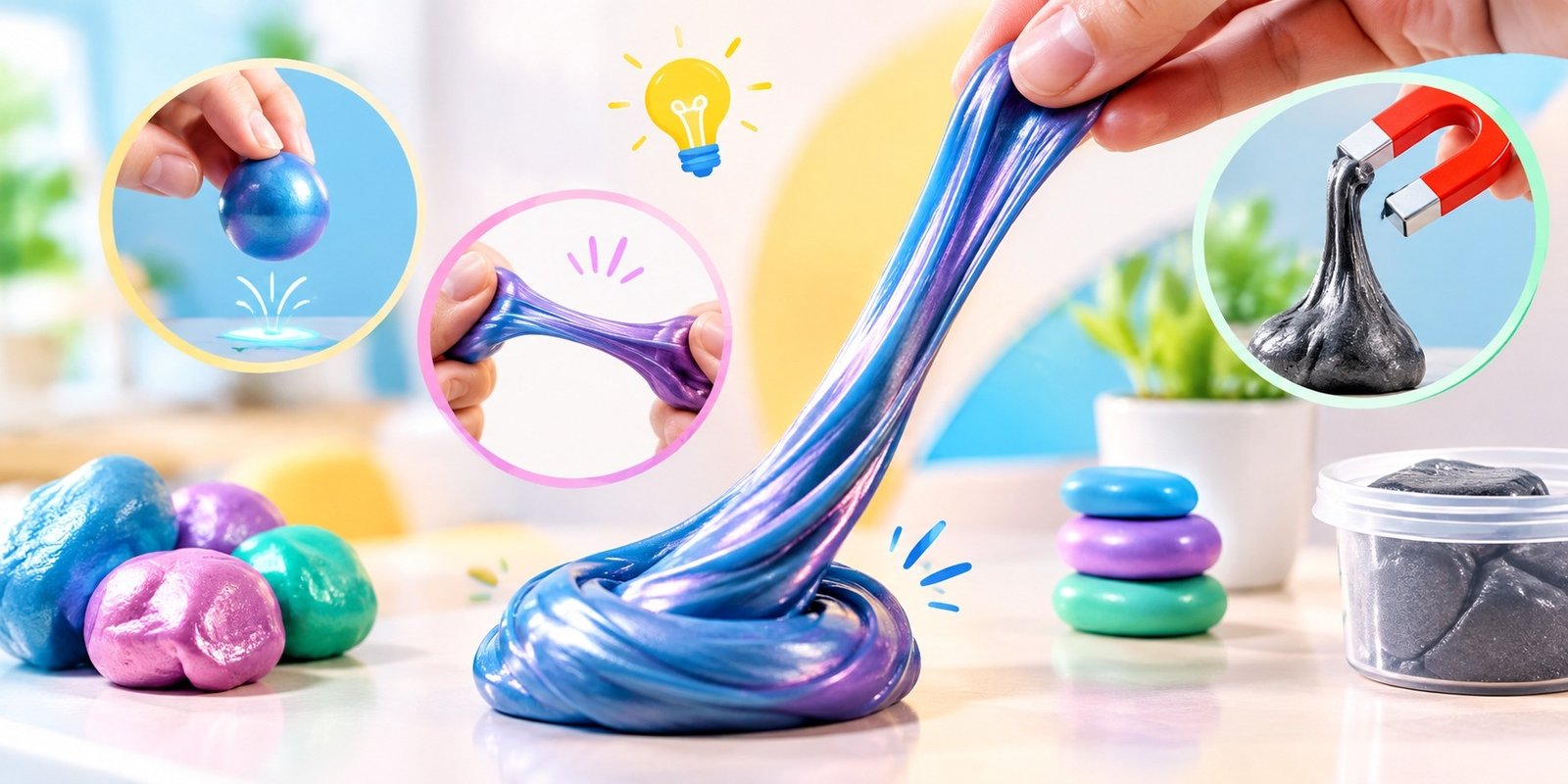
Putty is usually thought of as a simple material for squeezing, shaping, or making small models. Intelligent putty, however, behaves in ways that make it much more interesting than ordinary modeling clay. It can stretch slowly, snap when pulled quickly, bounce when shaped into a ball, and gradually flow when left alone. Some versions can also react to magnets, creating another layer of movement and interaction.
The word “intelligent” does not mean that the material can think or make decisions. It describes the way the material changes its behavior depending on the force, speed, and type of movement applied to it. A gentle pull and a sudden tug can produce completely different results.
That unusual behavior comes from the material’s viscoelastic nature. In simple terms, it can show characteristics associated with both elastic solids and flowing materials. Research on magnetic Silly Putty has found that its response changes according to the rate at which it is deformed.
For this reason, intelligent putty is used for more than casual play. It can provide tactile stimulation, encourage hands-on experimentation, support fine-motor activities, and demonstrate basic ideas from physics and materials science. Magnetic versions can make concepts such as attraction and magnetic response easier to observe.
What Is Intelligent Putty?
Intelligent putty is a soft, moldable material designed to respond differently to different types of force. Unlike traditional modeling clay, which generally stays in a predictable plastic form, this material can behave like an elastic solid under some conditions and a slowly flowing material under others.
The easiest way to understand it is through simple experiments. Roll the putty into a ball and drop it, and it may bounce. Pull it slowly, and it can extend into a long strand. Pull it sharply, and it may suddenly split. Leave a piece sitting on a flat surface for long enough, and it can gradually spread under its own weight.
These behaviors are not random. They are related to the material’s viscoelastic response. When force is applied quickly, the internal structure does not have as much time to rearrange, so the material can respond more like an elastic solid. When force is applied slowly, its molecular structure has more opportunity to move, allowing it to deform and flow.
This is one reason the material is sometimes described as “thinking” or “intelligent” putty. It appears to adapt to the way it is handled, although there is no actual intelligence involved.
Many commercial versions are designed to remain usable for a long time without drying out like ordinary modeling compounds. Some are also odorless and formulated to avoid leaving residue on the hands, although these properties depend on the specific product. Product specifications should therefore be checked before buying, particularly when the material will be used by children.
The term can also refer to different specialty products. Some versions are magnetic, some change color or appearance under particular conditions, and some modeling products use “intelligent putty” as a marketing description for their unusual handling characteristics.
Why Does Putty Behave Differently?
The unusual behavior of intelligent putty becomes much easier to understand when you stop thinking of it as ordinary clay. Its most important characteristic is that its response depends partly on how quickly you apply force.
Imagine slowly pulling a piece of putty between both hands. Instead of immediately snapping, it may continue extending into a thin strand. Now imagine giving the same material a sudden, forceful pull. It can break much more readily. The material has not changed into a different substance; the rate of deformation has changed.
This is characteristic of a viscoelastic material. Viscoelasticity describes behavior that falls between purely elastic and purely viscous responses. An elastic material tends to recover its shape after deformation, while a viscous material flows when a force is applied. Putty can display elements of both behaviors depending on the circumstances.
Scientific research on magnetic Silly Putty describes it as a non-Newtonian material whose response depends on deformation rate. At faster deformation rates, it can behave more like an elastic solid, while over longer periods its polymer molecules can move and untangle, allowing the material to flow.
Temperature, formulation, force, and duration can also influence how a particular putty feels. That means two products that look almost identical may not behave exactly the same way.
This explains several seemingly contradictory characteristics. A piece can be soft enough to mold with your fingers but firm enough to bounce. It can flow slowly while sitting on a table but resist a sudden impact. It can stretch extensively during a controlled pull and then break when the pulling speed changes.
Understanding this behavior also makes the material useful for demonstrations. Instead of simply telling someone that materials can respond differently to different forces, you can show the change directly with the same piece of putty.
How Magnetic Putty Responds
Magnetic putty adds another physical effect to the already unusual behavior of ordinary versions. Magnetic varieties contain magnetic or ferromagnetic particles within the soft putty matrix. When a sufficiently strong magnet is brought close, the material can move toward it and gradually deform around the magnetic field.
The result can look almost alive. A magnetic putty may slowly creep toward a magnet, form a peak, stretch in its direction, or partially surround the magnet. Commercial products often demonstrate these effects as part of sensory play and science-oriented activities.
The science behind the effect is more interesting than the visual trick suggests. The magnet exerts a force on magnetic particles distributed throughout the material. Because those particles are embedded in a soft, deformable substance, the magnetic force can cause the entire mass to move and change shape.
This is different from simply placing a magnet next to a metal object. A rigid metal object may move toward the magnet as one piece, whereas magnetic putty can deform while responding to the field.
Research has gone beyond toys as well. Magnetic putty has been investigated as a soft, reconfigurable material for experimental robotics and other applications because it can be manipulated through external magnetic fields. Researchers have described magnetic putty as malleable and potentially useful for prototyping and educational exploration.
That does not mean every toy sold as magnetic putty has advanced engineering properties. Consumer products vary considerably in formulation and magnetic strength. A simple magnetic sensory toy should therefore be understood primarily as a hands-on demonstration material rather than automatically treated as an advanced robotic material.
The most important practical point is to use any included magnet responsibly and follow the manufacturer’s age and safety instructions.
Stretching, Bouncing, and Breaking
One of the most enjoyable aspects of intelligent putty is that a single material can produce several different physical responses without changing its composition.
Start by rolling a small amount into a compact ball. When dropped onto a hard surface, many formulations can bounce because their elastic response allows them to store and release some of the energy from the impact. This is noticeably different from ordinary clay, which generally deforms instead of bouncing in the same way.
Next, try pulling the material slowly. With enough time, the putty can extend considerably without immediately breaking. The slower movement allows its internal structure to rearrange while the material deforms.
Now change the experiment. Pull it quickly. The result can be dramatically different: instead of extending smoothly, the material may tear or split. Some versions can even fracture into pieces when subjected to sufficiently strong, rapid force. Product demonstrations commonly use these contrasting behaviors to show why the material is considered unusual.
There is also a slow-flowing behavior. Place a piece on a flat surface and leave it undisturbed. Over time, gravity can cause it to spread gradually. This is why demonstrations sometimes compare its long-term behavior with a very slow liquid.
These differences make the material useful for simple home experiments. You can test how the same piece reacts to a slow pull, fast pull, impact, squeezing, rolling, and prolonged resting.
The important lesson is that “soft” does not always mean “behaves like a liquid,” and “stretchy” does not always mean “behaves like rubber.” The material can occupy different parts of that spectrum depending on the conditions.
That unusual combination is what separates specialty putty from conventional modeling materials and makes it useful as both a toy and a simple materials-science demonstration.
Intelligent Putty vs Modeling Clay
At first glance, intelligent putty and modeling clay can look almost identical. Both can be held in the hand, pressed, rolled, flattened, and shaped. Their behavior after those actions, however, can be quite different.
Traditional modeling clay is generally designed to remain in the shape given to it. If you make a small figure, the material tends to hold that form until you reshape it. It is primarily valued for sculpting and modeling.
Intelligent putty is usually more dynamic. Depending on its formulation, it may stretch extensively, bounce after being formed into a ball, slowly spread when left alone, or break when pulled quickly. Some products are also designed not to dry out during normal storage, giving them a very different lifecycle from air-drying modeling compounds.
The difference becomes especially obvious when the goal is sensory interaction rather than permanent modeling. Clay is useful when you want to construct something and keep working on its shape. Putty is often more interesting when you want to repeatedly squeeze, stretch, fold, pull, bounce, and reshape the material.
There can also be a difference in cleanup and texture. Some commercial putties are formulated to be non-sticky and leave little or no residue on hands, but this is not universal. Certain products can stain fabrics or react differently with surfaces, so manufacturer instructions still matter.
Another important distinction is that “intelligent putty” is not one standardized chemical formula. The term is used commercially for several related types of specialty putty. One product may emphasize sensory play, another magnetic behavior, and another may be intended for hobby modeling.
Therefore, comparing the names alone can be misleading. The material’s actual ingredients, magnetic content, recommended age, texture, and care instructions are more useful when deciding whether a particular product fits your needs.
Also Read: Trulieve Network IT Modernization Standardization Store Technology Rollout
Creative and Sensory Uses
The appeal of intelligent putty comes partly from the fact that it does not require a complicated activity. You can simply hold it, squeeze it, stretch it, roll it, or reshape it. That makes it suitable for short periods of hands-on sensory exploration.
For children, repeated manipulation can involve finger movement, hand strength, coordination, and tactile exploration. Some specialist toy retailers specifically position intelligent putty as a material for fine-motor activities and hand-eye coordination.
For adults, the same repetitive actions can make the material interesting as a desk or fidget object. Squeezing and reshaping something with the hands provides a physical activity that can break up periods of sitting or screen-based work. It is reasonable to describe this as a relaxation or sensory activity, but claims that a particular putty treats anxiety, ADHD, or another medical condition should not be assumed simply because a product is marketed as a stress-relief toy.
The material can also become a small science experiment. Try making predictions before manipulating it:
- Will it bounce after being rolled into a ball?
- How far will it stretch during a slow pull?
- What happens if the pulling speed increases?
- Does its behavior change after repeated kneading?
- How does a magnetic version react when the magnet is moved slowly?
- Does the material gradually spread when left untouched?
These questions turn ordinary play into observation and experimentation.
Magnetic versions can be particularly useful for demonstrating attraction and field-driven movement. A child can watch the material move toward a magnet rather than simply seeing a metal object snap toward it.
Creative users can also combine colors, make temporary shapes, create bubbles, flatten the material, or experiment with different forms. Unlike permanent modeling projects, the objective is often the process rather than the finished object.
That makes the material versatile: it can be a fidget, a sensory object, a creative medium, or a simple introduction to unusual material behavior.
Does Intelligent Putty Ever Dry Out?
One of the commonly advertised advantages of intelligent putty is that it can remain usable for a very long time without drying out in the same way as conventional air-drying modeling materials. Several current product descriptions specifically highlight this characteristic.
However, “does not dry out” should not be interpreted as “cannot ever change.” Storage conditions, contamination, heat, surface contact, formulation, and general wear can affect the condition of any soft material.
The best way to preserve putty is simple: keep it in its original container or another suitable airtight or protective container after use. Avoid leaving it exposed to dust, fabric fibers, food particles, or dirty surfaces. Those contaminants can change the texture and make the material less pleasant to handle.
Temperature can matter as well. A putty that feels different in a cool room may become softer in warmer conditions. This does not necessarily mean the material is damaged; its physical response can naturally change with temperature.
Magnetic versions deserve an additional consideration. If the product contains a strong magnet or is supplied with a strong magnet, follow the manufacturer’s safety guidance. Small magnets can be dangerous if swallowed, particularly by children, so they should be kept away from young children and handled according to the product’s instructions.
It is also worth checking age recommendations and material claims before buying. “Non-toxic” or “safe” claims should come from the manufacturer or a reliable seller rather than being assumed simply because a product is sold as a toy.
Ultimately, good storage is less about making the putty last forever and more about protecting the material’s original texture. Clean hands, clean surfaces, proper storage, and sensible handling can help preserve its unusual properties.
Also Read: How Deepfake Technology Works Neural Networks Explained
What to Know Before Using It
Before buying or using intelligent putty, the most useful question is not simply “Is it good?” but “What do I want it to do?” Different formulations can provide very different experiences.
If you want a basic sensory material, look for a product that focuses on softness, stretchability, molding, and repeated use. If your main interest is science or interactive play, a magnetic version may be more suitable. If you want a hobby material for modeling or masking, make sure the product is actually designed for that purpose rather than assuming all putties are interchangeable.
Pay attention to the product description for details such as recommended age, material composition, magnetic components, storage requirements, staining warnings, and whether the product is intended for children or adults.
It is also useful to understand what the material is not. Intelligent putty is not literally intelligent, and its unusual behavior does not mean it is an artificial-intelligence material. The name describes its responsive physical behavior.
Similarly, magnetic putty should not automatically be treated as a high-tech material simply because it responds to magnets. Consumer magnetic putty can demonstrate interesting physical principles, while specialized magnetic materials are also being researched for applications such as soft robotics. Those are related concepts, but they are not the same product category.
The safest approach is to start with small experiments. Stretch it slowly, then quickly. Roll it into a ball and test its bounce. Leave a small piece on a clean surface and observe it over time. If it is magnetic, bring the magnet near it gradually and watch how the material responds.
These simple tests reveal more about the material than a product label can.
Ultimately, the appeal of intelligent putty comes from its ability to make basic physical principles visible and enjoyable. It combines the hands-on satisfaction of modeling clay with behaviors associated with elasticity, viscosity, deformation, and, in magnetic versions, magnetic forces. That combination explains why the material continues to attract both curious children and adults looking for an interactive sensory experience.