
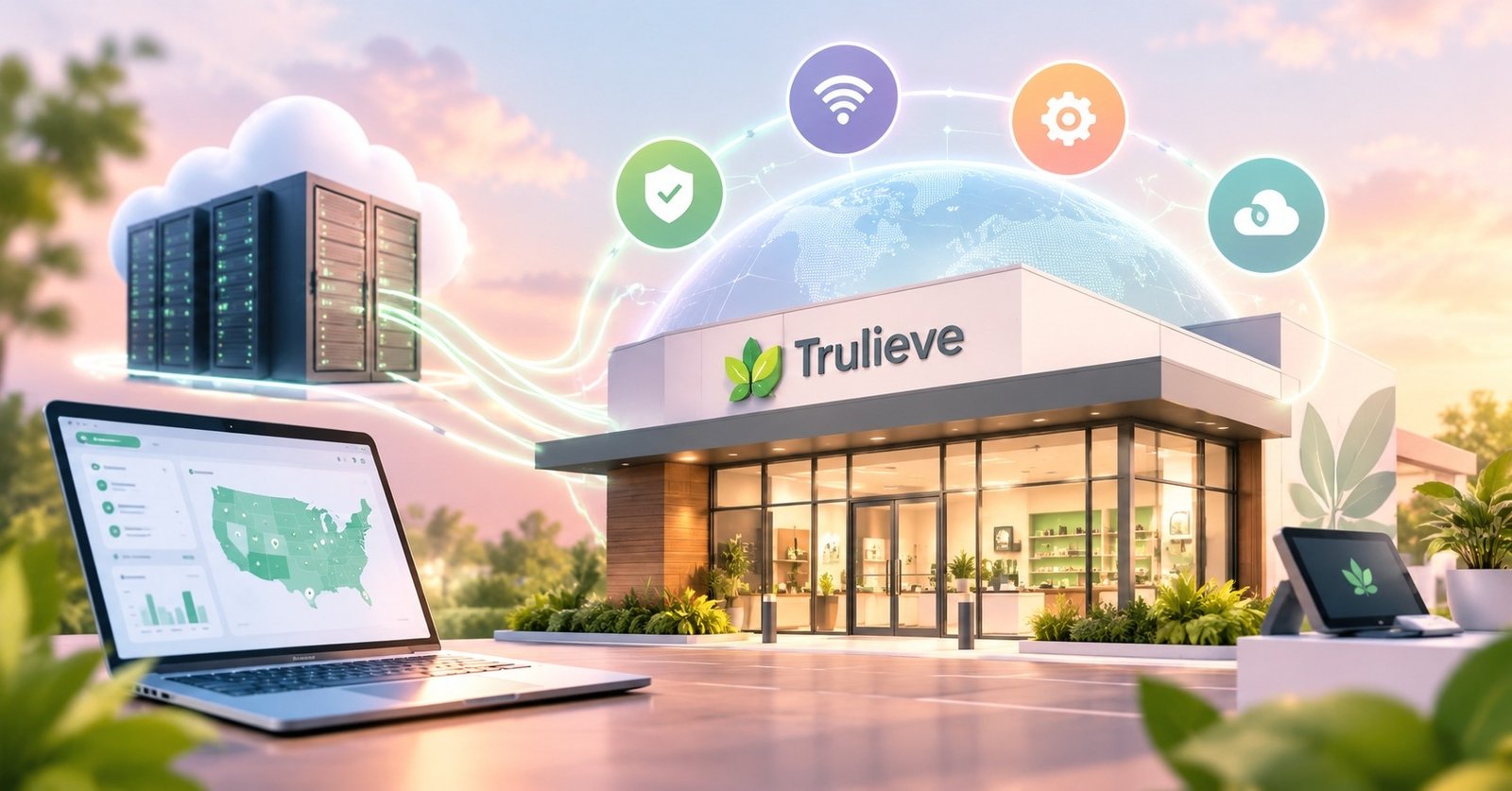
As a company operating a large and geographically distributed retail network, Trulieve needs more than individual store systems to keep its business running smoothly. Its technology environment has to connect retail locations with supply chain operations, production, distribution, ecommerce, customer information, loyalty programs, and management decisions. That makes technology modernization an important part of how the company scales.
The trulieve network it modernization standardization store technology rollout topic is therefore best understood as a broader look at how Trulieve is building a scalable digital ecosystem around its retail operations. Rather than focusing on one piece of hardware or one software deployment, the story involves enterprise systems, data, digital commerce, store operations, and newer artificial intelligence initiatives.
Trulieve has been using SAP technology since 2020, when its earlier systems were no longer keeping pace with business growth and sales demand. SAP S/4HANA became an important part of its enterprise technology environment, giving the company a platform designed to support its vertically integrated operations.
At the retail level, Trulieve has also continued improving its online shopping experience. Recent 2026 updates in Arizona introduced smarter search, improved filtering, online rewards redemption, a more capable store locator, and a simpler account experience.
Trulieve’s Technology Evolution
The trulieve network it modernization standardization store technology rollout story begins with the company’s rapid expansion. Trulieve does not operate like a single-location retailer. Its business connects cultivation, manufacturing, distribution, retail stores, ecommerce and customer engagement. A technology platform that works for a small operation can become difficult to manage when the number of locations, products, transactions and customers increases.
SAP’s account of Trulieve’s technology journey explains that the company originally adopted SAP because its legacy environment could not keep up with growth and demand. S/4HANA provided greater scalability and helped connect information across the business. Trulieve’s technology environment has since expanded to include additional SAP solutions such as SuccessFactors and Concur.
This evolution is important because modernization is not simply about replacing old software. For a large retailer, the goal is to create a technology foundation that can support future locations and changing market conditions without requiring a completely different system every time the company grows.
Trulieve’s current footprint demonstrates why this matters. Its 2026 investor materials reported 207 operating retail dispensaries within its consolidated operations and a branded retail network of 240 dispensaries as of June 30, 2026, alongside continued investment in technology and infrastructure.
The company has also continued refreshing physical locations. In its second-quarter 2026 commentary, Trulieve reported eight new Florida dispensaries year to date and 24 locations refreshed or remodeled across its markets.
This combination of physical expansion and digital modernization shows why a standardized technology approach is valuable. Every new or refreshed location needs to fit into a wider operational ecosystem rather than functioning as an isolated store.
Why IT Modernization Matters
Why does Trulieve need to keep modernizing its IT environment? The simple answer is scale.
A large retail organization produces enormous amounts of operational information. Sales, inventory, customer behavior, pricing, promotions, product movement, employee information and financial activity all create data that needs to move between systems. When those systems are fragmented, employees may have difficulty finding accurate information and management may have to make decisions using delayed or incomplete data.
The trulieve network it modernization standardization store technology rollout approach addresses this challenge by creating a technology environment that can adapt as the retail network grows.
SAP says Trulieve places particular emphasis on scalability and stability because the business operates in a dynamic market. Its enterprise platform provides greater visibility into operations and helps management respond to changing business conditions.
Modernization also matters because retail customers increasingly expect digital convenience. A customer may discover a product online, check availability at a nearby store, use a loyalty account, place an order, and visit the store for pickup. If these experiences rely on disconnected systems, the customer journey can become confusing.
Trulieve’s recent digital upgrades demonstrate the company’s response to this expectation. Its Arizona rollout introduced real-time store menus through an improved store locator, better product search and filtering, online rewards redemption, and a unified account experience.
Technology modernization therefore serves two audiences at once. Internally, it helps employees and managers operate a complex business. Externally, it gives customers a faster and more consistent way to interact with the brand.
Another benefit is adaptability. Trulieve operates across markets with different regulations and customer conditions. A flexible technology foundation allows the company to adjust digital and operational processes without rebuilding its entire technology environment whenever requirements change.
Building a Standardized Store Network
Standardization is one of the most important ideas behind the trulieve network it modernization standardization store technology rollout concept. When a retailer has hundreds of locations, allowing every store to operate completely differently creates unnecessary complexity.
Standardization does not mean that every location must look or operate exactly the same. Different markets can have different products, regulations, customer needs and operating requirements. Instead, standardization means creating common technology foundations, processes and customer experiences wherever practical.
Trulieve’s regional model illustrates this balance between centralized support and localized operations. Its filings describe regional hubs where teams and assets are grouped together while local operations remain tailored to individual markets.
A standardized technology foundation can make it easier to introduce new capabilities across multiple locations. If customer accounts, store information, ecommerce functions and enterprise data follow common structures, improvements can potentially be deployed more efficiently.
The same principle applies to store refreshes. When locations are remodeled, technology should not become a collection of unrelated systems. Store technology should fit into the company’s broader digital architecture.
The benefit is consistency. Customers should be able to recognize the basic digital experience whether they are interacting with a store in Florida, Pennsylvania or another Trulieve market. Employees also benefit when core systems and workflows are familiar across locations.
The trulieve network it modernization standardization store technology rollout perspective is particularly useful here because modernization becomes much more meaningful when it can be repeated across a large network.
Standardization can also simplify training and support. Employees moving between locations or supporting multiple stores do not necessarily have to learn completely different systems. IT teams can maintain common platforms rather than troubleshooting hundreds of unrelated technology configurations.
For a retailer expanding its footprint, that operational consistency can become a competitive advantage.
SAP and Enterprise Systems
SAP is central to understanding the trulieve network it modernization standardization store technology rollout because the company’s enterprise modernization is not limited to the storefront.
Trulieve has used SAP since 2020, and SAP S/4HANA became a key part of its effort to replace an older environment that could not keep up with business growth. SAP describes the system as helping Trulieve manage operations from cultivation and manufacturing through distribution and retail.
This matters because Trulieve is vertically integrated. The product journey can begin with cultivation and continue through processing, distribution and ultimately a retail store. Enterprise technology has to support visibility across that chain.
A modern ERP environment can provide a common source of operational information. Instead of treating production, distribution, finance and retail as completely separate activities, the company can connect information between them.
Trulieve also uses SAP SuccessFactors and SAP Concur, extending its enterprise technology environment beyond core operational management.
Another important element is system stability. SAP published a case describing work with Trulieve’s retail solution to improve stability, showing that modernization includes maintaining reliable systems after implementation rather than simply launching new software.
This is an often-overlooked part of enterprise modernization. A new platform only creates value when employees can depend on it during everyday operations.
The trulieve network it modernization standardization store technology rollout approach therefore involves both implementation and continuous improvement. Enterprise systems need to remain stable while the retail network expands, products change and customer expectations evolve.
For Trulieve, the value of SAP is ultimately connected to scalability. The company has said that technology needs to be flexible enough to adapt to a rapidly changing business environment.
Digital Commerce and Store Technology
The trulieve network it modernization standardization store technology rollout is also visible from the customer-facing side of the business.
In modern retail, the website is not simply an online brochure. It can act as an extension of the physical store. Customers use digital platforms to discover products, check availability, locate stores, manage rewards and prepare purchases before arriving.
Trulieve has repeatedly invested in this area. Its 2024 website redesign introduced a mobile-friendly interface, improved product selection, enhanced store location tools, ecommerce filters and a simpler checkout process. The company also said personalization was being introduced across its markets.
The technology rollout continued in 2026. In Arizona, Trulieve introduced a redesigned shopping experience with smarter product search, improved filters, online rewards redemption, enhanced store menus and streamlined account access.
This is significant because store technology and ecommerce increasingly work together. A customer does not necessarily think about whether a feature belongs to the “website” or the “store.” They simply expect the information to be accurate.
For example, a store locator that displays real-time menus becomes more useful when customers can immediately act on the information. Similarly, an online rewards account becomes more valuable when the same account can be used during the purchasing journey.
Trulieve’s Florida operations also demonstrate the combination of online ordering, home delivery and in-store pickup.
The larger goal is a connected retail experience. Physical stores remain important, but digital tools help customers interact with those stores before, during and after a visit.
That makes digital commerce a major component of store modernization rather than a separate project.
Customer Data and Personalization
Data is another major component of the trulieve network it modernization standardization store technology rollout strategy.
Trulieve has described its customer data platform as combining information from multiple applications. According to SAP, that data helps the company make marketing and operational decisions, including decisions involving pricing and promotions.
This type of integration can change how a retailer understands its customers. Instead of viewing every transaction independently, a connected data environment can provide broader insight into customer behavior and engagement.
Personalization is becoming increasingly important in this environment. Customers do not necessarily want to search through a large catalog without guidance. Better digital systems can make it easier to discover relevant products, promotions and information.
Trulieve’s newer website experience reflects this direction. Its Arizona rollout includes smarter search and filters, improved account access and online rewards functionality.
The company has also moved toward more advanced personalization through Project Hyper. During its second-quarter 2026 earnings discussion, Trulieve said Project Hyper was using generative AI to automate creative production, improve customer-message personalization and modernize digital commerce platforms.
The important point is that personalization depends on a strong data foundation. AI cannot reliably improve customer communication if the underlying information is fragmented, outdated or difficult to access.
That is why enterprise modernization and customer experience are closely connected. The ERP environment, customer data systems, ecommerce platform and store operations all contribute to the information available for better decisions.
For customers, the result should be a more relevant and less complicated experience. For the business, the result can be better visibility into what customers want and how different markets are performing.
Also Read: How Deepfake Technology Works Neural Networks Explained
Mobile Apps and Technology Rollouts
The trulieve network it modernization standardization store technology rollout becomes particularly visible when new digital features move from development into actual markets.
Trulieve’s 2026 materials show that the company is continuing to expand its digital capabilities. In Florida, the company reported a mobile app launch in November, with 50,000 downloads and more than two million user sessions during the second quarter of 2026.
At the same time, Trulieve’s Arizona website upgrade demonstrates a market-by-market rollout strategy. The company announced in May that the improved experience would begin rolling out across Arizona locations in June, with availability varying by store during the rollout.
This approach makes sense for a regulated multi-state retailer. Technology cannot always be deployed identically everywhere at the same time because individual markets may have different regulatory, operational and customer requirements.
A staged rollout allows teams to test features, monitor performance and address problems before expanding the technology further.
It also creates an opportunity to learn from real customers. A feature that performs well in one market may reveal useful lessons about navigation, search behavior, loyalty engagement or store information that can influence future deployments.
The rollout process is therefore more than a technical installation. It includes testing, employee readiness, customer communication, data integration, performance monitoring and continuous optimization.
This is where standardization becomes valuable again. A company can maintain common technology principles while still adjusting the implementation for individual markets.
Trulieve’s history of website upgrades shows that digital modernization is not a one-time project. The company launched a redesigned website in 2024 and continued introducing new market-specific digital experiences in 2026.
That pattern suggests a continuing technology roadmap rather than a single finished rollout.
Also Read: T-Mobile tests AI technology to boost 5G network speeds in 2026
The Future of Trulieve’s IT Strategy
Looking ahead, the trulieve network it modernization standardization store technology rollout story is likely to become increasingly focused on automation, personalization, data and connected digital commerce.
Trulieve identified investment in technology and infrastructure as one of its 2026 focus areas while also targeting retail, production and distribution expansion.
Project Hyper provides one of the clearest examples of where the company is heading. In its 2026 second-quarter update, Trulieve said the initiative was designed around hyper-personalized customer messaging, generative AI-assisted creative production and modernization of digital commerce platforms. The company expected additional capabilities to roll out ahead of a targeted March 2027 completion date.
This points toward a retail environment where technology does more than process transactions. It can help decide what information customers see, how promotions are created, how digital experiences are personalized and how teams use operational data.
AI may also become more closely connected with frontline retail operations. SAP reported that Trulieve sees opportunities for AI tools to assist dispensary associates by using supply-chain and customer information to make product recommendations.
However, successful modernization will depend on more than adding AI features. Reliable enterprise systems, accurate data, stable applications and consistent store processes remain the foundation.
For a large retail network, the long-term objective is not simply to have newer technology. It is to create a flexible technology ecosystem that can support new stores, new markets, changing customer expectations and new digital capabilities without creating unnecessary complexity.
That is the deeper meaning behind Trulieve’s modernization journey. Its technology strategy connects enterprise systems with stores, ecommerce, customer data and emerging AI. As those pieces become more integrated, technology can increasingly become part of the company’s everyday operating model rather than something that sits behind it.

4 Responses