
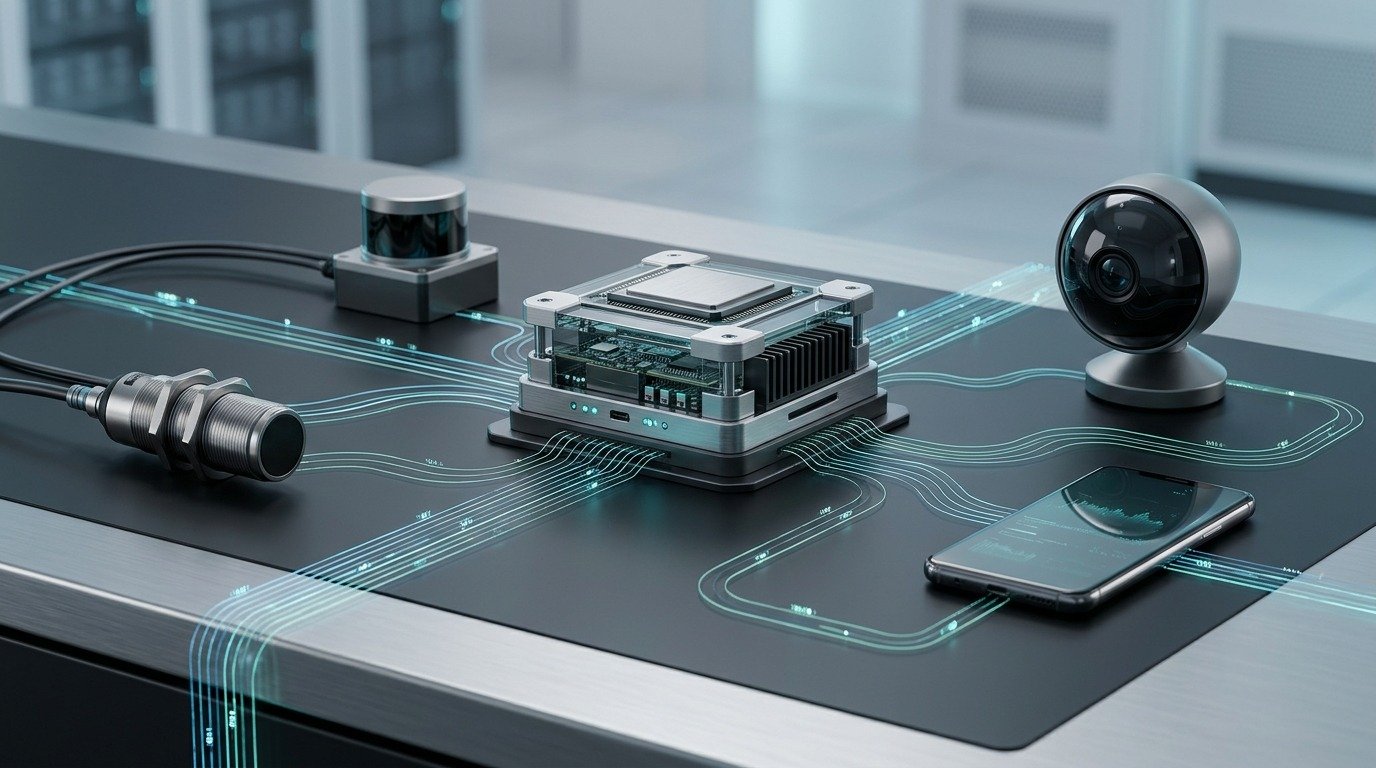
Artificial intelligence is changing how businesses, industries, and everyday devices process information. Traditionally, most AI applications have depended on centralized cloud servers to analyze data, generate predictions, and deliver results. However, this approach can create delays, increase network usage, and raise concerns about transferring sensitive information. A different computing approach is gaining attention: running artificial intelligence closer to where data is actually generated.
This approach is commonly known as Edge AI or AI at the edge. It combines artificial intelligence with edge computing to help devices analyze information locally and respond more quickly. From smart security cameras and industrial machines to connected vehicles and wearable devices, local AI processing is creating new possibilities for real-time automation.
Understanding AI Edging also requires looking beyond faster processing. Hardware limitations, data privacy, network reliability, model optimization, and deployment costs all influence how these systems perform in real environments. Exploring these factors helps businesses understand where local AI processing makes sense and where cloud infrastructure remains necessary.
What Is AI Edging?
AI Edging is the phrase used in this article for the concept of bringing artificial intelligence processing closer to the devices and systems that generate data. The established technical term for this approach is Edge AI. Instead of sending every piece of information to a distant cloud server, an AI model can operate directly on a local device or a nearby computing system.
This approach combines two important technologies: artificial intelligence and edge computing. Artificial intelligence enables machines to recognize patterns, analyze information, and make predictions. Edge computing provides the infrastructure that allows this processing to happen near the original data source.
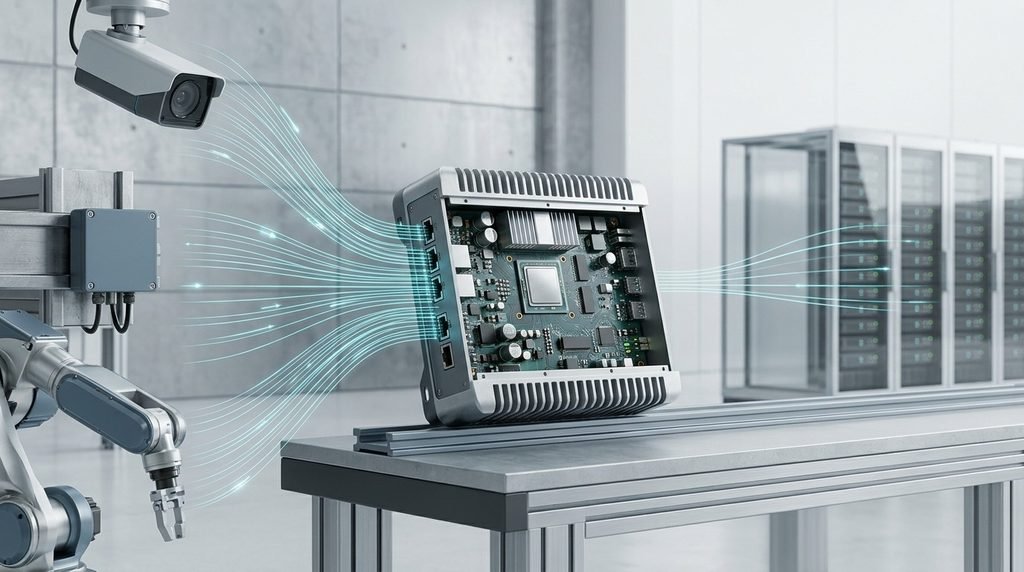
For example, consider a security camera installed inside a commercial building. A traditional system might continuously send video recordings to a remote server for analysis. With an edge-based AI system, the camera or a nearby processing unit can identify movement, recognize specific objects, and detect unusual activities locally. Only important events or selected information may need to be transmitted to a central platform.
Several technologies support this approach, including machine learning, computer vision, neural networks, specialized processors, and Internet of Things devices. Some systems also use compact language models to perform limited AI tasks directly on smartphones, computers, or industrial equipment.
One important distinction is that local AI processing does not mean every AI operation happens without cloud infrastructure. Training sophisticated models often requires powerful centralized computing resources. Once trained, however, optimized versions of those models can be deployed to smaller devices for everyday predictions and automated decisions.
The concept is particularly valuable in situations where immediate responses matter. Autonomous vehicles, industrial monitoring systems, smart medical equipment, and intelligent surveillance applications cannot always afford delays caused by sending information across distant networks.
Understanding this distinction is important for businesses evaluating AI infrastructure. Local processing is not automatically better for every application. Its value depends on the required response time, available hardware, data sensitivity, and complexity of the AI task.
How Does AI Edging Work?
Understanding how AI Edging works requires looking at the complete journey of information, from data collection to decision-making. Unlike traditional cloud-dependent systems, edge-based AI applications perform important processing activities near the location where information originates.
The process generally begins with data collection. Devices such as cameras, microphones, industrial sensors, smartphones, and connected machines continuously gather information from their surroundings. This information might include images, temperature readings, movement patterns, sound signals, or machine performance measurements.
The collected information is then prepared for analysis. This stage is known as data preprocessing. It can involve removing unnecessary information, adjusting image quality, filtering sensor readings, and converting raw information into a format that an AI model can understand.
After preprocessing, a previously trained machine learning model analyzes the information. This stage is called inference. For example, an industrial monitoring system might examine vibration patterns from a machine and identify unusual behavior that could indicate mechanical problems.
If the model detects a particular condition, the device can generate an alert, recommend an action, or trigger an automated response. A smart temperature controller, for instance, can adjust cooling settings when its sensors detect an unexpected increase in temperature.
The following stages explain the process:
- Data collection: Sensors and connected devices gather real-world information.
- Data preparation: The system filters and organizes incoming information.
- AI inference: A deployed machine learning model analyzes the prepared data.
- Decision-making: The system identifies patterns and determines an appropriate response.
- Action and monitoring: The device performs an action or sends relevant information to another system.
An important part of this architecture is model management. Although inference can happen locally, developers may still use cloud servers to train new models, evaluate performance, and distribute software updates.
This creates a continuous improvement cycle in which local devices perform everyday tasks while centralized infrastructure supports model development and system management.
The architecture can operate through different configurations. Some models run directly on a device, while others use nearby edge gateways or local servers. The right configuration depends on processing requirements, available hardware, and network conditions.
Key Technologies Behind AI Edging
The effectiveness of AI Edging depends on several technologies working together. A device needs more than an AI algorithm to process information independently. It requires suitable computing hardware, optimized software, reliable data connections, and an infrastructure capable of managing AI workloads.
Edge computing infrastructure provides the foundation. It places processing and storage resources closer to connected devices. Instead of relying entirely on centralized data centers, organizations can distribute computing capacity across factories, offices, hospitals, retail locations, and other environments.
Machine learning models provide the intelligence. These models identify patterns in information and generate predictions based on previously learned relationships. Depending on the application, they may use supervised learning, deep learning, computer vision, or other machine learning techniques.
Specialized AI processors are equally important. Traditional CPUs can perform many computing tasks, but certain AI workloads benefit from GPUs, neural processing units (NPUs), and dedicated AI accelerators. These processors are designed to handle mathematical operations used in machine learning more efficiently.
Another important technology is TinyML. It focuses on deploying compact machine learning models on resource-constrained devices, including microcontrollers and low-power sensors. This makes it possible to perform selected AI tasks without requiring expensive computing equipment.
Internet of Things (IoT) connectivity links sensors, machines, and other devices. IoT systems provide the data that AI models need to analyze. When combined with local intelligence, connected devices can respond to changing conditions without continuously depending on remote services.
Model optimization also plays an important role. Techniques such as quantization, pruning, and knowledge distillation can reduce model size or computational requirements. These techniques help developers deploy AI applications on devices with limited memory, processing power, and battery capacity.
Finally, device management and security tools help organizations maintain large deployments. They support software updates, model distribution, performance monitoring, access controls, and system maintenance.
These technologies are not independent components. They form a connected architecture in which hardware executes AI models, software manages processing, and network infrastructure coordinates communication between devices and centralized systems.
For businesses, understanding these components is essential before investing in local AI infrastructure. The best solution is not necessarily the most powerful hardware but the combination that delivers reliable performance within operational and financial requirements.
AI Edging vs. Traditional AI
The main difference between AI Edging and traditional cloud-based AI is where information is processed. Both approaches use artificial intelligence algorithms, machine learning models, and data analysis. However, their computing architectures create different advantages and limitations.
Traditional cloud AI sends information from a device to a centralized cloud environment. Powerful remote servers process the data and return the results. This architecture provides access to substantial computing resources, large storage capacity, and advanced AI models.
By comparison, Edge AI processes information directly on a device or a nearby computing system. This reduces the need to transfer every input to a remote server and can improve response times.
Consider a manufacturing facility that uses AI to monitor production equipment. A cloud-based system may send sensor readings to a remote platform for analysis. If connectivity becomes unstable, communication delays could affect how quickly the system responds.
A locally deployed model can analyze sensor information within the facility and identify unusual machine behavior without waiting for a remote response.
However, local processing also has limitations. Smaller devices generally have less memory, computing capacity, and storage than enterprise cloud servers. Consequently, complex AI models may need to be reduced or divided into smaller workloads.
The following comparison highlights their differences:
| Feature | Edge AI | Traditional Cloud AI |
| Processing location | Local devices or nearby servers | Remote cloud servers |
| Response time | Often lower latency | Depends on network conditions |
| Internet dependency | Can operate locally | Usually requires connectivity |
| Computing resources | Limited by local hardware | Highly scalable |
| Data movement | Less information may leave devices | More data may require transmission |
| Model complexity | Often optimized or smaller | Can support larger models |
| Best applications | Real-time monitoring and automation | Large-scale analysis and model training |
A hybrid architecture can combine the strengths of both approaches. Local devices handle immediate decisions, while cloud infrastructure manages demanding calculations, long-term storage, and model training.
This arrangement is particularly useful for organizations that need both fast operational responses and centralized analytical capabilities.
The choice should depend on the application rather than the assumption that one architecture can replace the other. Processing requirements, data sensitivity, operating costs, and connectivity determine which solution provides the most practical results.
Major Benefits of AI Edging
One of the biggest reasons organizations are exploring AI Edging is its ability to process information closer to where it is generated. This architectural change can improve operational efficiency, reduce unnecessary data transmission, and support applications that require immediate decisions.
Faster response times are among its most important advantages. When devices analyze information locally, they do not always need to communicate with distant servers before taking action. This is valuable for applications such as collision detection, industrial safety monitoring, and automated equipment control.
Reduced network bandwidth usage is another benefit. Connected devices can generate enormous amounts of information, particularly cameras and industrial sensors. Transmitting every recording or measurement to cloud infrastructure can consume significant network capacity. Local processing allows systems to send selected results instead of continuously transferring raw data.
Improved data privacy can also be achieved. When sensitive information remains on a local device or within a private network, fewer raw data transfers are necessary. For example, a smart camera may identify movement locally without uploading every video recording. However, local processing does not automatically guarantee security. Devices still require encryption, authentication, secure updates, and appropriate access controls.
Greater operational reliability is another advantage. Some applications can continue performing essential functions during temporary internet interruptions. A locally operating monitoring system, for example, may continue detecting equipment problems even when its connection to a cloud platform becomes unavailable.
Organizations can also benefit from improved scalability. Instead of sending every workload to one centralized location, processing resources can be distributed across multiple sites and devices. This can be useful for businesses operating factories, warehouses, retail stores, and remote facilities.
Energy efficiency is another consideration. Specialized low-power processors can execute certain AI workloads using less energy than general-purpose computing systems. However, the actual energy savings depend on hardware, model complexity, workload, and deployment design.
These advantages make local AI processing attractive for businesses that need responsive automation and efficient data management.
Nevertheless, organizations should evaluate the complete cost of implementation, including device procurement, software maintenance, security management, and technical support. The real benefit comes from selecting applications where local intelligence solves a measurable operational problem rather than deploying AI simply because the technology is available.
Also Read: Design and Engineering Practice: Principles That Work
Real-World Applications of AI Edging
The practical value of AI Edging becomes clearer when examining how organizations use local intelligence to solve everyday problems. Different industries have different requirements, but they share a common need to analyze information and respond without unnecessary delays.
Manufacturing and industrial automation
Factories use AI-powered sensors and cameras to monitor equipment, inspect products, and identify unusual operating conditions. Predictive maintenance systems can examine vibration, temperature, and performance patterns to identify possible equipment problems before they cause unexpected downtime.
For example, an automated inspection system can examine products moving along a production line and flag visible defects. This allows workers to investigate potential quality issues earlier.
Healthcare and patient monitoring
Connected medical devices and wearable technologies can analyze selected health measurements locally. A monitoring device may detect unusual changes in a patient’s readings and notify healthcare professionals when further attention is required.
Local processing can also help medical facilities manage information more efficiently. However, clinical decisions still require appropriate validation, professional oversight, and compliance with healthcare regulations.
Smart cities and transportation
Intelligent traffic systems can analyze information from road cameras and connected sensors to identify congestion, monitor traffic movement, and adjust signal timing. Vehicles also use local AI processing for selected safety features, including lane detection and obstacle recognition.
These systems need responsive processing because delays can affect transportation safety and efficiency.
Retail and customer experiences
Retail businesses use smart cameras, inventory sensors, and automated checkout technologies to improve store operations. Local AI applications can identify empty shelves, monitor stock movement, and help detect unusual activity.
Agriculture and precision farming
Smart agricultural equipment uses cameras, drones, and environmental sensors to monitor crop conditions. AI-powered systems can identify visible plant stress, detect certain pest-related patterns, and support more targeted irrigation or resource management.
Smart homes and connected devices
Home security cameras, smart thermostats, and voice-enabled devices can use local AI models for selected tasks. This can improve responsiveness and reduce the amount of information sent to external servers.
Across these industries, the most useful applications share three characteristics: they generate valuable data locally, require timely analysis, and benefit from reducing unnecessary dependence on remote processing.
The technology does not eliminate human involvement. Instead, it provides faster information and automation that can help people make better operational decisions.
Challenges and Limitations of AI Edging
Despite its advantages, AI Edging is not a universal solution. Deploying artificial intelligence across distributed devices introduces technical, financial, and operational challenges that organizations must understand before implementation.
Limited computing resources are among the biggest restrictions. Smartphones, sensors, cameras, and embedded systems cannot always support the same models used in large data centers. Developers may need to optimize algorithms, reduce model sizes, or select specialized processors to achieve acceptable performance.
Device management becomes more complicated as deployments expand. Managing ten devices is relatively straightforward, but organizations may eventually operate thousands of connected systems across multiple locations. Each device needs software updates, security monitoring, configuration management, and performance checks.
Cybersecurity risks also require attention. Distributed devices create additional points that attackers may attempt to access. Weak passwords, outdated firmware, insecure network connections, and poorly managed software updates can expose systems to threats. Businesses should implement secure boot processes, device authentication, encryption, and regular vulnerability assessments.
Data consistency and model accuracy present another challenge. Devices operating in different environments may receive different types of information. A computer vision model trained in one lighting condition, for example, may perform less accurately in another environment. Regular evaluation and model updates are necessary to maintain reliable results.
Implementation costs can also become significant. Although local processing may reduce some cloud and bandwidth expenses, organizations must invest in compatible hardware, installation, integration, software development, and ongoing maintenance.
Another limitation involves power consumption and physical conditions. Industrial devices may operate in environments with high temperatures, dust, vibration, or unstable power supplies. Hardware must be selected according to these real-world operating conditions.
Privacy also requires more than simply keeping data local. Organizations must establish clear policies explaining what information is collected, how long it is stored, who can access it, and when it may be transmitted to external systems.
Finally, AI models can produce incorrect predictions. A monitoring system might generate false alerts or fail to recognize an unusual situation. Critical applications therefore need human oversight, testing, and appropriate fallback mechanisms.
Successful deployment requires careful planning. Businesses should begin with a clearly defined use case, evaluate hardware limitations, establish security controls, and measure actual performance before expanding the system across their operations.
Also Read: Lab Automation News: AI, Robotics and Key Trends in 2026
Future Trends in AI Edging
The future of local artificial intelligence will be influenced by improvements in computing hardware, smaller machine learning models, connected infrastructure, and more efficient AI deployment methods. As devices become more capable, organizations will have additional opportunities to process information closer to its source.
One important development is the growth of on-device generative AI. Smaller language models are making it increasingly practical to perform selected language-processing tasks directly on smartphones, computers, and other connected devices. These models may support summarization, voice interaction, text generation, and basic assistance without sending every request to a remote service.
Another emerging area is TinyML. Researchers and developers are working on increasingly efficient models that can run on low-power microcontrollers. This could expand intelligent processing to smaller sensors and battery-powered equipment that previously lacked sufficient computing resources.
Advancements in AI hardware will also influence adoption. More efficient neural processing units and dedicated AI accelerators can improve inference performance while controlling energy consumption. This is particularly important for industrial equipment, wearable devices, and autonomous systems.
5G and advanced connectivity will further support distributed AI environments. Faster communication and lower network latency can help connected devices coordinate with nearby edge servers and cloud platforms. However, local processing will remain important because network speed alone cannot eliminate every connectivity or reliability issue.
Another significant trend is the development of hybrid AI infrastructure. Rather than choosing exclusively between local and cloud computing, organizations can distribute workloads according to their requirements. Devices may handle immediate decisions, edge servers may process larger local workloads, and cloud platforms may manage training and long-term analytics.
Privacy-focused technologies and federated learning may also become increasingly relevant. Federated learning allows participating devices to train models collaboratively by sharing model updates instead of routinely transferring all raw training data to a central location. Its implementation still requires careful security and privacy protections.
In addition, organizations are likely to focus more on AI lifecycle management. Monitoring model accuracy, detecting performance changes, managing software updates, and maintaining consistent security across distributed devices will become essential operational responsibilities.
The long-term direction is not simply to make every device intelligent. It is to create reliable systems that distribute computing resources intelligently, reduce unnecessary data movement, and provide useful decisions at the right time.
As these technologies mature, Edge AI is likely to become an increasingly important part of modern computing infrastructure across industrial, commercial, and consumer applications.

One Response