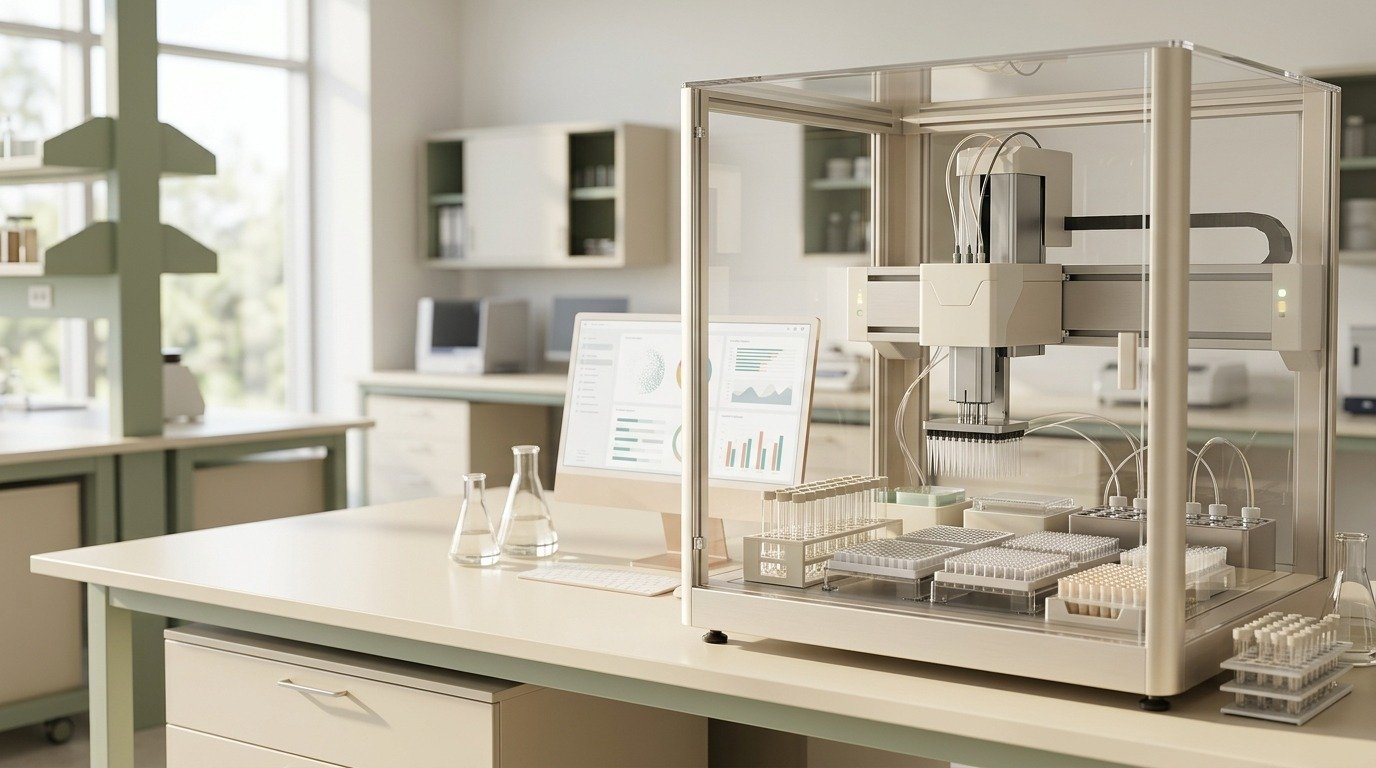
Laboratories are changing rapidly as artificial intelligence, robotics, connected instruments, and automated data systems become part of everyday scientific work. From clinical diagnostics to pharmaceutical research, these technologies are helping scientists perform repetitive tasks more consistently, process larger volumes of samples, and investigate questions that would otherwise require substantial manual effort.
The latest lab automation news is not just about faster machines. It increasingly focuses on connecting laboratory equipment, making experimental data usable by AI systems, and building workflows that can adapt when research requirements change. These developments matter because a laboratory can own advanced instruments and still struggle with disconnected software, inconsistent procedures, and manual handoffs between different stages of an experiment.
Several notable developments have emerged in 2026. The US National Science Foundation announced a $380 million investment in 20 teams developing AI-enabled automated laboratories on July 22. On October 8, the US Department of Energy announced four national laboratory-led projects focused on robotics and automation for scientific discovery. Meanwhile, commercial companies are developing more connected laboratory systems, and researchers continue to investigate how autonomous experimentation can improve scientific discovery.
Understanding these changes requires looking beyond product announcements. This guide explains the major developments, their practical applications, the limitations laboratories should consider, and the trends likely to influence the future of scientific research.
Latest Lab Automation News in 2026
One of the most significant developments in laboratory automation is the move toward connected systems that combine robotics, software, scientific instruments, and AI-driven decision-making.
On July 22, 2026, the National Science Foundation announced an inaugural investment of $380 million in a nationwide network of AI-enabled automated laboratories. The initiative involves 20 teams working to advance automated science and engineering. The funding is intended to help establish infrastructure that supports scientific discovery, reusable methods, reproducible results, and AI-ready research data.
Another important announcement came from the US Department of Energy on October 8, 2026. The department selected four national laboratory-led projects to advance robotics and automation for scientific discovery. Their work includes reusable robot skills, digital-twin environments, open software interfaces, datasets, safety practices, and methods for evaluating whether robotic capabilities can transfer between different instruments and laboratories.
These announcements highlight a critical change: the goal is no longer simply to automate one laboratory task. Researchers and institutions are working toward systems that can be reused, connected, evaluated, and expanded across different scientific environments.
Commercial developments are following a similar direction. In February 2026, Beckman Coulter Life Sciences announced a partnership with Automata to integrate laboratory instruments with a modular automation platform. Chemspeed and SciY also announced a self-driving laboratory platform combining automation hardware, analytics, and AI orchestration.
These projects have different purposes, funding arrangements, and stages of development. A government research initiative should not be treated as equivalent to a commercially available product, and an announced partnership does not automatically demonstrate measurable improvements in routine laboratory performance.
For readers following lab automation news, the important question is what each development actually enables. Does it connect previously separate instruments? Can it reduce manual transfers? Does it improve experimental traceability? Can it operate reliably under real laboratory conditions? These questions reveal more than a headline alone.
AI-Powered Labs and New Developments
Artificial intelligence is becoming an important component of modern laboratory automation, particularly when experiments generate more data than researchers can efficiently evaluate manually.
Traditional automated systems usually execute predefined instructions. A robotic liquid handler, for example, can dispense specified volumes into designated wells. An AI-enabled system may go further by analyzing previous experimental results, recommending the next experiment, or helping researchers identify promising conditions to investigate.
Self-driving laboratories take this concept further by combining automated experimentation with computational decision-making. A typical workflow may involve selecting an experimental condition, preparing materials, conducting an experiment, measuring the result, and using that result to decide what should happen next.
The research paper The Past, Present and Future of Self-Driving Laboratories, published in Nature Reviews Chemistry on July 31, 2026, examines how these systems are developing into broader scientific discovery platforms. It highlights scalability, the ability to transfer methods between laboratories, complete experimental records, and reliable AI as important requirements for future progress.
This distinction is important because not every laboratory that uses AI is autonomous. An AI assistant that summarizes research papers is different from a system that recommends experiments, while a self-driving laboratory must also connect its decisions to physical instruments and experimental results.
A useful example is materials research. Scientists may need to test many combinations of ingredients, temperatures, concentrations, or processing conditions. An integrated system can potentially select informative experiments, execute them through automated equipment, and use measured outcomes to guide the next round.
However, AI recommendations still require scientific validation. Poor-quality training data, unsuitable assumptions, instrument errors, or experimental conditions outside a model’s training range can produce unreliable conclusions. Human scientists remain essential for defining research objectives, checking unexpected results, and deciding whether findings are scientifically meaningful.
The most useful lab automation news therefore explains not only what an AI system can do but also which decisions it makes, what data it uses, and where human approval remains necessary.
Advances in Laboratory Robotics
Laboratory robots are moving beyond isolated movements toward coordinated operations across multiple instruments and experimental stages.
In a conventional setup, staff might prepare samples, transfer them between instruments, start analytical procedures, record measurements, and move results into a separate software system. Each manual handoff creates another opportunity for delays, inconsistent handling, or transcription errors.
Integrated robotics can connect these stages through automated sample transport, robotic arms, instrument scheduling, and centralized workflow software. Modular systems are particularly useful because laboratories can configure equipment for specific applications rather than replacing their entire infrastructure.
Research published in npj Robotics on May 16, 2026, examined the role of robotics in self-driving laboratories. The article describes how robotic synthesis, automated characterization, and AI-driven modelling can work together in a feedback-based experimental process. It also discusses challenges involving scalability and the ability to transfer capabilities across different research settings.
The practical challenge is that laboratory environments are not identical. Tubes, plates, instruments, sample containers, safety requirements, and experimental protocols can vary considerably. A robot that works reliably in one carefully configured workflow may need substantial adaptation before it can perform the same task in another facility.
For this reason, flexible robotics and interoperable software are becoming important design considerations. A modular system may allow a laboratory to add new instruments, change a workflow, or expand capacity without rebuilding every component.
Robotics can also support operations that are difficult, repetitive, or unsuitable for continuous manual handling. Nevertheless, automation does not eliminate the need for maintenance, calibration, safety procedures, and quality checks.
When evaluating lab automation news, readers should distinguish between a successful demonstration and a dependable production system. Reliable performance over repeated runs, recovery from failures, compatibility with existing equipment, and documented safety procedures are all important measures of practical value.
Automated Testing and Sample Handling
Automated sample handling is one of the clearest applications of laboratory automation because samples frequently pass through multiple preparation, testing, and reporting stages.
In clinical laboratories, automation may support barcode identification, sample sorting, centrifugation, aliquoting, instrument loading, analysis, and result routing. In life-science research, automated liquid handling and sample preparation can help researchers conduct experiments with many conditions or replicate measurements.
Clinical testing provides a useful example. On October 20, 2026, SelectScience published coverage of automated LC-MS/MS, explaining how automation, standardization, and integration with core laboratories could help expand access to mass-spectrometry-based testing.
LC-MS/MS, or liquid chromatography–tandem mass spectrometry, is an analytical technique used to identify and measure compounds in samples. It can be valuable for complex testing, but its workflows may involve technically demanding preparation and analytical procedures. Automation can help standardize repeatable steps, although laboratories must still validate analytical performance and maintain appropriate quality controls.
The following table summarizes how automation can support different stages of laboratory work.
| Laboratory stage | Automation application | Main consideration |
| Sample reception | Barcode scanning and sorting | Correct sample identification |
| Sample preparation | Pipetting, mixing, and aliquoting | Precision and contamination control |
| Analytical testing | Automated instrument loading and runs | Calibration and method validation |
| Result management | Electronic data transfer and review flags | Data integrity and human verification |
| Quality control | Scheduled checks and exception alerts | Appropriate acceptance criteria |
Automation can reduce repetitive handling, but it cannot guarantee that every result is correct. A misidentified sample, contaminated reagent, incorrectly configured method, or poorly maintained instrument can still compromise results.
Laboratories must also plan for exceptions. A damaged tube, insufficient sample volume, unexpected instrument flag, or failed analytical run may require human intervention. A strong workflow defines how such cases are detected, documented, and resolved instead of assuming that every sample will follow the normal path.
The value of lab automation news is greatest when it explains these operational details. Readers need to understand whether a technology improves throughput, consistency, traceability, or access to testing—and what safeguards are needed to achieve those benefits.
Also Read: Data Intelligence: How It Works, Benefits, and Uses
New Trends in Drug Discovery
Drug discovery is another area where automation can help researchers investigate complex scientific questions more efficiently.
Developing a potential medicine requires many stages of research, including target identification, compound screening, biological testing, optimization, and validation. Laboratory automation can support high-throughput screening, automated assay preparation, sample management, and repeated experiments across large numbers of conditions.
When these systems are connected to computational models, researchers may be able to prioritize experiments using earlier results. Instead of testing every possible combination equally, an AI model can suggest which conditions may provide the most useful information. Automated equipment can then carry out selected experiments, and the resulting data can inform subsequent decisions.
This approach is often associated with closed-loop experimentation. The process combines experimental planning, physical execution, measurement, analysis, and selection of the next experiment.
In February 2026, Beckman Coulter Life Sciences announced its collaboration with Automata to combine laboratory technologies with modular automation and workflow orchestration. The stated objective was to support more consistent, scalable experimentation and connected research environments.
These developments are relevant to pharmaceutical research, biotechnology, and other fields where experiments involve many samples or changing experimental parameters. However, automation does not establish that a candidate drug is safe or effective. Findings from automated laboratory experiments must still undergo appropriate validation, and promising preclinical results do not guarantee success in human clinical trials.
Another important consideration is experimental quality. If a screening assay produces biased or inconsistent measurements, processing more samples will not automatically produce better scientific conclusions. Researchers must ensure that the experimental design, controls, and analytical methods are suitable before interpreting results.
The strongest lab automation news in drug discovery should therefore connect technical capabilities to scientific outcomes without confusing faster screening with proven medical progress.
Smart Lab Software and Data Integration
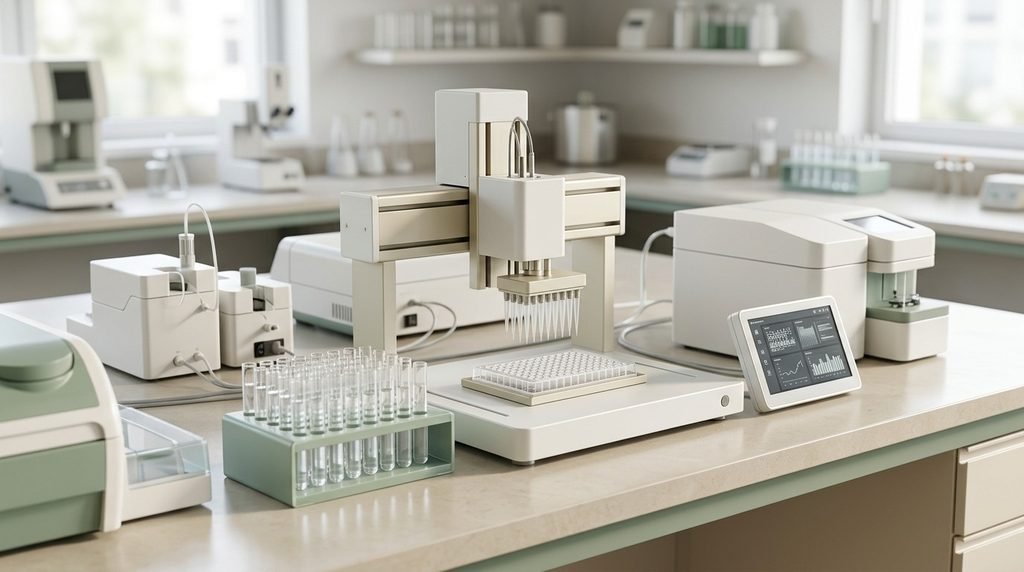
Laboratory automation depends on more than robotic hardware. Software determines how instruments communicate, how work is scheduled, how samples are tracked, and how experimental results are stored and interpreted.
Several software categories play different roles:
- Laboratory Information Management Systems (LIMS): Manage sample records, workflows, and associated laboratory information.
- Electronic Laboratory Notebooks (ELNs): Help scientists document experiments, observations, and research procedures.
- Laboratory execution and orchestration software: Coordinate instruments, schedule tasks, and manage workflows across equipment.
- Analytical and AI software: Process measurements, identify patterns, and support experimental decisions.
These systems may overlap, but they are not interchangeable. A laboratory may use a LIMS to manage sample records and a separate orchestration platform to coordinate robotic equipment. An ELN may preserve experimental context that is essential for interpreting the resulting data.
In February 2026, Chemspeed and SciY announced a self-driving laboratory platform designed to integrate modular automation, scientific analytics, laboratory management software, and an AI-ready data backbone.
The broader issue is interoperability. Different instruments may produce data in different formats, use different naming conventions, or rely on separate software interfaces. If systems cannot exchange information reliably, staff may still need to copy records manually or reconcile inconsistent datasets.
| Software or data layer | Primary role | Why it matters |
| LIMS | Sample and workflow records | Traceability and sample management |
| ELN | Experimental documentation | Reproducibility and research context |
| Orchestration software | Instrument and task coordination | Consistent execution across devices |
| Data integration layer | Connects instruments and software | Reduces isolated data systems |
| AI and analytics | Evaluates data and suggests next steps | Supports evidence-based decisions |
Data provenance is especially important. Scientists should be able to establish which sample was tested, which protocol was used, what instrument generated the measurement, whether any settings changed, and how the final result was calculated.
Without that information, a promising AI-generated recommendation may be difficult to reproduce or audit. Laboratories working in regulated environments must also consider applicable documentation, access controls, validation, and electronic-record requirements.
For lab automation news, software integration deserves as much attention as hardware launches. A laboratory with well-connected instruments and trustworthy data may be better positioned to expand automation than one with more robots but fragmented information systems.
Benefits and Challenges of Lab Automation
Laboratory automation offers meaningful advantages, but its performance depends on the workflow, equipment, implementation, and quality of the underlying scientific process.
One major benefit is consistency. Automated equipment can execute predefined steps with controlled parameters, helping reduce some forms of manual variability. Automation may also increase throughput by allowing multiple samples or experimental stages to be processed in parallel.
Another benefit is traceability. When instruments and software record sample movements, protocol settings, and measurements, laboratories can build a clearer history of how results were produced. Automation can also reduce repetitive workloads, giving scientists more time to interpret findings, investigate anomalies, and design experiments.
However, the initial investment may include more than purchasing a robot. Laboratories may need compatible instruments, software licences, integration services, facility modifications, staff training, maintenance contracts, and validation procedures.
A system can also introduce new failure modes. A software update may disrupt an interface, a robotic gripper may fail to handle an unfamiliar container, or an incorrect workflow configuration may affect many samples before the problem is detected.
The following comparison can help laboratories evaluate whether automation is appropriate.
| Potential benefit | Possible limitation | Practical response |
| Higher sample throughput | Equipment bottlenecks may remain | Map the complete workflow first |
| More consistent routine tasks | Incorrect settings can repeat errors | Validate protocols and monitor exceptions |
| Better data traceability | Disconnected systems can create gaps | Define data standards and integration needs |
| Reduced repetitive handling | Maintenance and recovery still require staff | Train operators and plan downtime |
| Scalable research workflows | Upfront and ongoing costs | Evaluate total cost of ownership |
Laboratories should also consider the risk of automating a process that is poorly understood. If staff have not identified the causes of recurring errors, automation may simply reproduce those problems more consistently and at a larger scale.
A sensible implementation begins with a clearly defined use case, baseline measurements, and a pilot project. Managers can then compare throughput, error rates, turnaround time, staff workload, and operating costs before deciding whether to expand.
The most credible lab automation news reports will distinguish between advertised benefits, measured outcomes, and future expectations. That distinction helps readers make decisions based on evidence rather than marketing claims.
Also Read: Emergency Room Triage Workflow: Smarter Decisions
What’s Next for Automated Laboratories?
The next phase of laboratory automation is likely to involve greater interoperability, more adaptive robotics, stronger AI integration, and improved access to remotely operated research infrastructure.
One important direction is the development of reusable automation capabilities. Instead of building every robotic workflow from scratch, research teams are working toward common interfaces, transferable robot skills, shared data standards, and methods for evaluating performance across different instruments.
Digital twins may also become more useful. These are digital representations of physical systems that can help researchers simulate workflows, test configurations, or investigate potential failures before making changes to real equipment. Their usefulness depends on how accurately the models represent actual instruments and operating conditions.
Cloud laboratories offer another possibility. In these environments, researchers may submit experimental requirements remotely while physical equipment carries out the work at a dedicated facility. This model can give users access to instruments they might not be able to purchase or maintain themselves. However, access costs, scheduling, data security, sample transport, and reproducibility remain important considerations.
AI agents may increasingly help coordinate scientific tasks, but reliable autonomy requires clear boundaries. Systems need to recognize uncertainty, detect abnormal conditions, respect safety constraints, and preserve a complete record of decisions and experimental actions.
The 2026 research initiatives announced by the National Science Foundation and Department of Energy illustrate growing interest in infrastructure that can support automated science across multiple institutions. They do not mean that every laboratory will become fully autonomous in the near term. Different research disciplines have different requirements, and many experiments still depend on expert judgment, complex manual procedures, or specialized facilities.
For laboratory managers, the practical next step is to focus on a workflow where automation solves a measurable problem. For researchers, it is to preserve experimental quality and understand the limitations of computational recommendations. For technology providers, it is to make systems easier to integrate, validate, maintain, and adapt.
Ultimately, the future of lab automation news will be shaped not only by increasingly capable robots but also by whether laboratories can connect equipment, trustworthy data, software, and scientific expertise into dependable systems.
Frequently Asked Questions
What is lab automation?
Lab automation uses instruments, robotics, and software to perform or coordinate laboratory tasks with less manual intervention. Examples include automated pipetting, sample sorting, instrument loading, data collection, and experimental workflow management.
What are the latest laboratory automation trends in 2026?
Major trends include AI-enabled automated laboratories, self-driving experimentation, modular robotics, connected instruments, improved laboratory data integration, and remote access to automated research facilities. Government-funded research programmes and commercial partnerships are helping advance different parts of this ecosystem.
How is AI changing laboratory automation?
AI can help analyze experimental results, identify patterns, recommend experimental conditions, and prioritize subsequent tests. When integrated with robotics and laboratory software, it can support closed-loop experimentation. Its recommendations still require suitable data, validation, and appropriate scientific oversight.
What is a self-driving laboratory?
A self-driving laboratory combines automated experimental equipment with computational decision-making. It can select or recommend experiments, execute procedures, analyze results, and use those results to guide subsequent experiments. The degree of autonomy varies between systems.
Does laboratory automation eliminate human error?
No. Automation can reduce certain manual errors and improve consistency, but it can also repeat incorrect settings, propagate faulty data, or encounter mechanical and software failures. Quality controls, validation, monitoring, and trained personnel remain essential.
Is laboratory automation only useful for large research institutions?
No. Smaller laboratories can automate individual tasks, such as pipetting, sample preparation, or data entry, without implementing a fully automated facility. The appropriate approach depends on sample volumes, workflow complexity, budget, and the availability of compatible equipment.
How can laboratories choose the right automation system?
Start by identifying the specific bottleneck and measuring current performance. Assess instrument compatibility, software integration, sample handling requirements, validation needs, maintenance, staff training, and total cost of ownership. A pilot project can help establish whether the expected benefits are achievable.
Conclusion
Laboratory automation is evolving from isolated equipment upgrades toward connected systems that combine robotics, AI, software, and scientific data. Developments announced in 2026 show growing investment in self-driving laboratories, reusable robotic capabilities, and infrastructure designed to support more scalable scientific experimentation.
Yet the real measure of progress is not how many tasks a robot can perform. It is whether automation produces reliable results, improves a clearly defined workflow, preserves experimental traceability, and gives scientists better evidence for their decisions.
For anyone following laboratory technology, understanding these practical details is essential. The most valuable developments are those that move beyond impressive demonstrations and deliver dependable, reproducible improvements in real scientific environments.