
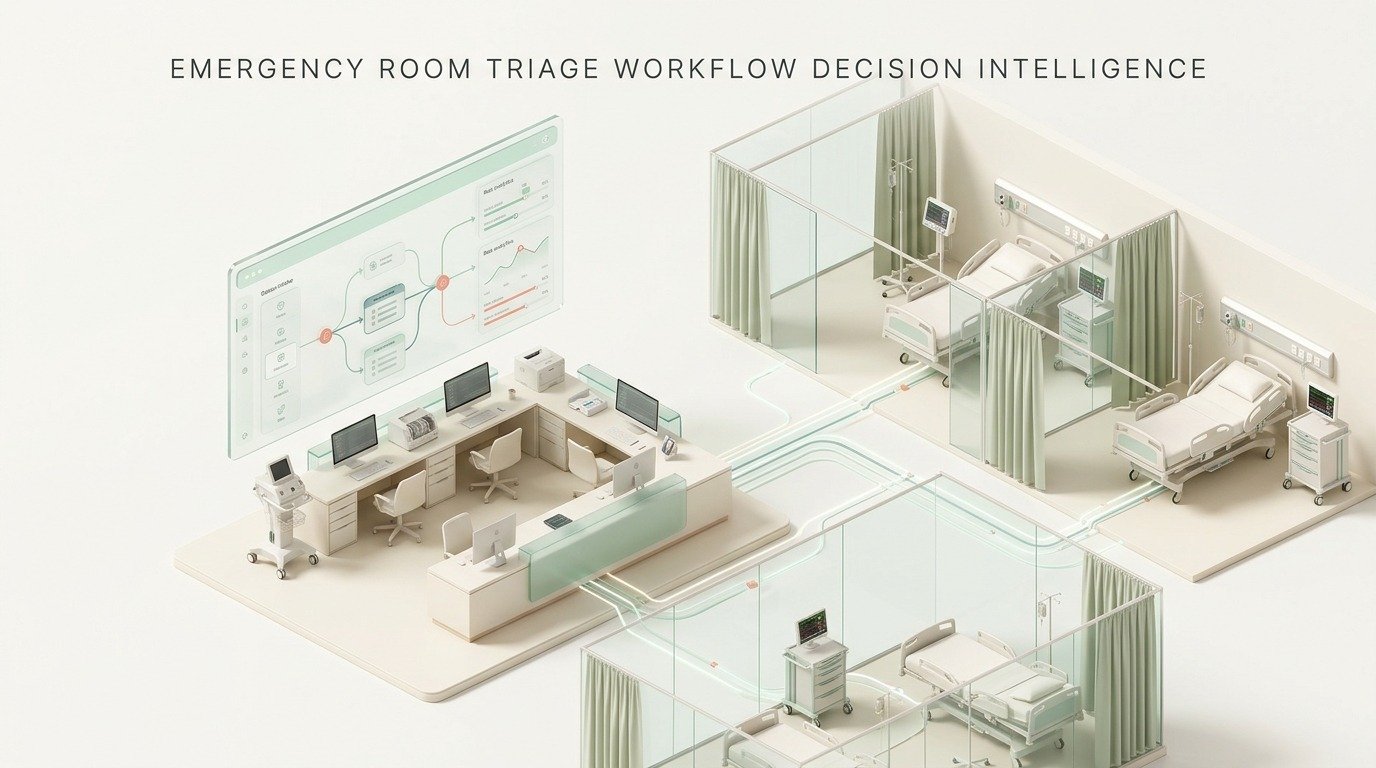
Emergency departments operate in environments where every decision matters. Patients arrive with different symptoms, levels of urgency, medical histories, and treatment needs. Some require immediate intervention, while others can safely wait for further assessment. Determining these priorities quickly and consistently is one of the most important responsibilities of emergency care teams.
Emergency room triage workflow decision intelligence brings clinical information, analytical methods, and decision-support technology together to help healthcare professionals assess urgency, identify potential risks, and manage patient flow more effectively. Instead of relying only on isolated observations, this approach can help clinicians interpret multiple data points and recognize patterns that may require additional attention.
However, intelligent triage is not simply about introducing artificial intelligence into a hospital. It requires reliable clinical protocols, accurate data, carefully validated models, clear responsibilities, and continuous human oversight. Technology must support clinical judgment rather than replace it.
Understanding how this approach works can help hospital administrators, clinical informatics teams, healthcare technology professionals, and researchers evaluate its practical value. From initial patient assessment to ongoing monitoring, the goal is to support safer decisions while making better use of limited emergency department resources.
What Is Emergency Room Triage Decision Intelligence?
Emergency room triage is the initial clinical assessment used to determine how urgently a patient needs medical attention. A triage nurse or another qualified healthcare professional evaluates presenting symptoms, vital signs, relevant medical history, and other clinical indicators before assigning an appropriate level of urgency.
Emergency room triage workflow decision intelligence extends this process by using structured information, clinical rules, analytics, and potentially artificial intelligence to support decisions. It can help healthcare teams identify concerning patterns, estimate certain risks, and recognize situations that may need additional assessment.
For example, two patients may arrive complaining of fatigue. One might have stable vital signs and symptoms that appear less urgent, while the other may have low blood pressure, confusion, or signs of serious illness. A decision-support system can bring these findings together and flag the second patient for urgent clinical review.
The technology does not independently establish a diagnosis simply because it identifies a risk pattern. Its purpose is to provide relevant information that helps qualified professionals make informed decisions.
Several technologies can contribute to this approach:
- Clinical decision support systems: Apply clinical rules and evidence-based guidance to patient information.
- Machine learning: Identifies patterns in historical data to estimate outcomes such as admission or clinical deterioration.
- Natural language processing: Extracts potentially relevant information from written clinical notes and presenting complaints.
- Predictive analytics: Estimates risks or operational outcomes using available data.
- Workflow analytics: Helps teams understand waiting times, patient movement, staffing pressures, and bottlenecks.
These technologies serve different purposes and should not be treated as interchangeable. A rules-based alert, for example, may work differently from a machine-learning model trained on historical patient records.
The key distinction is that decision intelligence combines information with a decision-making process. It considers not only what a system predicts, but also how that prediction should be reviewed, communicated, and used within clinical practice.
For hospitals, the objective is to make triage more consistent, improve awareness of emerging risks, and support timely reassessment without compromising established safety procedures.
How the Emergency Room Triage Workflow Works
An effective emergency department workflow begins when a patient arrives and continues through assessment, prioritization, treatment, and reassessment. Emergency room triage workflow decision intelligence can support several stages, provided it is integrated into the hospital’s established clinical protocols.
Initial registration and assessment: Staff collect the patient’s presenting complaint, relevant medical history, and available identification information. When necessary, immediate clinical assessment takes priority over administrative tasks. Patients with obvious life-threatening emergencies must receive urgent attention without waiting for routine registration or a complete data entry process.
Clinical information collection: Qualified staff assess relevant vital signs, symptoms, mental status, and other findings appropriate to the patient’s condition. Missing or unreliable measurements must be recognized rather than automatically treated as normal.
Risk identification and prioritization: Established triage protocols guide the initial urgency assessment. A validated decision-support tool may then highlight concerning combinations of findings or suggest that a patient requires further evaluation. The responsible clinician reviews the recommendation in context.
Care allocation: The clinical team determines the appropriate next step, which may involve immediate resuscitation, rapid medical assessment, diagnostic testing, or waiting with appropriate monitoring. Available resources matter, but operational convenience must never override clinical urgency.
Reassessment and escalation: Patients can deteriorate while waiting. Repeat observations, new symptoms, and changes in clinical condition may require an updated priority assessment. Decision-support technology can help identify patients who need reassessment, but staff must follow local escalation procedures.
Outcome review: Hospitals can examine whether patients received timely assessment, whether critical cases were missed, and whether workflow delays contributed to adverse outcomes.
This process should operate as a continuous feedback loop rather than a one-time classification. A patient’s initial triage category is not a permanent guarantee of safety.
When implemented carefully, emergency room triage workflow decision intelligence can help connect clinical observations with timely review and operational coordination. However, the workflow must remain understandable to staff, with clear escalation pathways whenever the system produces an unexpected result, becomes unavailable, or conflicts with clinical judgment.
How AI Helps Prioritize Emergency Patients
Artificial intelligence can analyze combinations of clinical variables that may be difficult to evaluate consistently during busy periods. In emergency care, machine-learning models have been studied for tasks such as predicting hospital admission, identifying patients at risk of deterioration, estimating critical-care requirements, and supporting triage classification.
Emergency room triage workflow decision intelligence can incorporate these predictions as additional information for clinicians. For instance, a model might identify a combination of symptoms, age, vital signs, and medical history associated with increased risk. The result could prompt a nurse to review the patient again or escalate the case according to established protocols.
A particularly important application is identifying subtle warning signs. Some seriously ill patients do not initially present with an obvious emergency. Their risk may become clearer when several findings are considered together. Machine-learning tools may help identify such patterns, although their reliability depends on the quality of their training data and validation.
Natural language processing offers another possibility. Patients often describe symptoms in everyday language rather than standardized medical terminology. NLP systems can extract relevant information from presenting complaints and clinical notes, potentially helping organize information for triage staff. Nevertheless, ambiguous language, spelling errors, missing context, and unusual presentations can lead to incorrect interpretations.
It is also important to distinguish different predictive tasks. Predicting whether a patient will be admitted is not the same as deciding how urgently that patient needs treatment. Admission depends on clinical factors, diagnostic findings, hospital capacity, and local practices. A model trained to predict admission should not automatically determine clinical priority.
Similarly, a high-risk score should trigger an appropriate review process, not an unsupported diagnosis. Clinicians need to understand what the score represents, what information influenced it, and what limitations apply.
The strongest use of AI is therefore complementary. Clinical protocols establish the safety framework, qualified professionals interpret patient-specific circumstances, and validated analytical tools provide additional information where useful.
Research reviews report promising predictive performance across several triage applications, but evidence of consistent improvements in real-world outcomes remains more limited. Hospitals should evaluate whether a particular tool improves decisions in their own setting rather than assuming that advanced algorithms automatically outperform every existing process.
What Data Drives Smarter Triage Decisions?
The quality of an intelligent triage system depends heavily on the information it receives. Incomplete measurements, inaccurate documentation, inconsistent terminology, and outdated records can undermine even sophisticated analytical models.
Emergency room triage workflow decision intelligence may use several categories of information, depending on the intended application and the hospital’s approved data-access policies.
Vital signs and clinical observations: Heart rate, respiratory rate, blood pressure, oxygen saturation, temperature, and mental status can provide important information about a patient’s condition. The relevance of each measurement depends on the clinical presentation, age, measurement quality, and applicable protocol.
Presenting symptoms: The patient’s main complaint and symptom history help establish the context for assessment. Chest discomfort, breathing difficulties, sudden weakness, severe pain, or altered consciousness may require different assessment pathways.
Medical history and risk factors: Relevant chronic conditions, medications, allergies, recent procedures, and previous medical events may influence clinical interpretation. Historical information should be checked for accuracy and relevance.
Arrival and workflow information: Arrival mode, time of arrival, current waiting time, and the patient’s location may support operational planning. These details can help identify bottlenecks, but they must not be used as substitutes for clinical assessment.
Diagnostic information: When available and clinically appropriate, laboratory results, electrocardiograms, and other diagnostic findings may contribute to specific risk models. Their use must follow the intended purpose and validation scope of the system.
Clinical notes: Free-text documentation can contain details not captured in structured fields. NLP may help extract these details, but the system must account for uncertainty and avoid treating inferred information as confirmed fact.
A practical data-quality framework should address four questions: Is the information accurate? Is it sufficiently complete? Is it available when the decision is needed? Is it appropriate for this specific clinical purpose?
Hospitals should also examine whether data represent different patient groups fairly. A model trained mainly on one population may perform differently for patients whose age, language, medical history, or patterns of healthcare access differ from the training data.
Data minimization and access controls are equally important. Decision-support tools should receive only the information necessary for their approved function, with appropriate safeguards for sensitive patient records.
Ultimately, more data does not automatically produce better decisions. Relevant, reliable, timely, and representative information is far more valuable than a large collection of poorly maintained records.
Also Read: Data Intelligence: How It Works, Benefits, and Uses
How Decision Intelligence Improves Patient Flow
Emergency department overcrowding is not simply a problem of too many patients. Delays can occur because of limited staffing, unavailable beds, slow diagnostic processes, delayed specialist review, or difficulties transferring patients to inpatient units.
Emergency room triage workflow decision intelligence can help hospitals understand these pressures by connecting patient-level information with operational performance data.
One potential benefit is earlier recognition of patients who may require additional clinical attention. When a validated model identifies a concerning pattern, the system can support a timely review under the hospital’s escalation policy. This may help staff direct attention toward patients whose condition needs reassessment.
Another application involves operational forecasting. Historical arrival patterns, current patient volumes, treatment-space availability, and expected demand can help managers anticipate periods of pressure. Forecasts may support staffing discussions and resource planning, although they cannot predict every sudden surge or major emergency.
Decision intelligence can also help identify bottlenecks. For example, a hospital may discover that patients are being assessed promptly but experience long delays while waiting for diagnostic results or inpatient beds. In this situation, improving the triage algorithm alone would not solve the main problem.
A useful operational dashboard might track:
- Time from arrival to initial clinical assessment.
- Waiting time by triage urgency.
- Time to reassessment when required.
- Delays between clinical decisions and treatment.
- Patient departures before medical evaluation.
- Admission and transfer delays.
- Staffing pressure and treatment-space availability.
These measures should be interpreted together. A shorter average waiting time is not necessarily evidence of safer care if high-risk patients are still being missed or if staff are documenting assessments less thoroughly.
Hospitals should also avoid using a single performance target to reward speed at the expense of quality. Balanced measures can include patient safety, clinical outcomes, staff workload, and patient experience alongside efficiency.
The practical value of emergency room triage workflow decision intelligence lies in helping decision-makers understand where attention and resources are needed. It can inform improvements in coordination and planning, but actual gains depend on whether the hospital can address the problems the data reveal.
A well-designed system should therefore connect its insights to clear responsibilities and achievable actions rather than simply generating more dashboards and alerts.

Common Challenges in AI-Assisted Emergency Triage
Although AI can support emergency care, introducing it into a high-pressure clinical environment creates important technical and operational challenges. Hospitals need to understand these limitations before deploying any decision-support tool.
Undertriage and overtriage: Undertriage occurs when a patient is assigned lower urgency than their condition requires. Overtriage occurs when the assigned urgency is higher than necessary. Undertriage can delay essential care, while excessive overtriage can consume resources needed by other patients. Both outcomes require careful monitoring.
False alerts and alert fatigue: If a system repeatedly generates low-value warnings, staff may become less responsive to important alerts. Alert thresholds should be evaluated against clinical priorities, and recommendations should provide enough context for meaningful action.
Model drift: Patient populations, clinical practices, available treatments, and data-recording procedures change over time. A model that performed well during initial testing may become less reliable when those conditions change.
Poor generalizability: A system developed using records from one hospital may not perform equally well elsewhere. Differences in patient demographics, prevalence of disease, staffing, equipment, and triage protocols can affect performance.
Workflow disruption: Separate dashboards, duplicate documentation, slow interfaces, and poorly timed alerts can increase workload rather than reduce it. Technology should fit the actual sequence of clinical work.
Bias and unequal performance: Historical data may reflect differences in healthcare access or previous clinical decisions. Hospitals should examine performance across relevant patient groups and investigate meaningful disparities.
Privacy and security: Clinical information requires strong access controls, appropriate data handling, and protection against unauthorized disclosure.
Another challenge is explaining predictions. Clinicians need understandable information about the purpose of a risk score, its limitations, and the recommended next step. A number without useful context may create false confidence rather than improve decision-making.
These challenges demonstrate why successful implementation requires more than purchasing an AI product. It requires clinical governance, staff training, technical integration, safety testing, and a defined process for investigating failures.
Hospitals should also maintain a reliable fallback procedure. If a model becomes unavailable or produces an implausible result, clinicians must be able to continue using established triage protocols without unnecessary delay.
Why Clinical Oversight Matters in Triage Decisions
Emergency triage involves uncertainty, incomplete information, and rapidly changing conditions. No decision-support system should be assumed to understand every clinical situation or replace the judgment of qualified healthcare professionals.
Emergency room triage workflow decision intelligence is most useful when its recommendations remain reviewable and accountable. The triage professional must be able to consider the patient’s actual condition, identify missing information, and escalate concerns even when the software produces a low-risk score.
Human oversight is especially important when symptoms are unusual, vital signs conflict with the patient’s appearance, information is incomplete, or the model’s recommendation does not match clinical findings.
A safe implementation should define who reviews alerts, which findings require immediate escalation, how disagreements are documented, and who is responsible for updating the patient’s assessment. These responsibilities should be established before deployment rather than improvised during an emergency.
Hospitals should also distinguish between a model’s prediction and a clinical decision. A prediction estimates the likelihood of a defined outcome. A clinical decision considers that estimate alongside examination findings, medical history, clinical protocols, available evidence, and the patient’s needs.
For example, a model may estimate a relatively low probability of hospital admission. That result does not establish that a patient can safely wait, because admission probability and immediate clinical urgency are different questions. Staff must interpret predictions according to the system’s intended use.
Explainability can help strengthen oversight. Depending on the model, clinicians may receive information about the factors influencing a prediction, uncertainty indicators, or warnings that the case falls outside the model’s validated scope. These features are useful only when presented clearly and evaluated for clinical relevance.
Hospitals should also provide training that explains what the tool can and cannot do. Staff need to understand how to report errors, challenge questionable recommendations, and use the fallback workflow when technology fails.
Importantly, human oversight should be meaningful rather than a routine approval step. If staff are expected to accept every recommendation without sufficient time or information to review it, the presence of a human reviewer does not provide adequate protection.
The objective is a collaborative process in which technology contributes relevant evidence while qualified professionals retain appropriate clinical responsibility. This approach supports accountability, safer escalation, and more trustworthy decision-making.
Also Read: TikTok Shop API Changes Impact Data Intelligence Platforms
How Hospitals Can Evaluate Triage Intelligence Systems
Hospitals should evaluate an intelligent triage system according to its intended purpose, clinical safety, operational usefulness, and performance in the environment where it will be used. Impressive technical results alone are not enough to justify implementation.
The first step is to define the problem clearly. A tool designed to identify possible deterioration requires different evaluation measures from one designed to forecast patient arrivals or estimate admission probability. Hospitals should establish what decision the system supports and what action follows a positive or uncertain result.
Next, the organization should assess the quality and representativeness of the data used to develop and test the model. Independent external validation is important because performance on a development dataset may not reflect performance in a different hospital or patient population.
Model discrimination and calibration should be examined separately. Discrimination measures how well a model distinguishes patients with different outcomes. Calibration examines whether predicted probabilities correspond to observed outcome frequencies. A model may rank patients reasonably well while systematically overestimating or underestimating risk.
Clinical evaluation should also measure undertriage, overtriage, sensitivity, specificity, and relevant patient outcomes. The importance of each measure depends on the intended use and the consequences of missed or unnecessary alerts.
Operational testing should consider workflow integration, alert response times, staff workload, documentation burden, and system downtime. Hospitals should establish baseline performance before deployment so they can distinguish genuine improvements from changes caused by patient volumes or staffing.
A practical implementation plan includes:
- Define the clinical or operational problem.
- Review data quality, privacy, and governance requirements.
- Validate the system using appropriate independent data.
- Test usability and safety in a controlled setting.
- Train staff and establish escalation procedures.
- Introduce the system with appropriate clinical oversight.
- Monitor outcomes, disparities, errors, and model drift.
- Reassess performance regularly and suspend use if safety requirements are not met.
Emergency room triage workflow decision intelligence should be judged by its measurable contribution to care, not by the novelty of its technology. Hospitals should look for evidence that the system supports safer prioritization, reliable clinical decisions, or meaningful operational improvements without introducing unacceptable risks.
Future progress will depend on prospective studies, transparent reporting, better integration with electronic health records, and evaluation across diverse clinical environments. A careful, evidence-led approach offers a stronger foundation for responsible adoption than assuming that every AI-enabled system will improve emergency care.

One Response