
hen a business makes a product, it has to decide how that product will be produced. A handmade wedding dress cannot be made in the same way as thousands of bottles of water, and a bakery producing different types of bread needs a different approach from a company building custom furniture.
This is where methods of production in business become important.
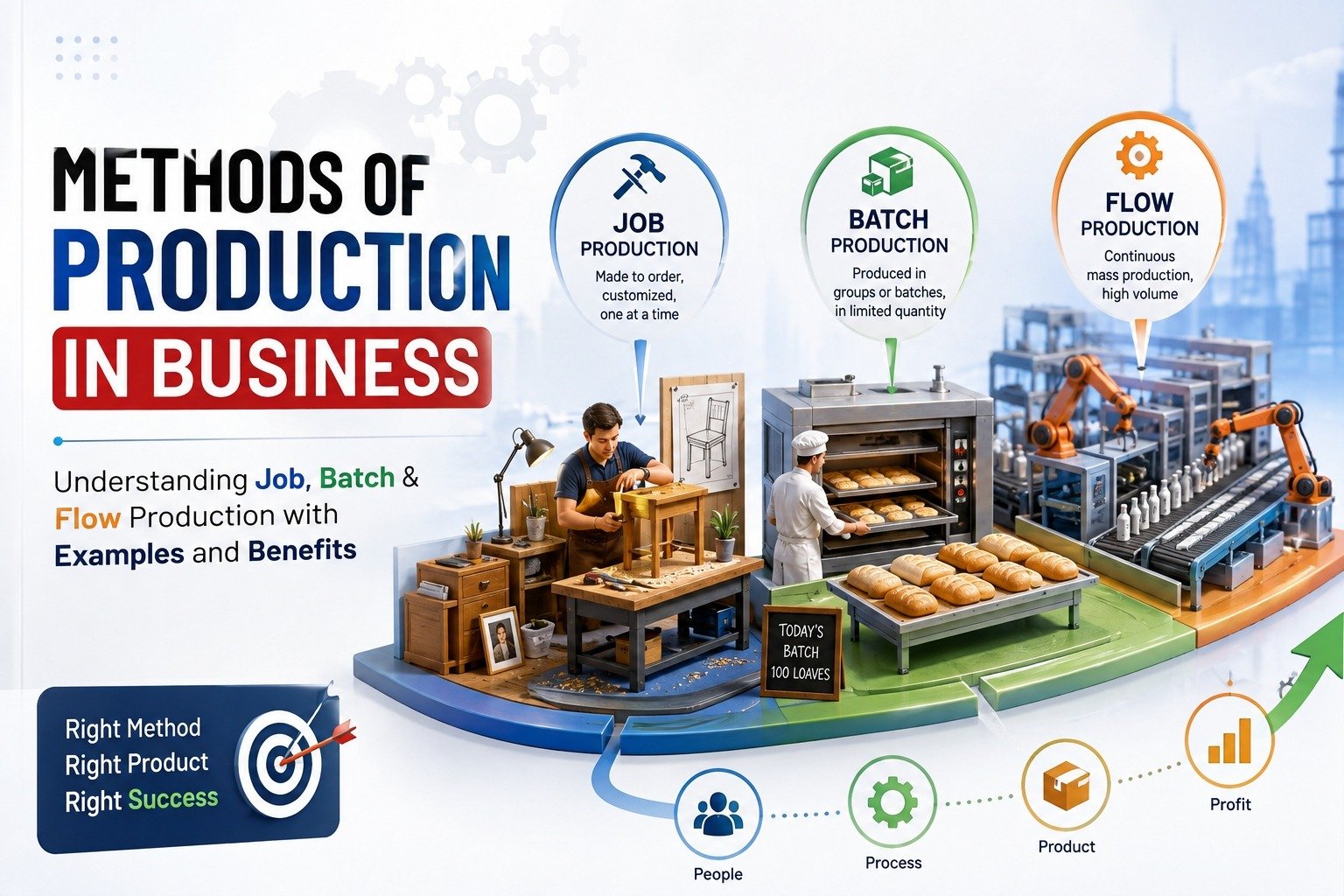
Methods of production are the different ways a business organizes its workers, equipment, materials, and processes to create goods. The three main methods are job production, batch production, and flow production. Each method works best in different situations depending on production volume, product design, customer requirements, costs, and the level of automation available.
Choosing the right method can affect much more than the production process. It can influence product quality, production speed, employee skills, flexibility, operating costs, and ultimately the price customers pay.
So, what are the main methods of production, how do they differ, and which one should a business choose? Let’s break it down in simple terms.
What Are Methods of Production?
Methods of production are the different approaches businesses use to manufacture goods or provide products efficiently.
In simple terms, production turns inputs such as raw materials, labour, machinery, energy, and time into finished products. The method a business uses determines how those inputs are organized.
For example, imagine three businesses:
- A furniture maker creates one custom dining table for a customer.
- A bakery produces 100 chocolate cakes before switching to another product.
- A car manufacturer produces thousands of similar vehicles on an assembly line.
All three businesses are producing goods, but they are using different production methods.
The three main methods are:
- Job production – making one customized product at a time.
- Batch production – making a group of similar products together.
- Flow production – continuously producing large quantities of standardized products.
The difference is mainly related to volume and variety. Job production usually offers the greatest customization but produces fewer units. Flow production is designed for high-volume output but offers much less variety. Batch production sits between the two.
A business does not simply choose a method because it sounds efficient. It must consider what customers want, how much they are willing to pay, how many products are needed, and what resources the business can afford.
That is why understanding production methods is an important part of business operations.
What Is Job Production?
Job production is a method in which one product is made at a time, usually according to a specific customer’s requirements.
Instead of producing hundreds of identical products, workers focus on completing one individual product before moving to another job.
Think about a tailor making a wedding suit. The suit is designed around one customer’s measurements, preferences, fabric choice, and style. Once that job is completed, the tailor can start working on another customer’s order.
Other examples include:
- Bespoke furniture
- Custom wedding dresses
- Luxury yachts
- Handmade jewelry
- Custom-built houses
- Specialist machinery
- Commissioned artwork
Job production is particularly useful when customers want something unique or personalized. It also allows skilled workers to pay close attention to individual products.
Advantages of job production
The biggest advantage is customization. A business can create a product that closely matches the customer’s requirements.
It can also support high quality because workers can spend more time on individual products. Customized products may command premium prices, which can make job production profitable even though output is relatively low.
Workers may also find this type of production more interesting because their tasks can vary from one project to another.
Disadvantages of job production
The major drawback is cost.
Because each product may require different materials, designs, skills, and amounts of labour, the cost per unit can be high. Production can also take longer than standardized methods.
It can be difficult to achieve economies of scale because the business is not producing huge quantities of the same product.
Job production therefore works best when customers value uniqueness more than low prices and very fast production.
What Is Batch Production?
Batch production means producing a specific quantity of identical products together before switching to another product or batch.
Imagine a bakery making 100 chocolate cakes. It prepares the ingredients, produces the cakes, finishes the batch, and then changes its process to make another type of cake.
That is batch production.
Common examples include:
- Bread and cakes
- Clothing
- Furniture
- Paint
- Medicines
- Packaged food
- School uniforms
A business can produce different products without completely changing its factory or equipment. For example, a clothing manufacturer might produce 500 small shirts, change the setup, and then produce 500 medium shirts.
This gives batch production an important advantage: it offers some variety while still allowing businesses to produce products in reasonably large quantities.
Advantages of batch production
Batch production is generally more efficient than making every product individually.
Workers and machinery can specialize in particular stages of production, helping the business increase output. The cost per unit can also be lower than job production because several products are made during the same production run.
Another advantage is flexibility. A business can change from one product or product variation to another when demand changes.
For example, a bakery can increase production of popular products and reduce the number of less popular items.
Disadvantages of batch production
The main problem is changeover time.
When a business finishes one batch and starts another, machines may need to be cleaned, adjusted, or reconfigured. This creates downtime and can increase costs.
Businesses may also have to hold work-in-progress or finished stock between production stages. That stock takes up space and ties up money.
Batch production can therefore be a useful middle ground, but it is not always as cheap or fast as continuous flow production.
Also Read: Automated Data Analysts: How AI Is Changing Data Analysis
What Is Flow Production?
Flow production is a continuous production method in which standardized products move through a sequence of production stages, often using an assembly line.
It is designed for businesses that need to produce very large quantities of the same or highly standardized product.
Think about a car factory. Instead of one team building an entire car from beginning to end, the production process is divided into stages. One stage may install components, another may fit doors, another may handle painting, and another may complete final checks.
Examples of flow production include:
- Cars
- Bottled drinks
- Consumer electronics
- Canned food
- Household products
- Pharmaceutical products
Flow production often relies heavily on machinery, automation, and division of labour. Because products follow a consistent process, businesses can produce large quantities quickly.
Advantages of flow production
One major benefit is low cost per unit.
When a business produces a large number of identical products, fixed costs can be spread across many units. Automation can also reduce labour requirements and improve production speed.
Flow production can provide consistent quality because products pass through standardized processes. It is also suitable for businesses facing high and predictable demand.
For a company selling millions of identical products, producing each item individually would be extremely inefficient. Flow production makes much more sense.
Disadvantages of flow production
The biggest weakness is the high initial investment.
A production line can require expensive machinery, technology, factory space, and specialist equipment.
There is also less flexibility. If customers suddenly want a completely different product, changing the entire production line may be expensive and time-consuming.
Another risk is breakdown. If an important machine on the production line stops working, the entire production process may be delayed or stopped. Supply problems can create similar difficulties because the line needs a steady supply of components and materials.
Job vs Batch vs Flow Production
The easiest way to understand the three methods is to compare them side by side.
| Feature | Job Production | Batch Production | Flow Production |
| Production volume | Low | Medium | High |
| Product variety | High | Medium | Low |
| Customization | High | Some | Very low |
| Unit cost | High | Medium | Low |
| Flexibility | High | Medium | Low |
| Worker skill | Usually high | Moderate | Often lower for individual tasks |
| Automation | Limited | Moderate | High |
| Production speed | Slow | Moderate | Fast |
| Best suited to | Unique products | Product varieties | Standardized products |
The basic pattern is easy to remember:
Job = unique
Batch = groups
Flow = continuous
Job production is strongest when customization matters. Batch production is useful when a business needs variety but still wants reasonable production efficiency. Flow production is strongest when demand is high and products are standardized.
Advantages of Production Methods
There is no single production method that is automatically best for every business.
Each method provides different benefits.
Job production offers flexibility and customization. It is suitable for customers who are willing to pay more for something made specifically for them.
Batch production provides a balance between variety and efficiency. A business can make products in groups and change production between batches.
Flow production provides speed, consistency, and low unit costs when a business has enough demand to justify large-scale production.
The key is matching the method to the business model.
For example, a luxury furniture company may benefit from job production because customers care about design and personalization. A bakery may prefer batch production because it needs to make different products in reasonable quantities. A bottled-drinks manufacturer may need flow production because demand is high and the products are standardized.
Therefore, the advantage of a production method depends on the situation in which it is used.
Disadvantages of Production Methods
Every method also has limitations.
Job production can become expensive because it requires skilled labour, careful planning, and more time per product. Its low output also makes it difficult to benefit from economies of scale.
Batch production can lose time during changeovers. Businesses may also need to store products or work-in-progress between stages.
Flow production requires significant investment in machinery and infrastructure. It can also be difficult to adapt when customer preferences change. A breakdown in one critical part of the production line may affect the entire operation.
This is why businesses should not simply ask, “Which production method is cheapest?”
They should ask:
“Which production method gives us the right balance of cost, quality, speed, flexibility, and customer value?”
That is a much better business question.
How to Choose a Production Method
A business should consider several factors before deciding how to produce its goods.
1. Production volume
How many products need to be made?
If demand is very low, job production may be appropriate. If demand is extremely high, flow production may make more sense.
2. Product customization
Does every customer want something different?
Highly customized products are generally better suited to job production. Standardized products are more suitable for flow production.
3. Customer demand
Businesses need to understand what customers actually want.
If demand changes frequently, a flexible method such as job or batch production may be useful. Stable, high demand can make flow production more attractive.
4. Cost
The business must consider both operating costs and initial investment.
Flow production can reduce the cost per unit, but setting up an automated production line may require substantial capital.
5. Available skills
Job production often requires highly skilled workers because each product may be different.
Flow production can divide work into simpler, repetitive tasks, although technical staff may still be required to manage advanced machinery.
6. Technology and automation
The availability of machinery and automation can influence which method is practical.
A business with access to advanced production technology may be able to produce large quantities efficiently, while a small craft business may rely more heavily on skilled workers.
7. Product variety
If a company sells many variations of a product, batch production can provide a useful balance.
A business can produce one variation, change the setup, and then move to another.
Ultimately, the best production method depends on the product, market, demand, available resources, and business objectives. Current Business Studies resources consistently emphasize output level, product characteristics, customization, and automation when explaining this decision.
Frequently Asked Questions
What are the three main methods of production?
The three main methods are job production, batch production, and flow production.
Job production creates individual customized products. Batch production makes groups of similar products. Flow production continuously produces large quantities of standardized products.
What is the difference between job and batch production?
Job production usually makes one customized product at a time, while batch production makes a group of similar products together.
For example, a tailor making one customer’s suit uses job production. A clothing company producing 500 identical shirts before switching to another size or design uses batch production.
What is the difference between batch and flow production?
Batch production makes products in groups, with production stopping or changing between batches. Flow production continuously moves products through a standardized production process.
Batch production provides more variety, while flow production is generally better for very high-volume standardized products.
Which production method is best for a small business?
There is no universal answer.
A small business producing customized products may benefit from job production. A small bakery or clothing business producing different products in groups may prefer batch production.
The right choice depends on demand, product type, customer requirements, available skills, and budget.
Which production method has the lowest unit cost?
Flow production generally has the lowest unit cost when it is operating at a sufficiently high volume because automation, specialization, and economies of scale can reduce the cost of producing each unit.
Is mass production the same as flow production?
The terms are often used together in Business Studies because mass production commonly uses a continuous flow or assembly-line system to produce standardized goods in large quantities.
However, the exact terminology can vary between courses and textbooks.
Can a business use more than one production method?
Yes.
A modern business does not always have to rely on a single method. Different parts of its operation can use different approaches.
For example, a manufacturer might use batch production for certain components and flow production for final assembly. Some businesses may also offer customized products alongside their standard product range.
Final Takeaway
Understanding methods of production in business becomes much easier when you focus on one simple idea: volume versus variety.
Job production is designed for unique, customized products.
Batch production is designed for groups of similar products while still allowing some variety.
Flow production is designed for high-volume, standardized production.
The best method is not necessarily the one with the lowest cost. A business must find the method that fits its customers, products, demand, workforce, technology, and budget.
If you remember job = unique, batch = groups, and flow = continuous, you already have the foundation for understanding the three main production methods. From there, the real business decision is knowing when and why each method makes sense.


One Response