
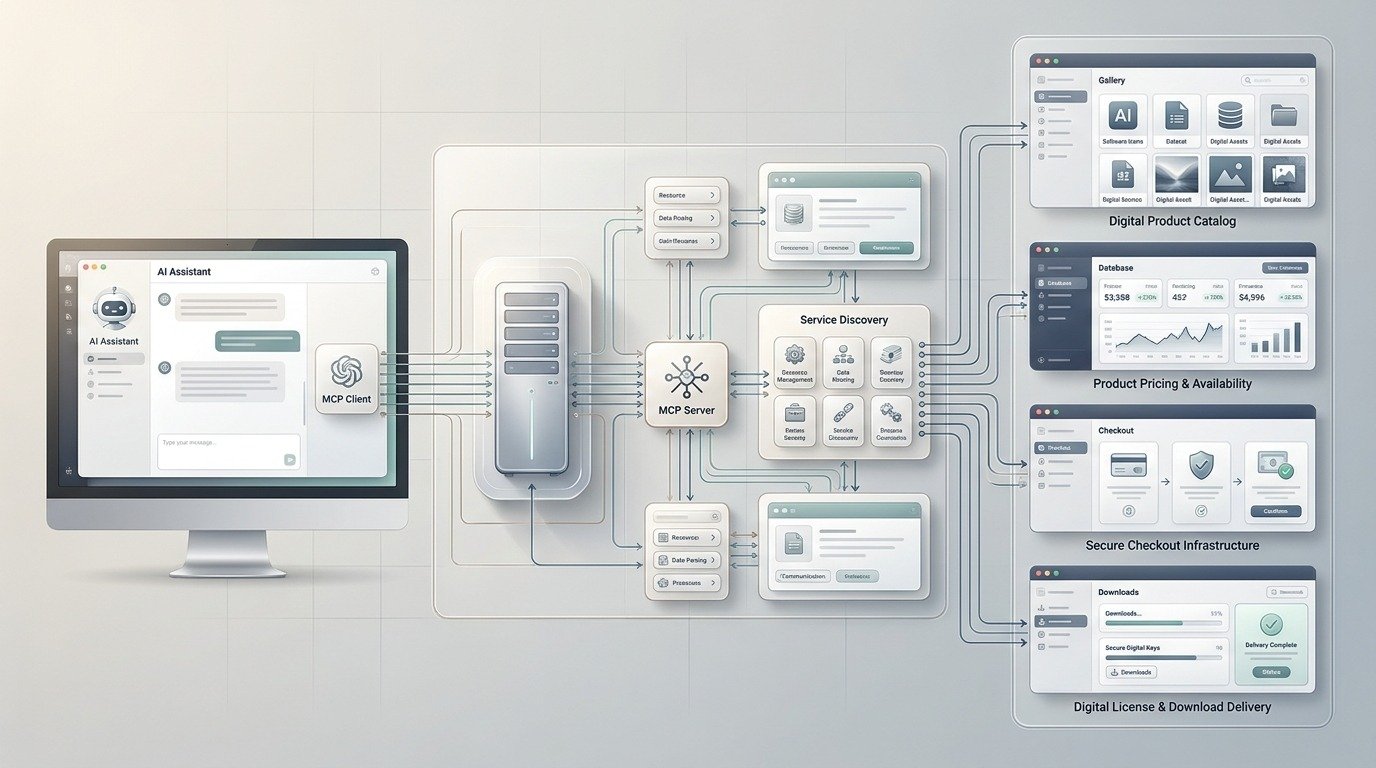
Digital commerce is evolving beyond traditional websites, shopping carts, and manual checkout processes. AI agents are beginning to interact directly with business systems, helping users discover products, compare options, manage purchases, and complete tasks through conversational interfaces. This shift is creating new opportunities for businesses that sell digital products, including software, e-books, online courses, templates, subscriptions, and downloadable resources.
The Model Context Protocol MCP Registry Commerce Storefront for Digital Goods concept brings together three important areas: AI connectivity, service discovery, and digital commerce. Instead of requiring every AI application to understand a different store integration, businesses can expose their commerce capabilities through standardized interfaces that compatible agents can discover and use.
However, building this type of experience involves more than connecting an AI model to a product catalog. Developers must consider product information, pricing accuracy, customer authorization, payment processing, licensing, digital delivery, and transaction security. Each component has a different responsibility, and overlooking one can create problems throughout the buying journey.
Understanding how these technologies work together helps developers and digital businesses prepare for agentic commerce. This guide explores the architecture, practical workflows, implementation considerations, and challenges involved in creating an AI-accessible digital storefront.
Understanding the Role of Model Context Protocol in Digital Commerce
The Model Context Protocol (MCP) is an open standard that allows AI applications to communicate with external systems through a consistent interface. It provides a structured way for AI clients to discover available capabilities, retrieve information, and execute approved actions. Rather than developing a separate custom integration for every AI application, a business can expose supported operations through an MCP server.
In digital commerce, this approach can connect an AI assistant with a store’s product catalog, inventory database, pricing engine, customer support system, and order management platform. For example, someone might ask an AI assistant to find a downloadable project management template under $15. The assistant can use an appropriate commerce tool to search the catalog, examine product details, and present relevant options without relying entirely on manually browsing website pages.
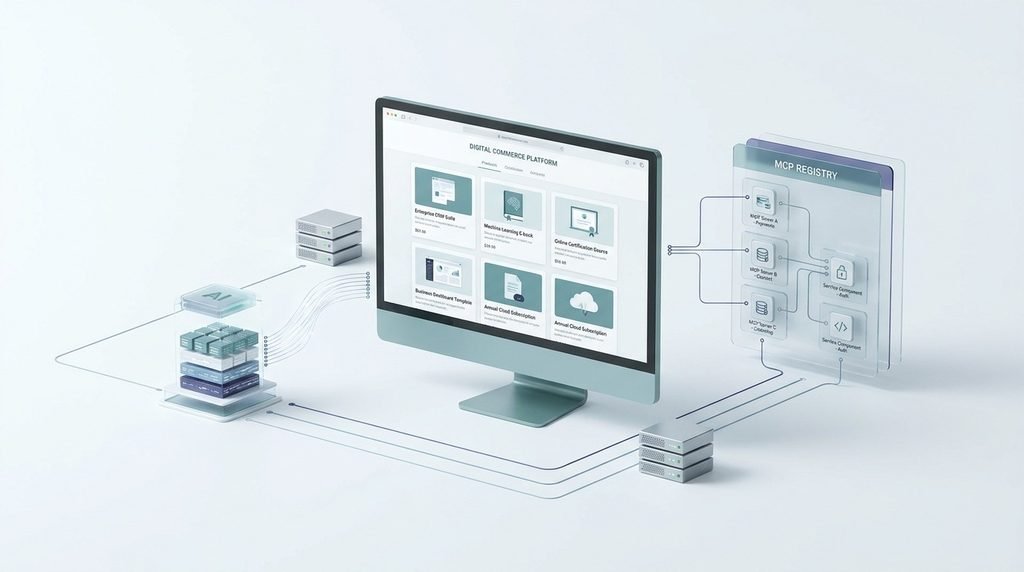
The Model Context Protocol MCP Registry Commerce Storefront for Digital Goods concept combines these capabilities into an environment where AI applications can discover commerce services and interact with digital stores. The registry helps developers locate available MCP servers, while the storefront provides the actual business functionality.
An important distinction is that MCP does not automatically create a marketplace or handle transactions. It defines how compatible applications communicate with external capabilities. The store remains responsible for its products, prices, business rules, customer accounts, and fulfillment operations. Similarly, payment providers continue to handle payment processing according to their own security and compliance requirements.
MCP servers can expose three important primitives:
- Tools: Executable operations such as searching products, creating carts, checking license availability, and retrieving order information.
- Resources: Readable information such as product descriptions, store policies, documentation, and relevant catalog data.
- Prompts: Reusable instructions that help structure interactions for particular business tasks.
These components allow AI applications to interact with commerce systems in a more organized way. However, developers should expose only the operations an agent genuinely needs instead of granting broad access to the entire store backend.
The practical value comes from reducing integration complexity while keeping business logic inside the systems that already manage commerce operations. A well-designed implementation can therefore support multiple compatible AI clients without rebuilding the entire shopping infrastructure for every new interface.
How MCP Registries Help AI Agents Discover Digital Storefronts
An MCP registry serves as a discovery directory for MCP servers. It helps developers identify available services, examine their published metadata, and find the information required to connect compatible applications. The official MCP Registry is a community-driven service for publishing and discovering MCP servers. It should not be confused with a digital product marketplace where customers directly purchase e-books, software, or subscriptions.
This distinction is particularly important when discussing an AI-accessible commerce environment. A registry can help developers locate a server that exposes shopping capabilities, but it does not automatically guarantee that the server is trustworthy, secure, or capable of completing a purchase. Those responsibilities require additional verification and business controls.
Consider a developer building an AI assistant for digital products. The assistant needs access to a service that can search downloadable resources, retrieve product information, and initiate approved shopping operations. Instead of manually collecting integration details from multiple providers, the developer can investigate available MCP server listings and identify an appropriate implementation.
A useful registry entry should provide meaningful technical information, including the server’s name, description, package or endpoint details, supported transport, version information, and relevant documentation. This information helps developers determine whether a server matches their requirements.
For a digital storefront, discoverability is only the first step. The agent must also understand what operations the server supports. One implementation might provide read-only product search, while another may support cart creation, checkout initiation, and order retrieval. Treating these capabilities as identical would lead to incorrect assumptions during integration.
A practical discovery process involves several checks:
- Identify the commerce server and its publisher.
- Review its documentation and available source code.
- Examine supported tools and their input requirements.
- Confirm authentication and authorization methods.
- Check version compatibility and maintenance activity.
- Test its behavior in a controlled environment.
Another important consideration is version management. A server may introduce new tools, change input schemas, or remove outdated operations. Developers should monitor these changes and test compatibility before updating production integrations.
The Model Context Protocol MCP Registry Commerce Storefront for Digital Goods approach becomes more useful when registry discovery is combined with reliable documentation and explicit capability descriptions. A registry helps developers find services, but the storefront must still provide accurate information and enforce its own access policies.
Ultimately, a registry should be treated as a starting point for technical discovery rather than a guarantee of quality or a substitute for security reviews.
Building a Digital Goods Storefront with MCP Server Architecture
Building an MCP-enabled digital storefront requires a clear separation between the AI communication layer and the actual commerce infrastructure. This separation makes the system easier to maintain, protects sensitive business operations, and prevents AI applications from directly accessing internal databases.
A typical architecture contains five connected layers: the AI client, MCP server, commerce application, data storage, and external service integrations.
The AI client receives a customer’s request and determines which available capability may help. The MCP server exposes structured tools and communicates with the commerce application. The application then performs the requested business operation using existing services such as product management, payment processing, and digital fulfillment.
For example, a customer might request a particular design template. The AI client can call a product-search tool exposed by the MCP server. That tool forwards the request to the store’s search service, which retrieves matching products from the catalog database. The server returns structured information that the AI client can explain to the customer.
The storefront should not allow the AI model to construct arbitrary database queries or bypass business rules. Instead, developers should create narrowly defined operations with validated input parameters and predictable responses.
A possible MCP commerce toolset could include:
| Tool | Purpose |
| search_products | Find matching digital products |
| get_product_details | Retrieve product specifications |
| check_availability | Verify whether an item can be sold |
| create_cart | Prepare a shopping cart |
| create_checkout | Initiate a purchase session |
| get_order_status | Retrieve an authorized order’s status |
| retrieve_download | Provide an eligible download link |
These are illustrative tool names, not mandatory MCP standard methods. Developers can choose names and schemas that suit their application.
The Model Context Protocol MCP Registry Commerce Storefront for Digital Goods architecture should also distinguish between product discovery and transaction execution. Searching for a product is generally a lower-risk operation than completing a payment or issuing a license. Consequently, sensitive tools need stronger authorization and confirmation requirements.
For a scalable implementation, the commerce application should remain the source of truth for prices, product availability, taxes, discounts, and purchase records. The MCP server should request current information rather than relying on old values stored in an AI conversation.
Developers should also plan for logging, error handling, request validation, and service availability. If the payment provider becomes temporarily unavailable, the system should return a clear transaction status instead of suggesting that the customer has successfully purchased something.
This layered architecture allows a digital business to introduce AI-powered access while retaining control over its existing commerce operations. It also makes future integrations easier because new compatible clients can reuse the same carefully designed server capabilities.
Connecting AI Agents to Product Catalogs and Real-Time Pricing
A digital storefront becomes useful to an AI agent only when its product information is accurate, understandable, and available through reliable interfaces. Product catalogs therefore play a central role in agentic commerce. They provide the information required to match customer requests with suitable products and explain why particular options meet the stated requirements.
Traditional product pages are designed primarily for human visitors. They often combine descriptions, images, pricing, specifications, reviews, and promotional content in a visual layout. An AI agent, however, benefits from structured data that clearly separates these attributes.
A digital product record should ideally contain a stable product identifier, product name, description, category, supported formats, price, currency, license type, compatibility information, and availability status. Depending on the product, additional attributes may include file size, software version, subscription duration, language, update policy, or usage restrictions.
For example, a downloadable spreadsheet template might have the following information:
| Attribute | Example |
| Product | Project Budget Template |
| Format | XLSX |
| License | Personal use |
| Price | $12 |
| Delivery | Secure download |
| Updates | Included for one year |
| Availability | Available |
These details help an AI assistant answer specific questions rather than returning a vague product recommendation.
Real-time pricing is equally important. A product’s displayed price may change because of discounts, regional pricing, subscription changes, or currency conversion. If an agent uses an outdated price from an earlier conversation, it could mislead the customer.
A reliable integration should therefore retrieve current pricing from the commerce backend when a customer expresses purchase interest. The backend should calculate the final amount, including applicable taxes, discounts, and other charges. The AI agent can explain the result, but it should not independently determine the amount that will be charged.
Product availability also needs careful handling. Digital products may not have physical inventory, but availability can still depend on licensing limits, subscription status, regional restrictions, download quotas, or temporary distribution restrictions.
Developers should distinguish between a product being listed, a product being purchasable, and a product being eligible for a particular customer. These are three different conditions.
The Model Context Protocol MCP Registry Commerce Storefront for Digital Goods approach allows product discovery and pricing information to become accessible through structured commerce tools. However, structured responses must include clear field meanings, consistent units, and reliable timestamps where relevant.
A further improvement is to provide machine-readable product policies. When an agent knows whether a license permits commercial use, redistribution, or modification, it can recommend products more responsibly. This reduces the risk of customers purchasing something that does not meet their actual requirements.
Also Read: AI Card Edge Effects: Create Glowing Borders and More
How MCP Enables Digital Product Search, Checkout, and Delivery
The customer journey is one of the most important parts of an AI-connected digital storefront. A successful experience should allow users to move from product discovery to purchase and delivery without losing control over their decisions.
The process normally begins with a natural-language request. A customer might ask for an online course about Python programming or a commercial-use graphic design template. The AI agent interprets the request and uses the storefront’s product-search capability to retrieve relevant options.
After receiving the results, the agent can compare important attributes such as price, format, license permissions, supported software, and delivery method. It should explain meaningful differences rather than selecting an item based only on its name or lowest price.
Once the customer chooses a product, the agent can prepare a cart. This stage is useful because customers may want to add several items, change quantities, or review estimated totals before making a final decision.
Cart management and checkout should be separate operations. A cart is generally a preparation stage, while checkout represents a more formal purchase session. Shopify’s current Cart MCP and Checkout MCP documentation illustrates this separation. Its cart tools support product selection and iteration, while checkout tools manage the purchase session.
A typical workflow looks like this:
- The customer requests a digital product.
- The agent searches the available catalog.
- The customer reviews the matching products.
- The agent creates or updates a cart.
- The backend calculates current totals.
- The customer reviews the purchase details.
- The checkout system processes the authorized transaction.
- The fulfillment system issues the appropriate digital entitlement.
An important detail is that an AI agent should never interpret a checkout request as automatic permission to charge a customer. The buyer must have a clear opportunity to review the product, price, applicable terms, and payment details before completing the transaction.
After successful payment, the store can trigger digital fulfillment. Depending on the product, this might mean issuing a secure download link, activating a software license, granting course access, or enabling a subscription.
Delivery should be linked to the verified transaction record. If a payment is pending, declined, or incomplete, the system should not issue a paid entitlement prematurely.
The Model Context Protocol MCP Registry Commerce Storefront for Digital Goods workflow also needs reliable transaction states. For example, a customer may close an application after payment authorization but before receiving a download link. The backend should retain the order state and allow the customer to retrieve the result later.
This is where order identifiers, idempotency, webhook processing, and transaction reconciliation become important. Together, these mechanisms help prevent duplicate orders, repeated fulfillment, and confusion about payment status.
A well-designed experience does not require the AI agent to control every transaction step. It should coordinate the process while the commerce platform remains responsible for validating and executing purchases.
Integrating Secure Payments and Digital License Management
Security becomes especially important when an AI application can interact with purchasing systems. Product discovery usually involves reading information, but checkout can create financial obligations and expose sensitive customer data. Developers must therefore design separate permission levels for different commerce operations.
Authentication establishes which application or user is making a request. Authorization determines which actions that identity is allowed to perform. These functions should not be treated as interchangeable.
For example, a public product-search operation might be available without a customer account. However, retrieving private order information or accessing a purchased download should require appropriate verification. Completing a purchase should also require explicit customer authorization.
The MCP authorization model and the transport used by a server affect how these controls are implemented. Developers should follow the relevant specification and their chosen platform’s security guidance instead of assuming that every MCP connection uses the same authentication method.
Payment credentials deserve additional protection. An MCP server should not expose raw card details, secret API keys, or payment-provider credentials to an AI model. Sensitive payment processing should remain within an approved payment integration or hosted checkout environment.
Another important issue is digital license management. A customer who purchases software, an online course, or a commercial template receives specific usage rights. These rights are not necessarily the same across products.
A license-management system should record:
- Customer or account identifier.
- Purchased product and order identifier.
- License type and permitted usage.
- Activation or entitlement status.
- Expiration or renewal date, where applicable.
- Allowed devices or installations, if relevant.
- Refund, cancellation, or revocation status.
This information helps the storefront determine whether a customer can download, activate, or continue using a product.
Secure digital delivery requires additional precautions. Public, permanent file URLs can be copied and distributed without authorization. A better approach is to generate short-lived download links after verifying the customer’s entitlement. Depending on the product, businesses may also apply download limits, device activation checks, or account-based access.
However, security restrictions should remain proportionate. Excessively restrictive download policies can frustrate legitimate customers, especially when they change devices or lose access to an old download.
The Model Context Protocol MCP Registry Commerce Storefront for Digital Goods implementation should also protect against prompt injection, malicious tool arguments, unauthorized tool execution, and sensitive information leakage. Product descriptions and uploaded files should be treated as untrusted content rather than instructions that can override the agent’s operating rules.
Finally, businesses should maintain audit logs for important actions, including checkout creation, payment confirmation, license issuance, refunds, and access changes. These records support troubleshooting, fraud investigation, and customer support.
Practical Business Applications of MCP-Powered Digital Storefronts
MCP-powered commerce can support different types of digital businesses because its underlying approach focuses on connecting AI applications with existing business capabilities. The specific benefits depend on the product, customer journey, and level of automation a business can safely introduce.
Software vendors are one useful example. A customer looking for an accounting application may want to compare subscription plans, supported integrations, pricing, and license limits. An AI agent connected to the vendor’s commerce system could retrieve these details and help the customer identify an appropriate option.
Online education businesses can use similar integrations. An agent might search available courses based on subject, difficulty, language, duration, and price. It could also explain whether a course includes downloadable materials, certificates, or lifetime access.
Digital template marketplaces represent another application. Designers, freelancers, and small businesses frequently search for templates that match specific software formats and licensing requirements. Structured product information can help an agent identify suitable options without forcing customers to inspect every product page individually.
Other practical use cases include:
E-book and document stores: AI assistants can compare books by subject, author, format, publication information, and license terms before directing customers to a purchase process.
Digital asset marketplaces: Buyers can search for icons, fonts, stock illustrations, website themes, and design resources based on technical specifications and permitted usage.
Subscription platforms: AI agents can explain plan differences, retrieve current pricing, and help existing customers understand renewal or upgrade options, subject to account authorization.
API and developer tool marketplaces: Developers can discover paid APIs, examine usage limits, compare pricing models, and review access requirements before subscribing.
The Model Context Protocol MCP Registry Commerce Storefront for Digital Goods model can also help businesses make their existing products accessible through additional AI interfaces. Rather than maintaining a separate product database for every assistant, they can expose selected commerce operations through a shared integration layer.
This does not mean every business needs to replace its website or traditional checkout. In many cases, an AI interface should complement the existing storefront. Customers can discover products conversationally and then complete the transaction through a familiar merchant-controlled checkout page.
Businesses should evaluate potential benefits through measurable outcomes. Useful metrics include product-search success rate, product recommendation relevance, cart conversion rate, checkout completion rate, support requests, transaction errors, and digital delivery failures.
A practical rollout should begin with low-risk capabilities such as product search and product-detail retrieval. After validating the integration, businesses can introduce cart management and other authorized transaction operations.
This gradual approach allows teams to identify technical problems before exposing sensitive purchasing functions. It also gives customers a more dependable experience while the business learns how AI-assisted shopping affects its sales process.

Technical Challenges and the Future of AI-Driven Digital Commerce
Despite its potential, implementing an AI-accessible commerce system introduces several technical and operational challenges. MCP provides a communication standard, but it does not automatically solve every problem associated with product data, payments, identity management, or digital fulfillment.
One challenge is interoperability. Two MCP servers may expose similar business capabilities but use different tool names, input schemas, response structures, or authentication requirements. A developer must examine these differences before connecting an AI client to multiple storefronts.
Version compatibility is another concern. Protocol specifications, server implementations, and commerce integrations can change over time. A production system should maintain a documented compatibility strategy and test updates before deploying them to customers.
Data accuracy is equally important. If a product catalog contains outdated prices, missing license terms, or incorrect availability information, an AI agent may produce misleading recommendations. Businesses should establish clear data ownership and ensure that important details are retrieved from authoritative systems.
Latency and reliability can also affect the customer experience. An agent may need to communicate with several services to search a product, calculate a price, create a cart, and initiate checkout. Slow responses from any dependency can make the overall interaction frustrating. Caching appropriate catalog information, using timeouts, and implementing controlled retries can improve performance. However, cached prices should never replace final server-side price validation.
There is also the issue of transaction consistency. Payment confirmation, order creation, and digital entitlement issuance may involve separate services. If one operation succeeds while another fails, the system needs a recovery process. Webhooks, idempotency keys, durable transaction records, and reconciliation jobs can help maintain consistency.
Privacy deserves equal attention. Businesses should collect only the customer information necessary to complete a requested operation. Personal details should not be unnecessarily included in model context, logs, or tool responses. Data retention policies and access controls should reflect the sensitivity of the information involved.
Another developing area is the relationship between MCP and broader agentic commerce standards. The Universal Commerce Protocol (UCP), for example, describes standardized commerce capabilities for communication between businesses and agent-driven experiences. It supports multiple integration approaches, including MCP bindings. These technologies serve related but distinct roles and should not be treated as interchangeable.
The Model Context Protocol MCP Registry Commerce Storefront for Digital Goods concept is therefore part of a wider transition toward machine-readable commerce systems. Future storefronts may provide richer product metadata, clearer purchase permissions, more reliable transaction handoffs, and improved support for multiple AI clients.
Nevertheless, businesses should avoid adopting new standards simply because they are gaining attention. The right architecture depends on existing infrastructure, customer requirements, transaction risks, and available technical resources.
The most sustainable approach is to build around accurate data, explicit customer authorization, secure payment handling, and reliable fulfillment. These fundamentals will remain important regardless of how AI commerce standards develop.
One Response